Wednesday, July 3, 2013

"Despicable Me 2" - Film Review

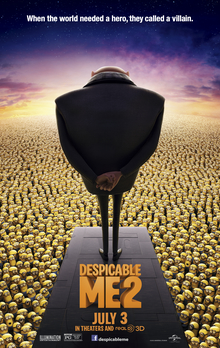
Despicable Me 2 is a film that is very much like its predecessor. This is both its blessing and its curse. This is still a rather fun and entertaining family movie. But it’s also a film that plays so many of the same cards that the first film played. The film has a familiarity that is never entirely played against or that the film tries to elevate itself above.

The studio realized that much of the success of the first film came from the adorable, scene stealing sidekicks to Gru (Steve Carell) called the Minions. The tiny, fuzzy, yellow, intelligible creatures are given even more screen time than the last outing, and it’s a decision that isn’t entirely ill chosen. The Minions remain to be the funniest and most adorable aspects of the film, even if the film does lean a little too heavily on them. Some of this material doesn’t land, but the film also uses them in unexpectedly new ways that honestly the film could have used more of.

After the last film, what story is there left to tell about Gru? There really isn’t much. It’s cute to see Gru fumble in his attempts to raise his adopted daughters. But there’s only so much story to be mined from this, and the writers seem to know this. A plot is added at the center that turns Gru into a spy working for the government, attempting to take down a villain. Then Gru falls for the partner assigned to help him and the romantic subplot is used to show a surprisingly vulnerable side to the character.

Despite that there’s little reason to tell more story here and despite how very jumbled the storytelling is, the film remains to be fun. I laughed a lot (and that’s saying a lot from me – I’m a robot). The film disappointingly lacks the depth of the first film, and this sequel is far less emotional and cleverly told. But as a kid sitting in the row ahead of me shouted as the Minions appeared on screen, “This is the funny part!”  And there enough of those moments, funny, fun and sweet, that it largely doesn’t matter that this isn’t as strong of an outing. This is some fine animation and some solid family friendly entertainment   

Grade: B-

"Before Sunset" - Film Review

Before Sunset is a sequel that could so easily feel unnecessary or cheap. Before Sunrise told such a sweet and perfectly encapsulated story that to move beyond it could come off as trite. Before Sunset works so well, perhaps even better than its predecessor, by deepening the emotions that it explores. The film keeps returning to the events of Before Sunrise, but they’re no longer purely romantic with hindsight. There’s bitterness, sadness and longing underlying the film, and the emotional maturity of the story makes it all the more powerful and satisfying.

Before Sunrise told the story of an American man and a French woman (Ethan Hawke and Julie Delphy) who meet by chance on a European train and decide to spend one day together in Vienna where they walked around the city and talk about love and life. They fall deeply for eachother over the course of the day. Before Sunset is set nine years later where by chance Jesse and Celine meet eachother once more, this time in Paris, where Celine is now living. Jesse has written and published a semi-successful book fictionalizing the events of that one night he had with Celine, and Celine stops in on a book signing. We learn what happened at the planned six month later meet up discussed at the end of Before Sunrise, and more importantly we learn where the two stand about that one day they spent together. 

The two almost immediately fall back into their easy patterns of discussion as if a day hasn’t passed by. The films dialogue (written by Delphy, Hawke and director Richard Linklater) is something special; casual, smart, witty, sad, and quite unlike that of any other film. They walk around Paris, discussing what’s happened to them in the time intervening their meetings. It’s here that the film finds its strongest material. If Before Sunrise was about two young people involved in romantic idealistic yearning, then Before Sunset is about two people who have become more cynical and bitter about romance and love. They’re older and wiser. And yet they can’t shake hold of that one night they shared together, which is the subtext of everything they talk about and feel in this second encounter.   

Before Sunset is a beautiful movie. It’s bittersweet and somber, but much like these two people who seem destined to meet only in brief walkabouts around famous European cities, there’s a spurned romantic at its core. And in between the longing for what once was and what is the film finds some poignant truths and some lovely observations about life and love. 

Grade: A

"Celeste and Jesse Forever" - Film Review

Celeste and Jesse Forever is a romantic film masquerading as something more unusual than your typical rom-com. And to an extent it is a different film, showing a divorced couple who still acts like not much has changed … until they’re forced to confront the nature of their relationship. This is an interesting premise that plays out with some messy results, but it’s not nearly as messy as it could have been. The film relies on lots of clichés. Granted the tropes it utilizes are often handled well, and the film finds a lot of charm in its formulaicness. This primarily comes from its performers who are all very likeable and funny.

The film actually becomes more about Celeste (Rashida Jones) as Jesse (Andy Samberg) starts to get over the break up more readily than her. This is perfectly fine as Rashida Jones is ready to carry the screen time and makes her break down come off as more amusing than sad. The film was co-written by Jones and it’s quite possible the role was written with herself in mind.

The film handles its subject matter a tad too neatly but there’s still lots of funny, sweet, and occasionally even surprisingly deep material here. The slighter elements (including a turn by Emma Roberts as a trashy popstar) are ultimately overcome by some good performances and an amiable, breezy tone. 

Grade: B-

Tuesday, July 2, 2013

Thoughts on Season 1 of "Justified"

 Spoilers Below:

Justified took a drips and drabs approach to its serialization in its first season. In an age where every show, and especially dramas, is expected to have stories carry across episodes, this could feel frustrating. The pilot episode of Justified seemed to suggest a heavily serialized program ready to charge right out of the gate. Instead, the show took its sweet time doling out long-term storylines, parsing them out little by little in each episode. But as the isolated one-off stories and the season long arcs began to dovetail more and more and the standalones became pretty damn fun in their own right, the show proved that it had made the right decision not going gung-ho with its serialization.   

Justified used the early going of the show to establish its world, its tone, and its thematic interests. And the show then brought them together more forcefully in its back half of the season leading to some excellent results. Part of the frustration over the procedural episodes was that the premise of Justified seems ripe for some exploration. U.S. Marshall Raylan Givens (Timothy Olyphant) looks and often acts like he belongs in the Old West. He wears a Stetson and adheres to a doggedly rigid code that doesn’t always strictly align with the letter of the law. The first scene of the series shows Raylan confronting a drug cartel member in a Miami country club. He’s given the guy 48 hours to get out of town, but the man has ignored the advice. Raylan all but murders the man, warning him he’d kill him if he didn’t exit the state. Raylan sums up the incident as, “He drew first. I shot him. End of story”. 

For his questionable behavior, his punishment is to be sent back to his hometown in Harlan county Kentucky. He hasn’t been back home in years and for good reason: there’s bad blood between him and many of the townsfolk. This includes father, Arlo (Raymond J. Barry), a crafty conman that Raylan would prefer to have nothing to do with. There’s also the shady Crowder clan, a prodigious family with their hands in countless criminal enterprises in Lexington. One of the most prominent of the Crowder clan is Boyd (played with awesome relish by Walton Goggins) who, like so many characters, has a complicated past with Raylan. Boyd pretends to be a white supremacist and later a religious zealot in order to win over cult-like followings to perform unquestioned criminal activities for him. 

Raylan also has to deal with the women in his life. He meets Ava Crowder (Joelle Carter) once again after she shoots her abusive husband Bowman Crowder. Despite being a number years his junior, Raylan is infatuated by the down-to-earth Ava, and they start a relationship that could (and does) screw with the case against Boyd and the Crowders. Raylan also has to revisit his relationship with his ex-wife Winona (Natalie Zea), who has since remarried to a much different, meeker man than her former husband. There’s still lingering feelings between them, but there’s also bitterness. 

Justified is its writing and its acting. The show is based on crime author Elmore Leonard's short story “Fire in the Hole”. Leonard has a very unique style of prose that’s both utilitarian and fun, advancing the plot while revealing character details, and doing both with flourish (For those unfamiliar, Quentin Tarantino adapted one of his books into Jackie Brown). His stories also give a significant level of prominence to the criminals being pursued. This means we spend a fair amount of time with those being sought after by Raylan and the Marshall’s office. But the criminals prove to be often as entertaining and laconic as our protagonists. 

The dialogue is one of the treasures of the series. And it’s rather enjoyable to see it recited by the many actors and guest stars featured in the series (The show has done a great job of hiring a number of wonderful character actors in supporting roles).

Justified’s first season wasn’t the show its pilot promised and in some ways that made it not nearly as good as it could have been. But the show continually demonstrated itself to be lots of fun. Its mix of old fashioned justice and present day criminal dealings and police proceedings proved to be an environment with plenty of opportunities. The show seems to be just getting started.
"The Kid With A Bike" - Film Review

The Kid With A Bike is about a kid who wants his dad, and instead ends up with a bike.  

Cyril Catoul (Thomas Doret) is living in a group home. His father Guy (Jeremie Renier) put him in one, claiming it would be for only a month. A month has passed though, and Cyril is now upset. He thinks the home is trying to keep him away from his father. He’s idealized the man, but the man is not how Cyril imagines him to be. He’s a deadbeat who wants nothing to do with his son. 

Cyril spends much of the film searching for fathers or father-figures. The one person who seems to have actual interest in him is kindly hairdresser Samantha (Cecile de France) who takes in the boy on weekends after meeting him by chance. She’s trying her best to get through to Cyril who is quietly stewing, frustrated, unresponsive and confused. But we can tell Cyril’s antics are beginning  to wear on her; she’s becoming exasperated.

Cyril is too young to truly understand the opportunity he’s stumbled upon in this woman. She’s a working woman, struggling to make due, and yet she can't help but help this kid. She doesn’t know the boy but she sees from their first meeting that this is a sweet kid deep down, simply troubled and distrusting.

The boy rides around on a bike constantly throughout the film. It’s the one thing in life he seems to get any enjoyment from. The bike keeps getting stolen and Cyril has to get it back. He tracks down the bike in one instance to a youth gang, where the leader recognizes an easy target and manipulates Cyril. He plays the father-figure that Cyril so desperately desires. He’s giving Cyril all the attention and responses he thinks he wants and deserves, rather than the sterner love Samantha provides him. 

The film takes a starkly realistic approach to its subject matter. There’s little romanticism to be found here. The most sentimental scenes are in quietly stolen moments between Samantha and Cyril. The film even finds some oddly metaphysical material to work with when Cyril coincidentally runs into two people he attacked as part of a crime with the gang leader. But on the whole the film tells its story with confounding simplicity.   

The film discovers quiet tragedy and emotional devastation in its realistically drawn story. Cyril is doggedly resolved upon finding his father, despite his father’s absolute disinterest in having anything to do with him. When he finally discovers him, after he avoids a meeting Samantha set up, Guy quickly dismisses his son before telling Samantha he doesn’t want to see him. Samantha can’t bring herself to tell Cyril and makes the man tell his son the truth. Cyril is quiet on the car ride home, and then he snaps. All Samantha can do is hold him.

When we first meet Cyril, he's running away from the group home. Throughout the film we keep witnessing him running away. He's distancing himself from his problems and avoiding hard truths. As the film starts, he doesn't have the bike, his father has sold it away (They must have stole it from him, Cyril says). Even as Samantha buys it back for him, he can't accept that it was sold away. Even when he does accept things, he learns that life is never that easy or that fair.

Grade: A-

"Belle De Jour" - Film Review

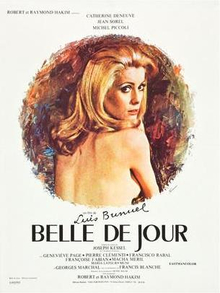
Catherine Deneuve is good at playing impenetrable. It’s difficult to play blankness; it can come off as bad acting rather than ambiguity. It helps that Deneuve is young and incredibly attractive. She’s classically beautiful and the film plays against expectations

Deneuve plays a woman, Severine Serizy, who’s adrift, and sexually frustrated. She’s no longer sleeping with her husband Pierre (Jean Sorel). And she inexplicably decides to become a high class prostitute after learning about a whorehouse. She spends her afternoons when her husband is at work working a brothel.

When we first meet her in the film’s opening scene, we see her in what we learn is a dream, and a very twisted one. It’s more nightmare or dark fantasy than a typical dream. Director Luis Buñuel is setting the tone and the mood with the scene. Bunuel was notorious for his films that attempted to startle and unsettle with their imagery. (Think of Un Chien Andalou). Here we see a quaint carriage ride that quickly turns into a twisted bondage, rape fantasy. 

Severine clearly has a troubled mind. The film keeps cutting away to dreams, daydreams, fantasies, memories. Eventually it’s hard to tell what these visions are. We see her as a child, where she is molested, and participating in the Eucharist. She’s been sexually repressed, but her longing leads her to Madame Ansais’ (Genevieve Page) brothel, given information for the apartment’s location by a family friend Henri Husson (Michel Piccoli - a man who keeps making advances on her that she denies and yet appears in her fantasy, dreams, and memories). 

At the whorehouse she participates in and witnesses a number of disturbing sexual rituals and fantasies played out. There’s a professor with a messed up sense of role playing. She drives out to a man’s home where she’s not asked for sexual favors but to act like the corpse of the man’s dead wife.

And yet despite how strange this all is, she seems to be taking pleasure out of it. This is especially true after she foolishly falls for and leads on a criminal, Marcel (Pierre Clementi), who attends the brothel. The guy is unstable and violent, but she longs for him. 

Eventually this all ends badly. She’s from a comfortable, reasonably well-off middle class lifestyle, and she has little business being here. The other prostitutes are there because they need money and the pay is good. She is there to fill some need within herself that even she can’t quite explain. A client ends up being Henri and he threatens to tell her husband. Marcel becomes obsessive, and she leaves the business to avoid contact with him. But he shows up at her home and then shoots her husband. 

The film ends with Severine's husband, essentially a vegetable now, sprung back to life at the discovery of the information from Henri. The soundtrack plays strange sounds, including the sound of the bells from the carriage. And then we cut to a shot of the carriage from the beginning and it's now empty. Has Severine changed? What does it all mean? Bunuel may not necessarily be concerned with meaning. He wants us to react to his surreal and absurd imagery and contemplate what it all means. But the imagery is as alluring (and disturbing) as the erotica that Deneuve participates in. Bunuel skillfully balances the surreal imagery with a fascinating character study about bourgeois repression.    

Grade: B+           

Monday, July 1, 2013

Thoughts on Season 2 of "Awkward."

 Spoilers Below:

Awkward.’s second season was more insular than its first. Its first season felt like it was constantly branching out, testing out the possibilities within its high school, teen drama setting. The second season always seemed like it had been given a lot less leeway for the options of its storytelling. The second season's major plot device was the love triangle between Jenna, Matty, and Jake. This quickly wore its welcome though, especially as we got glimpses of other stories that weren’t being given as much time because of the emphasis on the love triangle.

The strongest story of the second season was between Jenna and her mom Lacey. When Jenna discovered that her mom wrote the letter from last season and then confronted her about it, the emotional material for their scenes became increasingly potent. When Lacey tells Jenna that she’s a terrible mother who doesn’t deserve to be loved, it’s the most devastating, teary-eyed moment that the season pulls off. 

But the Jenna-Lacey scenes took a back seat to Jenna sorting out her conflicted feeling between Jake and Matty. Initially this was interesting but then the story kept repeating the same beats over and over, and it became less compelling. It refreshed itself to a degree when Jake broke up with Jenna after discovering she had been with Matty (and then a little bit after Jenna’s blog went public – which led to some delightful metaness). But I kept wanting to learn more about Ming (a fun but underused character), who had already been sidelined a little too much last season. This was the case with a number of supporting characters. Lissa was barely given screentime and Sadie’s stories (primarily involving her relationship with Ricky Schwartz) felt reductive.  

This isn’t to overstate my frustrations with Awkward.’s second season. The show remained incredibly charming and refreshingly sincere while playing around within this genre. There was never an episode that made me dread watching more; Awkward. is the kind of show that makes you feel delightful just to inhabit its world a little while. These characters are good (occasionally silly and fast talking) people. They mean well, but most of them are teens in high school figuring out the world and navigating the difficult terrain of high school politics and romance.

I think the show missed some opportunities. The fall out over the discovery of the letter’s authorship was passed over a little too quickly and the anonymous blog commenter felt like more of the same plot devicing as the letter from last season. The choice of who Jenna ended up with also occurred off screen which came off like a cop out after being so heavily a concern for this season. But the paths the series went down were true to creator Lauren Iungerich’s vision, even if they weren’t as neatly plotted out as the first season, and remained interesting and entertaining while never entirely losing sight of the characters, even the supporting ones who could use a greater presence.