Tuesday, March 19, 2013

How I Met Your Mother - "The Fortress" - Review

Structurally “The Fortress” is a well-made episode. It has a clear beginning, middle, and end that all flow logically from one point to the next. The episode even finds ways to be at its core an exploration of the relationships of Barney and Robin, and, to a lesser extent, Marshall and Lily. A foundation which is something a number of episodes in recent seasons have been lacking or acting like they had but totally didn’t (which meant emotional moments that weren’t well-earned).

And yet, there’s something missing. As Community reached a new low in its most recent season, critics scrambled to figure out what had changed to cause such a distinctive diminish in quality. Todd VanDerWerff tried to grasp at what was wrong with the latest season. He argued, “This is Community, yes, but it’s a version missing the most crucial element to keeping an audience that loves a TV show in love with that TV show: its soul.” Similarly, Matt Zoller Seitz noted, “It’s still a good show, but it doesn’t give me that anticipatory buzz that defines a really great series, that joyous anxiety born from being continually, often delightfully surprised”. While Community has made a much more significant leap in decline than HIMYM, whose decline in quality has been a slower trudge, there’s a fundamental similarity in the clear change in quality. 

I could keep running through the gambit of critics who’ve made complaints, but what they’re saying about Community is something that’s true for HIMYM. HIMYM feels like it’s going through the motions. There are all the jokes and all the gags, and yet it all feels incredibly forced. There’s an artificiality to the whole enterprise. To use a turn of phrase from A.O. Scott: “chuckles and heartwarming moments [are] distributed as carefully as nuts in a factory-made brownie.” There are jokes and they seem like the jokes the characters of HIMYM would be making, and they’re in character and they fit the scenarios at hand. There are even some slightly touching moments between characters that grow out of the conflicts of the episode, and sometimes I get “all the feels” about it (though not in this episode to be honest). And yet it doesn’t inspire any great feeling in me other the occasional sentiment of “Oh, I guess that was sort of amusing”. 

Now being funny is subjective. What I find funny and what you find funny are possibly not going to line up. And so it’s tricky for me to throw around the term “funny”, but (and I can only give you my opinion because may be you disagree), but this episode, and this season in particular, just hasn’t been all that funny. For a series that is so very, very obviously stalling and killing time until it reaches the point where we meet the mother, it NEEDS to be at least funny to justify itself. Because none of the situations we’ve been privy to are really all that interesting, and they’ve increasingly had little to say about these character growing up and dealing with the ups and downs of life (two broad themes that would elevate the series if it chose to tackle them). 

Shows tend to go broader with their jokes as they get older, and HIMYM has become a pretty bad offender of this. That bed that shoots into the wall and sweeps away Barney’s hookups (along with his other bag of tricks described throughout the episode) is squarely in a realm of jokes that the series doesn’t necessarily want to lean on. These jokes can work when they come from unreliable narration (i.e. Older Ted’s many euphemisms), but they work much less so when the show seems to accept them at face value. 

There’s chuckle worthy material here and some well-delivered lines. But the show is using the likability of its cast to cover for some very weak material. Neil Patrick Harris is a great performer, but some of these “Barney used to be a man-whore” jokes are getting really repetitive. They also don’t line up with the new direction of his character as he chooses to settle down with Robin. But then again, I’m finding that pairing incredibly problematic. The show in this second half of the season is using our affection for these characters and the desire for this coupling to justify them being together, when it often feels like it’s been achieved too easily. Conflict drives a show, and there’s no conflict between Barney and Robin. This is especially true if the writers are going to give easy resolutions to established problems such as selling the apartment. Barney and Robin have become boring because they’re not challenging eachother. There’s glimpses of the instability here (such as in “Weekend at Barney’s”), but the series tends to sweep aside these apparent problems for something simpler and therefore a whole lot less believable. 

Stray Observations:
-As someone who enjoys Downton Abbey (often despite my better judgment in the second and third season), I found the Woodworthy Manor concept amusing but I wish it had more specificity. Without the bite of full-on satire the joke fell into that that broad joke telling that has become a problem.
-All the art suggestions by the Captain were another example of broad joke-telling, but even I couldn’t help but laugh at, “I’m willing to go as high as 600 cigarette cartons and a jug of toilet wine”.
-“Know what’s not a choice? Being gay for this kitchen” – Colbie Smulders’ line delivery is priceless.
-“… And that the Superman films are uneven”
-“Why do you think light bulbs are boob shaped?”   

Grade: B

"Nashville" - Film Review

If you’re looking for a film with a plot, Nashville isn’t the recommended film to turn to. There are stories here (a ton of stories in fact), but no single story dominates the plot. Typical of director Robert Altman’s trademark style, the film isn’t all that concerned with establishing a plot. It ends just as abruptly and aimlessly as it begins (And wow does that ending come out of nowhere and leave the film on an incredibly odd note). The moment we start to think particular characters are there for us to hang our hats on them; they disappear for long stretches only to reappear much, much later in the film.

Nashville is a satire of country music and Southern culture to an extent, but it’s oddly enough fairly subtle with the satirical elements. There are big concerts and events in the hyped-up, deep fried style of country music and patriotic exuberance of the South. But it’s often just a more straightforward comedy at times, and even a surprisingly serious drama. There is affairs, domestic disputes, political campaigning, exploitation of talent (or rather lack thereof), and coping with illness and death. 

Occasionally the film takes time to let us to just listen to people sing (some of them are very good singers), and many of these songs are similar to many other country songs you’ve probably heard while also being their own original work. But more often the film is jumping from one character to the next, casually observing one little small, well-observed moment after the other. 

Altman always liked to work with large casts, and Nashville is no exception. It has a sprawling cast (there are 24 main characters), and some members are short shrifted in favor of other story lines. But for the most part, everyone gets a fair amount of screentime and each is given some wry or funny moment. Much of the dialogue is improvised and overlapping which creates a wonderfully naturalistic feel.  

It's an incredibly assured film in the hands of Altman and he gets great performances of nearly everyone. Though it's often sprawling and directionless, none of it ever feels pointless or overstuffed. The film frequently feels true to life and the time it was made in, while also being very funny and featuring some great musical numbers.  

Grade: B+

Monday, March 18, 2013

The Walking Dead - "Prey" - Review

Between “Clear” and tonight’s episode “Prey”, it’s become very apparent that The Walking Dead is a show that is much, much better when it focuses on just a few characters and puts everyone else on the backburner for a while.

Why is that exactly? Good series can manage many different characters effectively all at once in a given episode, but The Walking Dead feels much more stop and go when it tries to find excuses to fit in a scene for every one of its characters. Though this episode puts on hold a number of characters that are some of my favorites, and though it focuses on one of the series’ most problematic characters (Andrea), for me this worked.

It worked firstly because every scene for these characters particularly Andrea, Tyrese, and Milton (and I supposed the Governor) were used in order to advance the plot in a certain direction. While some of these scenes could have been better (The other members of Tyrese’s group are severely underdeveloped, but Chad Coleman is so good he sells much of the conflict), at least it was human drama that was stemming from conflicts that had been hinted at to some degree and that were built to a point of tension where, particularly in the case of Andrea, it was guttural, spine tingling, and nerve racking.  

Could these conflicts have been established and built towards better? Absolutely. But the mere fact that there was drama that didn’t come from zombies or didn’t exist just to kill time and that felt like they were in service of the larger plot elevated the episode at times. 

Sure, there was clunky exposition and scenes here because The Walking Dead is still an occasionally clunky show (Seriously, go back to the first eight episodes and you’ll find they’re still very, very clunky despite their improvements). For example, Andrea taking a breather in the forest only to get attacked by walkers was one of those scenes where a character is doing something that by no logic they would ever be doing simply because the writers wanted to force something to happen. Another example was that flashback between Andrea and Michonne, which should have had way, way more umpph since it was supposed to establish the tone, theme, and emotional grounding of the episode (seriously, if you didn’t realize something terrible was about to happen to either Andrea or Michonne by episodes end based on that flashback, you need to take Television 101. Anytime an episode starts dedicating weirdly significant amount of time to a character, especially on a series like The Walking Dead, their days are numbered). 

But in spite of this clunkiness (which is an unfortunate inherent part of the show that you sort of have to accept if you want to get to the good stuff), “Prey” manages to pull off one of the most intense action sequences the series has ever staged. This is, of course, the terrifying scene where the Governor hunts down Andrea. It plays out like an excellent horror film with a brooding, creepy atmosphere, heightened by some of the best music Bear McCreary has ever produced for the series, and filled with tons of twists and turns, and a real sense that, hell, Andrea might just die. I’m not the biggest fan of Andrea, but I’m a human being dammit and no one (shy of the Governor - who is getting into cartoon villainy levels of unbelievableness) really deserves to die, and especially not by the twisted designs of the Governor. 

Anyone who’s read the comics would have recognized those chains the Governor was fiddling with at episode’s start from the prison story arc and been reminded of a particularly gruesome incident involving Michonne. The “torture chair” (as I have it labeled in my notes) is pretty sadistic creation, and it’s not something I entirely expected the series to put in there. The series went “rape-y” but they stopped just shy of actually having anyone get raped (because that would be awful especially in a world where you’re already paranoid and miserable because of zombies).  The show has always gone just shy of the worst possibilities an apocalyptic world might bring. Zombies have caused bad things but it never goes Game of Thrones levels of terribleness (or, for a much more awful example, The Following) to its characters. It shies away from letting the awfulness of this world be felt. I was foolish enough to think Andrea might just get the attention of Rick (who is only in the episode for that brief moment, while no one else from the prison is in this episode).

The vibe that anyone could get harmed or die at any moment is one necessary for a show like The Walking Dead, and, in this episode, I actually was given that overwhelming sense. Not just about Andrea, but Tyrese as well. I even suspected he might wise up to the true nature of Woodbury (but that’s probably too soon for where we’re at in the season). But the seeds of doubt have been placed and since Tyrese is likely to be a character that will go to be part of the series beyond this season, he’s likely to be returning to the prison at some point. Milton has also pushed himself into an uncomfortably precarious position where he’s clearly lost favor with the Governor, which means that his safety is also in question.        

Still the episode had the problem of feeling like patchwork, which is yet again another problem of this show. Some scenes worked better than others, but the elements that worked I found to work really well. And it was in some instances the type of material the series had trouble with, including exposition and interpersonal conflicts. But it was also the elements that have proven to be what the series at least needs to do to stop itself from being stale and that’s pure action, and here we got to have our cake and eat it to. Not only was it a very, very intense action, but action that made sense in terms of the characters and plot. And how did we get here? By being more focused. Hopefully the series will take a lesson because it works much better when it chooses to focus on a handful of characters. 

Stray Observations:
-My notes read: “Underdeveloped Milton is torn as to what to do”- Milton may have been underdeveloped and they should have emphasized how torn he was more, but I ultimately bought his distress and his inevitable choice of actions, even if it could have been handled a lot better.
-The Tyrese-Andrea scene felt stilted but was necesary in order to sow doubt in Tyrese’s  mind.
-Seriously, I forgot that other guy was part of Tyrese’s group.
-Tyrese at the pit was another good scene, especially since Tyrese doesn’t fully comprehend how unstable the ground he’s walking on is.
-Sure, just go on and believe the Governor when he claims the pit walkers are for show. Makes total sense. 

Grade: B+

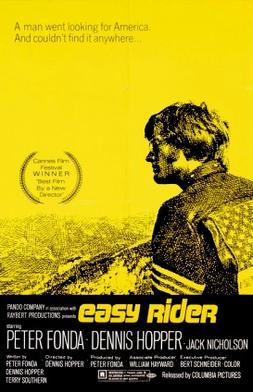
"Easy Rider" - Film Review

It may not seem as revelatory as it was in 1969, but in its heyday Easy Rider was groundbreaking. Its stripped down, DIY filmmaking style was a breath of fresh air in an increasingly stagnant studio based system. Its en plein air approach to tackling a film opened up the floodgates for films to be made outside on location and not just confined to studio sets.

What the film pulls off better than almost any other film is capturing a particular cultural milieu. This has counterculture written all over it and it’s an endearing, humanistic portrait of two members, Wyatt and Billy (Peter Fonda, Dennis Hopper - Hopper also directed, and both wrote the script) of a subculture that was definitely not getting much screen time back in the 1960’s. 

Our protagonists set out on motorcycles after scoring big on a drug deal and take a meandering road trip that leads them from LA to New Orleans. Along the way they stop at farms and communes, and camp out in fields and forests (after hotels refused their patronage, mind you). They pick up hitchhikers with similar hippie, free-spirited lifestyles, including Jack Nicholson as a well-educated, drunken Southerner. They take plenty of drugs (there’s a memorable Avant-garde-like sequence where they take acid and go on a wild drug trip), they sleep with prostitutes, and they ride their hogs. 

The soundtrack is incredibly well-chosen. There’s rarely ever been a song in a film as perfectly used as Steppenwolf’s “Born to Be Wild”. When it plays as the characters ride their bikes across the vast Southwestern landscape, it establishes the tone of the film impeccably.  

It’s a didactic movie that makes an argument in favor of these characters and their life styles. There’s a great scene where they stop in at a cafĂ© to eat, and sitting in a nearby booth are a bunch of racist Southerners who make homophobic remarks about them (due to their long haired appearances). They can see the writing on the wall and leave before any trouble is stirred up (though sadly they come back after them in the middle of the night and it ends badly).  

It’s not a perfect film; it’s incredibly uneven, dated at times, and some parts work better than others (the parts with Jack Nicholson stand out, including the aforementioned diner scene and one where his character gets high for the first time and describes his views on aliens). The film always feels a bit livelier and truer to the spirit of the people it’s following when it moves along at a brisk pace, and when it gets sidetracked, that’s when it tends to drag. The ending is also terribly abrupt and comes out of nowhere. But this scraggly, fitful nature goes well with the sensibility of the film and its characters

Even if Easy Rider hadn’t ushered in a new era of film-making, it would be worth watching. A great soundtrack and an unmistakable counter-cultural vibe make Easy Rider an entertaining if occasionally irregular and artefactual experience. 

Grade: B

Sunday, March 17, 2013

"Heathers" - Film Review

Heathers is the dark cousin of the John Hughes 80’s teen movies. It’s a dark antidote to the sentimentality of The Breakfast Club, Ferris Bueller’s Day Off, and Sixteen Candles. It’s a dark, twisted, cynical satire of high school, cliques, and popularity.  

The moment a guy pulls a gun out in the middle of a cafeteria, shoots people with blanks, and everyone seems to just shrug it off matter of factly is when you should realize Heather doesn’t exactly want you to always take seriously everything that’s taking place.  

Veronica (Winona Ryder) befriends the popular clique of the Heathers (Shannen Doherty, Lisanne Falk, Kim Walker) three attractive mean girls all with the same name who dominate social life. Veronica thought she wanted to gain popularity and power at the school, but she’s two smart and subversive to truly belong to the Heathers. She’s getting fed up with all their bashing and pranking of the geeks and outcasts, which they’re making her an accessory to.

Enter J.D. (Jason Slater) a pretty boy rebel with an odd sense of humor who wants knock the Heathers down a peg as much as she does. 

This is where Heathers increasingly enters into the realm of the absurd and surreal. The satire remains but it becomes broader and darker. When the de facto leader of the Heathers pisses Veronica off, she decides she’ll give her a bad hangover cure that’ll make her throw up. J.D., on the other hand, suggests giving her drainage fluid; she, ouf course, refuses this idea and takes it as a joke. However, when Veronica mistakenly picks up the cup containing the poison, J.D. simply smirks and purposely fails to tell her. Heather drops dead and the two scramble to make her death look like a suicide.   

The fake suicide ends up turning Heather into a fallen martyr; she suddenly has depth no one could have imagined, and she now has a hold over the school that’s even stronger than when she was alive. AKA the exact opposite thing they could have hoped for. Veronica could have swallowed the death if it actually brought greater equality in the school, but everyone acts like vultures, picking off the suicide for their own benefit and gain.  

J.D. has bizarre control over Veronica; she doesn’t want to harm anyone else, but he keeps convincing her to take the lives of other people. But, hey, it’s only popular kids who’d be making life miserable for the majority of people. When Veronica just can’t be part of this anymore with a clean conscience, well, J.D. doesn’t take it too kindly. 

There are films that I claim are fun but that I personally don’t find to be fun; however, these types of films are the ones that I could definitely see other people getting a lot of enjoyment out of and it’s why I frame the reviews in that way. This is not the case with Heathers which is one of those films that I’m not feigning how much I liked it. It’s a film that’s frequently hilarious with its apocalyptic sensibilities and sharp, intelligent satire. It could have stayed the course as a typical teen film about a girl realizing she wants nothing to do with the popular kids anymore and embracing other subcultures and life outside the it crowd, but, by allowing itself to go into murkier, off the beaten path territory, it turns the film into something far more interesting and memorable, even if it’s not always well-executed. There’s a fair amount of caricature here, there’s plenty you have to accept at face value in order to buy into the premise, and that ending feels slightly tacked on, but by refusing to be a traditional teen movie, Heathers become something far more peerless and gratifying than it would have otherwise.    

Grade: B+

Saturday, March 16, 2013

The Vampire Diaries - "Bring It On" - Review

Something The Vampire Diaries has proven itself incredibly adept at is evolution. It’s taken advantages of one of the strongest assets of the television medium, the ability to change characters over time. Go back to the Pilot and you’ll find a much different character in Elena Gilbert.

This is a character that was a shy, nervous teen that was bored and uncertain about her life. Now she’s strong-willed, defiant … and of course most importantly a vampire. While the series has handled the vampire transformation with mixed results (particularly after the sirebond reveal), Elena turning off her humanity plays out wonderfully in “Bring It On”.

The series at its peak was a sight to behold for how purely entertaining it was. Throughout the second season (its best season), there’s practically not an episode that isn’t a rip roaring good time. Part of this came from how anything could happen at any given moment. The wildcard in the form of Katherine shook things up so radically that it caused constant twists and turns, changes in alliances, backstabbings, scheming, and people getting injured and dying left and right. Then the third season came along and the pacing slowed down and things became a bit more predictable and a bit less inspired.  

I bring this up because Elena without her humanity is a great deal of fun. She’s utterly unpredictable and delightfully manipulative and calculating. She throws off pithy one-liners and strings along people, particularly Steffen. Nina Dobrev has proven herself great throughout the run of the series, but she always appears to be enjoying herself so much more when she gets to play Katherine, the more lively of her two reoccurring roles. I got a serious Katherine vibe in humanity-less Elena and that’s all for the better. It sparked new life into a series that’s plot wheels have been getting stuck lately.

The rest of what’s going on in the episode is much less interesting. Damon and Rebekah are a nice pairing and its amusing to watch Damon tell Rebekah’s what’s what, but this storyline ultimately amounts to little. Damon is forced to kill someone he supposedly knows but whom we never met and so the moment has little impact. We also discover someone has been hoarding blood bags from nearby hospitals, and it’s likely Silas feeding after thousands of years of imprisonment.  

Klaus and Hayley on the other hand are a far more interesting pairing, even though they’re much more disconnected from the plot. The writers are doing a great job setting up the spin-off The Originals (which will feature both Joseph Morgan and Phoebe Tonkin). Their dialogue also worked well as both banter and an exploration of who these two characters are. We finally get some background on Hayley who’s apparently an orphan seeking her parents (with the help of Katherine). Klaus is revealed to have an obsession for control, which isn’t revelatory but it’s interesting to hear him admit. Although, the discussion of control leads to a slightly offputting sex scene between the two characters where Klaus dominates the situation (albeit at her request).  

However, I can forgive these subplots or their lapses because that Elena main plot was delightful. “I’m no longer the scared little girl who didn’t want to admit what she wanted to be,” Elena tells Damon.  It’s very, very true, and that means anything could happen. And that’s a good thing.

Stray Observations:
-Elena strips naked in front of everyone. Cuz that’s what people who don’t give a fuck do. Her response to their aghast reactions: “What? It’s nothing you haven’t seen before”
-The important part in all of this that I forgot to mention is that the sirebond no longer works now.
-When Elena attacked Sheriff Forbes I was really upset. Too far!
-“Your world revolves around me” – Seriously though Steffen get a hobby or something.
-Tyler is gone for good, which hopefully means Caroline will stop leaving angsty voicemails. 

Grade: B+

"Network" - Film Review

Network is a broad, unsubtle, and at times wonderfully absurd satire that takes a cynical attack on television.

Howard Beale (Peter Finch) is having an awful time in life. His wife is dead, he has no kids, and he’s about to be fired from his job. Is it all that surprising that he snaps then? A terrible psychosis kicks in and on the nightly news broadcast where he announces his retirement, he also announces he plans to kill himself. The people in the editing room are so used to the typical routine of news broadcasting that they initially don’t even notice that he’s made plans for suicide on the air in two weeks.

The network scrambles to deal with the aftermath and most think Howard is crazy and ought to be fired. But Diane Christensen (Faye Dunaway) sees an opportunity; USB’s ratings went up after Howard’s candid talk to his audience and Diane realizes that they could have a real hit on their hands if they let Howard speak his mind. Diane plays all the angles and convinces network executive Frank Hackett (Robert Duvall) to produce a show hosted by Howard. 

What follows is an incredibly funny, but also slightly terrifying, (and admittedly sort of implausible) look at the power of television and its power to construct the world and our lives. There’s, of course, Howard’s now infamous line: “I’m mad as hell and I’m not going to take this anymore”. Soon after we find his fans all across the country accepting his advice, opening their windows, and yelling at the top of their lungs this refrain. It’s undoubtedly hilarious but it’s also a nice statement on television’s influence. In many ways, Network feels ahead of its time; sure, television was big back in 1976, but now pop culture is even more pervasive. Studios increasingly go out of their way to create the most sensational content to garner audiences in an increasingly fragmented marketplace. 

Bolstered by a great cast, a great script by Paddy Chayefsky, and sure handed direction by Sydney Lumet, Network is prescient, funny, intelligent, dark, and a whole lot of fun.  

Grade: A-