Monday, March 24, 2014

How I Met Your Mother: “End of the Aisle”

Regardless of your feelings towards how How I Met Your Mother has treated the relationship between Ted and Robin over the course of the series run, particularly in more recent seasons and with Ted’s lingering feelings towards Robin, “End of the Aisle”’s treatment of where the writers had taken that relationship felt right. It felt true to the developments and character arcs of both of these characters and it put a necessary and touching button on the relationship. So much of the show’s run had sapped the vitality out of this relationship and Ted’s undying feelings only served to make it all the more unbearable, but this is what we got and it was tremendously satisfying. 

Of course Robin would see through Ted’s gambit, and, in that moment, sticking with this direction for these two characters over the show’s run paid off. The scene between them played off the show's history with the kind of emotional honesty I cherished from this show at its peak. This episode is filled with plenty of call-backs and a few too many feel like call-backs for their own sakes, but that worked here, in this instance, and it worked because it wasn’t mere fan service but where this story needed to go. 

As Older Ted tells us that he’s heard what he has long died to hear, that Robin loves him, and that hearing it for real snaps him to attention, it was the culmination of the story this show has been telling about Ted and Robin. You may not have liked the turns it took, and I certainly got fed up with it, but in this moment I could almost forgive the series for its shortcomings. 

This was far from a perfect episode. The answer of the strangely orchestrated mystery of why Robin asked for Ted to come and see her on her wedding day was built up far too much prior to this episode for the payoff here to really work. And too much time here is spent marking time until the finale when the real answers were looking for, regarding Ted and the mother, are dealt with (including the potential that the mother is dead in the future – which I dislike as an narrative possibility, especially if Robin is the kid’s step-mother, as it feels like slight cheat) and the episode feels a bit flabby, with jokes and moments stretching out longer than they ought to, particularly with Marshall and Lily and the wedding vow gags. 

But as a penultimate episode of a series that has been on for nine years, this worked very well. It released tensions between Ted and Robin, and Robin and Barney that were necessary, and it did it in very acute, relieving and pleasing ways. 

HIMYM may have had it rough for a while, not least of which during this final season, but when it has its sights on its characters and what they need going forward versus what we as an audience supposedly want (which Carter and Bays seem to have lost a grip on at some point, and that was coupled with typical sitcom aging), well, it can still hit a sweet spot.

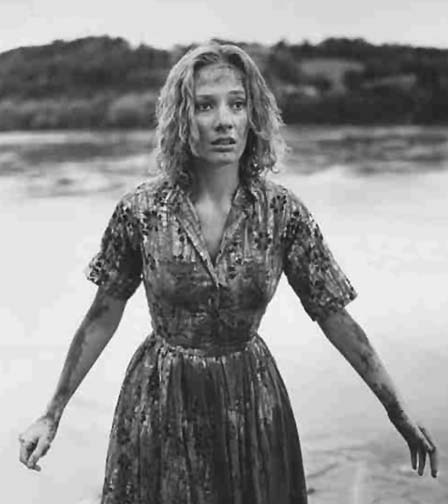
"Carnival of Souls" (1962)

Herk Harvey is a creepy looking dude, and, with the make-up effects used on him in Carnival of Souls, his every appearance as the mysterious figure the Man is deeply unsettling. But sometimes all you need is a few memorable images such as the ghastly looking creep of Carnival of Souls to give you some chilling goose bumps. Harvey also directed the film and he turns the film’s B-movie limitations into its greatest asset. In the Val Lewton mold, the film plays around with suggestion, lighting and use of space to instill fear in us by playing on our expectations and by what we don’t see as much as what we do. A woman (Candance Hilligoss) who survives a drag-racing car crash into a river is haunted by her survivor’s guilt, and as she moves away to take up a job as a church organist she’s drawn to a bizarre run-down carnival. The image of the giant carnival structure looms over the film like a frightening eyesore and it sets the mood for the film. The film plays like a more modestly-budgeted Repulsion, watching the mental state of the protagonist deteriorate, and it also has the vibe of a David Lynch or George Romero film. The woman has a lout of a suitor in the form of her next door neighbor, and she draws concern from her landlady and a psychiatrist. The film’s strangest and most disturbing moments are its quietest; she seems to slip out of reality and finds herself incapable of communicating or being seen by anyone. Does it really happen, or is it just in or head? The film’s great surreal and unnerving ending suggests it may still be something else entirely. But the film doesn’t need to make sense; it’s playing on our fears, and looking surprisingly great and mesmerizing while doing it, and that it does it so effectively with so little is still deeply impressive. 

Grade: A-

Sunday, March 23, 2014

"A Woman, a Gun, and a Noodle Shop" (2010)

East Asian films are far more comfortable with situating broad humor side by side with serious drama. For American viewers there can be a bit of a whiplash with the rapidity and ease with which this is achieved. A Woman, a Gun, and a Noodle Shop is set in a world, filled with characters, elasticity and humor that the Roadrunner and Wile E. Coyote might be comfortable with, but its action is, by contrast, consistently, and perhaps questionably and strangely, dark and bloody. The film is loosely remaking the plot of the Coen Brother’s debut Blood Simple. And while anyone who’s seen the original will recognize the basic shades of the story, Zhang Yimou fills the film with touches that are very un-Coen Brothers-like. A noodle shop owner discovers his wife is having an affair with a low-level employee, so he hires a soldier to kill his adultering, but also sexually abused, wife and her lover. The soldier, however, finds himself incapable of going through with the murders, but he isn’t above killing the owner and trying to break into his safe loaded with money. No one’s actions go as plan and the universe seems to be playing a cosmic joke on all of them for their moral transgressions. Yimou has the characters react with comic disbelief as impossible shit piles onto their troubles, but when the violent scheming occurs he shifts the tone to be appropriately thrilling, tense and serious. The film benefits from Yimou’s attention to action which re-calls his other action-adventure efforts House of Flying Daggers and Hero. The film is sure to give tonal whiplash to even the most unconcerned viewer, but Yimou provides a gorgeous sense of scope and atmosphere and never loses sight of the slippery slope his characters have set themselves upon.

Grade: B

Friday, March 21, 2014

"Nymphomaniac: Volume I" (2014)

Lars von Trier, ever since the day of Dogma 95, has always hated complacency. He finds Hollywood narratives lull us into a false sense of comfort, and his films seek to shake us out of our supposed stupor. His latest film Nymphomaniac: Volume I is yet another provocation right from the tantalizing and twisted hook: a sex addict recounts the stories of her many, many sexual encounters. But von Trier has more in mind beyond shock and awe for anyone who cares to pay attention. The film is doubtless to end up as no one’s cup of tea, and, intentionally, that’s part of the point. Yet von Trier is reaching for his usual obsessions of gender, sexuality and power; he simply buries the lede (purposely, I hasten to add), shoving them to the background of situations either shocking or caustic. There’s a consistent sense like many of von Trier’s other films of shoving our face in things we don’t particularly wish to witness and lingering on them to an excruciating length. 

Nymphomaniac begins with Joe (Stacy Martin as a young woman and Charlotte Gainsborough later in life) being discovered by the kindly Seligman (Stellan Skarsgård) bloody and bruised, lying in a snow covered alleyway. A deeply self-loathing Joe has resigned herself to certain Puritanical notions of her sexual conquests, seeing an unforgivable, even highly sinful, destructive path left in the wake of her bottomless desires. Joe tells of her sexual adventures starting from her earliest discoveries of her own sexuality, while Seligman consistently butts in, trying to bring order and possibly insight to Joe’s clinically portrayed life story. Von Trier tells the story in chapters, breaking down Joe's life into different segments, told in highly different tones and styles. The story isn’t entirely painful or disturbing; von Trier manages some hilarious moments, and not always through sheer discomfort. 

While a lot of sex drives the narrative, it really isn’t the singular concern. Von Trier is interested in how we use sex to define ourselves, to control people, to empower and undermine ourselves, and how sex can be an act of performance. He’s using sex as a complex intersection between gender, class, privilege, power and identity. He also takes seriously Joe’s addiction and how it slowly and insidiously eats away at every aspect of her life. For Joe, sex provides pleasure but it is also an act of sublimation and self-annihilation. Much of Nymphomaniac concerns itself with the ways people fall into holding patterns; it’s at times frustratingly repetitious but that’s because it forces us into the mind of someone who doesn’t know how to, and possibly doesn’t even want to, change. Joe thinks she’s doomed, but von Trier offers up something far less fatalistic (thankfully and surprisingly after the despairing Antichrist and Melancholia)

This is an incomplete work, and not all of this works, but anything this ambitious and audacious is more interesting and, at times, more compelling than anything else currently out there. But even if part two misses the mark, it will likely do so in highly over-reaching and fascinating ways. 

Grade: B+

Thursday, March 20, 2014

"Les Biches" (1969)

“She has a perfect center of gravity,” a comic supporting character says coyly and humorously early in Les Biches. The line represents the film in a nutshell: sexy, dirty and intellectual. The premise of Claude Chabrol’s film sounds tawdry: a story of lesbian lovers torn apart by a man who catches both of their attention. But Chabrol handles the film in far too sophisticated and intelligent ways for it to ever devolve into anything truly lurid. The film is far more concerned with human nature and human behavior and observes it through beautiful pastel cinematography and lilting camerawork. The selfish and self-serious Frédérique (Stéphane Audran) is drawn to a struggling artist drawing does (“les biches” in French) on the streets of Paris. The artist identifies only as “Why” (Jacqueline Sassard), and the sexually inexperienced young girl is seduced by Frédérique. Frédérique brings Why to her summer home in Saint Tropez where at a party they meet Paul (Jean-Louis Trintignant) and both fall in love with him. Chabrol hooks us with the sexiness and the naughty suggestion and this engrosses us and leads us to observe and question the characters’ actions more seriously. The last third of the film loses some of this delicate balance (entering into out-and-out sensationalism), but it also does it with continued ambiguity and casual sensuousness, remaining both enticing and intently meditative.  

Grade: B+

Wednesday, March 19, 2014

"The Lego Movie" (2014)

The directing team of Phil Lord and Chris Miller have a solid track record for taking seemingly disreputable film properties and turning them into finely tuned pieces of entertainment. With Cloud with a Chance of Meatballs and 21 Jump Street, they proved they could make clever, witty, all-around entertaining films that didn’t insult your intelligence or forget to tell a meaningful story with some thematic resonance. On one level these films worked because they were about films. They were carefully keyed into the pop culture-addled age we reside in: eye-catching, mixed and matched, and weird and absurd yet oddly endearing and warm. But though these films were self-referential, that was always a third or fourth goal. With The Lego Movie, however, they turn up the self-reflexivity up to eleven.

But it is not entirely in a meta-way. Self-aware cultural mash up and deconstruction is the part of the goal here, but it’s also simply to be constantly fun. The Lego Movie isn’t just about films; it’s about culture. The Lego Movie’s defining feature is a child-like love for taking the most fun and memorable elements of the pop culture we adore and putting them side by side as if it’s no big deal. 

The world it is set in is one that embraces the Lego’s quality as a toy. The film’s animation looks like nothing else because it not only models itself after stop motion animation (though it's actually CG animation) but also because it’s a film that seems to love the occasional clunkiness or handmade quality due to the animation featuring Legos. This might sound like something found on Youtube, but the film embraces a sense of depth and scope unimaginable on that homemade scale. One of the Lego Movie’s defining traits is its desire to build up a world and keep inhabiting it with destinations and characters who are interesting, bizarre and lovable. 

Emmett (Chris Pratt, channeling some of his Andy Dwyer goofball charm from TV's Parks and Recreation), a not especially special Lego person, finds himself caught in a grand scheme to overthrow the evil President Business’ (Will Ferrell) autocracy and segregation of the massive Lego Universe. A prophecy, created by a wizard (Morgan Freeman, spoofing himself), has foretold of the Special, a person who will find the “piece of a resistance”, a magical piece that will put an end to President Business’ mass consumer conformity. 

The Lego Movie, despite being technically a giant piece of product placement, is a deeply anti-big business film. At its heart, it’s about the fear of films, and culture more generally, becoming too corporate, cold and calculated. The odd irony here being that despite the Lego Movie being a certain corporate product, it has resisted being a part of the crass mass culture it critiques. It genuinely has an abundance of character and personality. 

The film’s strength lies in relying on what has always made the Legos so beloved: the ability to create worlds, to let your imagination run wild and an infinite sense of wonder and possibility.

Grade: A

Saturday, March 15, 2014

"Mon Oncle" (1958)

Jacques Tati loves intricate contraptions that require a lot of set up before having all the gears click and letting his slapstick antics go off like a well-oiled machine. Tati is reaching back to a tradition of comedy more in line with Charlie Chaplin or Buster Keaton than anything recognizably being made when his films were released. More precisely, in Mon Oncle, Tati’s character of Monsieur Hulot feels like he belongs in a silent movie. He barely has any lines and everything he does is conveyed through actions, gestures, and sound effects. While the modern world wants to suck Hulot into its over-refined ways he’s still stuck up in the clouds, always affably bumbling by. Other characters have lines, notably Hulot’s sister and her husband, who are getting fed up with Hulot’s daydreaming and aimlessness, and they feel like they could possibly belong to the real world. Well, more than Hulot at least; Tati at times seems to be working in caricature, but he really has an affection for the human element underneath his calculated comedic machinations. There is a light bit of satire regarding bourgeoisie pretensions, but Tati intends it as all in good fun. Tati’s larger aim is to capture the rhythms of city life, using his Hulot as a gateway into how work, play and everything in between are gone about. Tati delights in a number of precisely arranged comedy setpiece and he keeps the tone breezy and charming, but he’s reaching for deeper emotions of melancholy and disappointment.

Grade: A