Monday, March 3, 2014

"The Ful Monty" (1997)

The Full Monty is a bawdy comedy built on a foundation of melancholy. The film centers on a story of working class men out of work who turn to stripping to make cash off of one big performance. These men are desperate, and trapped in the  formerly prosperous industrial town of Sheffield, now slowly decaying. Flighty yet lovable Gaz (Richard Carlyle) needs money to maintain custody of his son Dylan. To ensure that the crowd comes out to their act, the men decide that they will make their burlesque act the “full monty”, aka a completely nude strip. Simon Beaufoy's script scores some convenient points off of the sexual and farcical nature that this story entails, but it also seriously considers some relevant issues about what it means to be a modern man. These are not conventionally attractive men, and they know it. They worry about their appearances and body image, and they fret over no longer being bread winners. The Full Monty is consistently uproariously funny but inside its traditional narrative structure is an insightful and incisive examination of masculinity. While these men shouldn’t be sexy, especially not performing a Chippendale number, the film provides sharp characterizations that make us sympathetic to their crisis of identity and remind us that beauty is far from skin deep. To be a real man means allowing yourself to be as emotionally naked as a striptease might leave you physically naked.

Grade: B+

"The Burmese Harp" (1956)

Rarely has the use of sound and silence been used as effectively and evocatively as it is in Kon Ichikawa’s The Burmese Harp. Private Mizushima (Shoji Yasui) has learned to play a Burmese harp for his Imperial Japanese Army regiment. His harp and the regiment’s singing are the only things that maintain the troops’ peace of mind. They’ve fled war-torn Japan to Burma when British troops inform them that Japan has surrendered. The scene where the British soldiers approach the regiment is a work of beauty by Ichikawa. The Japanese soldiers do not yet know of the surrender, and they play music to make it appear as though they are unaware of the British soldiers. There is a tension between the sorrowful joy of the music and the stakes of the situation. When the British give them the news, the music slowly transitions to something just as potent and poignant but with a completely different context. Mizshuma’s story leaves him stranded from the regiment. He poses as a Buddhist monk to make it safely back to his company. In his journey across Burma he witnesses the tremendous destruction wrought on the land, told in near silence. Ichikawa’s compositions are elegant and yet haunted, and the sights transform Mizshuma. He becomes a monk and vows to bury the nameless soldiers scattered endlessly across the country. Once such an affable individual, the war has broken what little remains of his constitution, and even his regiment’s sincere, warm outpourings of loyalty and friendship cannot restore him. Though The Burmese Harp is an anti-war film, it more often has the ethereal quality of a ghost story, with the specter of lost souls from the fighting hanging over everything. 

Grade: A-

Sunday, March 2, 2014

"The Roaring Twenties" (1939)

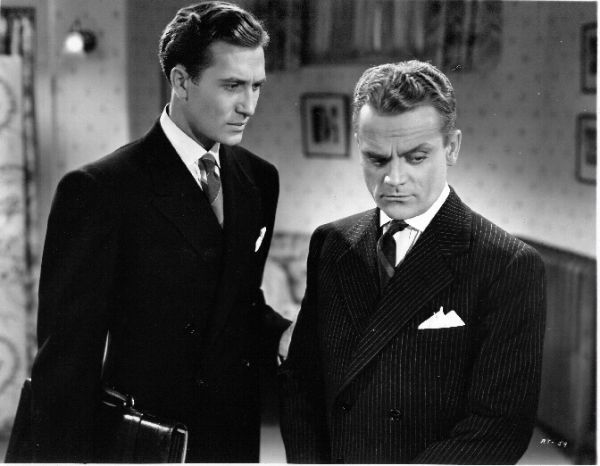
The 1920’s are often remembered for being both glamorous and gritty, overflowing with decadent excess built on questionable and troubling enterprises. The decade is consistently depicted as a time of reckless abandon right before the Great Depression put the carefree lawlessness of the Jazz Age to an end. Whether this is true or not, Prohibition was inextricably linked to this allure, and nowhere was this more noticeably seen than in a number of 1930's James Cagney gangster films. The Roaring Twenties nostalgically looks back on the illicit enterprises that made the twenties so “roaring”. Cagney plays Eddie Bartlett, a WWI veteran who can’t find work when he comes back home, and falls into criminal activity out of necessity. He soon discovers a knack for bootlegging and rises to the top of the gangster underworld, only for the repeal of the 18th Amendment to turn Eddie into a man with a useless skill-set. With a charming, hard-nosed mug, Cagney was able to make his gangster characters highly absorbing and likable but also tragic and repellant. Eddie’s motivations are deeply sad, even when he’s at his grandest. Raoul Walsh’s thoroughly energetic and stylized direction snappily moves the story along and grounds Eddie’s exciting and fateful rise and fall. "He used to be a big shot," goes the film's great closing line, and the nobility implied rings true. Eddie may have been a bruiser, but it's hard to resist that Cagney grin.

Grade: A-

"The River" (1951)

“Films have grown so aggressive and jittery that it takes patience to calm down into one like ‘The River,’” Roger Ebert wrote about Jean Renoir’s great film. Renoir’s characters are not characters, but people, humans, and his story is more observationally than narratively driven. Renoir was praised for his humanism, how he seemed to have such deep affection for his characters. “I didn’t know growing could hurt,” young Harriet informs her mother late in the film, and she does a lot of growing up, and just as much remaining the same. Harriet (Patricia Walters) lives in colonial India, and she has her first crush on a man visiting, Capt. John (Thomas E. Breen), who lost his leg in the war and has grown sullen. She is naïve and young, and her story is told to us in voiceover by a much older Harriet (June Hillman), fondly recalling her memories. The film does not confront the issues of colonialism and racism that pervade the film; Renoir, in stead, lets them subtly play out in the background. The older, but still guileless, Valerie (Adrienne Corri), also likes Capt. John, as does the half-Indian Melanie (Radha), though her relationship remains quiet and unnoticed by most. They each vie for the man’s attention in their own way and this is the main narrative thrust, but otherwise this is a film about time and place. Renoir filmed on location in India, and he captures the beauty of not just the country but the culture as well. This is some of the best color cinematography ever put to film. The River looks beautiful but it is also a deeply felt film. It is beautiful for its simplicity but also for its powerful understanding of human nature. Life goes on, and life repeats itself, and it keeps flowing on and on.  

Grade: A

Saturday, March 1, 2014

My Film Review of "Robocop" (2013)

I wrote a review of the re-make of Robocop for my college's newspaper, The Lafayette. So if you're interested in my somewhat pointed take-down of the film, I would direct you to the online version of the article. I'm really pleased with how this came out, and it's one of my personal favorite reviews I've done so far writing for my school's paper. I also get to make transparent but thoroughly amusing metaphors, so that's always fun.

"Closely Watched Trains" (1968)

Milos Hrma (Vaclac Neckar) is a go-getter. What he’s trying to get, and how good he is at achieving it, well, that’s up for debate. But he will try to get it none the less, and that’s what counts. Closely Watched Trains is Milos’ coming of age story -- and what a delight, for us, it is. He works as a train dispatcher in Nazi occupied Czechoslovakia, and he spends his days desperately trying to impress everyone around him, especially a young, sultry female train conductor (Jitka Bendova). Milos is naive and clueless, but he’s also chipper and enthusiastic. He’s teased, which he doesn’t quite mind, except on the subject of sex, which he’s still a bit inexperienced with. The film suggests realism, observing the everyday lives of Milos and his co-workers, and frankly and wryly depicting and discussing sexual mores. But the film is also buoyed with a fanciful, whimsical sensibility. Often the film plays like a delightful farce, and more than one moment is a piece of pure comic absurdity. Director Jiri Menzel contrasts the seriousness facing the Czechs under the Nazi regime with Milos desperate and irreverent journey to get deflowered. Like the titular trains that should be but aren’t watched, Milos misses the very history that he is part of and even occasionally defining. But like all of us, he's got bigger concerns on his mind.

Grade: A-

"Performance" (1970)

Life is one giant performance. Shakespeare’s old adage about the world being a stage is accurate. We act differently around different people, and we change our mannerisms or appearances to impress or deceive individuals. Performance is about this performance, but it’s also about other performances. It regards a low level gangster, Chas (James Fox), who takes out his sadism as a piece of performance art on the individuals who’ve crossed the criminal outfit he works for. When his boss seeks to rub him out, Chas goes out on the lam and hides out in a bohemian pad, inhabited by Turner (an electrifying performance by Mick Jagger), a musician, a performer you might say, who quickly sees through the fake persona Chas has adopted in hiding. Chas might be gay, and this adds another layer to the film’s thematic interrogation: Isn’t hiding your homosexuality a type of performance, posturing hyper-masculinity to feel safe and hidden. As Turner deconstructs Chas’ many performances, reality begins to breakdown and their identities blend together. The film is like Persona filtered through the late swinging 1960’s milieu. But even this sells it short; Performance is a deeply experimental film, as much about experience as narrative. Frantically paced and edited, it is a film that feels surprisingly modern, a precursor to music videos and jumpy action blockbusters, where its finger prints can be seen all over. 

Grade: B+