The 1920’s are often remembered for being both glamorous and
gritty, overflowing with decadent excess built on questionable and troubling enterprises. The decade is consistently depicted as a time of reckless abandon right
before the Great Depression put the carefree lawlessness of the Jazz Age to an
end. Whether this is true or not, Prohibition was inextricably linked to this
allure, and nowhere was this more noticeably seen than in a number of 1930's James
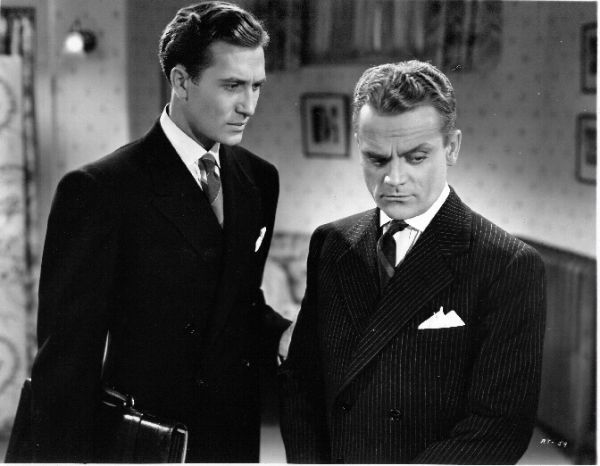
Cagney gangster films. The Roaring Twenties nostalgically looks back on the
illicit enterprises that made the twenties so “roaring”. Cagney plays Eddie
Bartlett, a WWI veteran who can’t find work when he comes back home, and falls
into criminal activity out of necessity. He soon discovers a knack for bootlegging and
rises to the top of the gangster underworld, only for the repeal of the 18th Amendment to turn
Eddie into a man with a useless skill-set. With a charming, hard-nosed mug, Cagney
was able to make his gangster characters highly absorbing and likable but also
tragic and repellant. Eddie’s motivations are deeply sad, even when he’s at his
grandest. Raoul Walsh’s thoroughly energetic and stylized direction snappily
moves the story along and grounds Eddie’s exciting and fateful rise and fall. "He used to be a big shot," goes the film's great closing line, and the nobility implied rings true. Eddie may have been a bruiser, but it's hard to resist that Cagney grin.
Grade: A-
Sunday, March 2, 2014
"The River" (1951)
“Films have grown so aggressive and jittery that it takes
patience to calm down into one like ‘The River,’” Roger Ebert wrote about Jean
Renoir’s great film. Renoir’s characters are not characters, but people,
humans, and his story is more observationally than narratively driven. Renoir
was praised for his humanism, how he seemed to have such deep affection for his
characters. “I didn’t know growing could hurt,” young Harriet informs her
mother late in the film, and she does a lot of growing up, and just as much
remaining the same. Harriet (Patricia Walters) lives in colonial India, and she has her first
crush on a man visiting, Capt. John (Thomas E. Breen), who lost his leg in the war and has grown
sullen. She is naïve and young, and her story is told to us in voiceover by a
much older Harriet (June Hillman), fondly recalling her memories. The film does not confront the issues of colonialism and racism that pervade the film; Renoir, in stead, lets them subtly play out in the background. The older, but still guileless,
Valerie (Adrienne Corri), also likes Capt. John, as does the half-Indian Melanie (Radha), though her
relationship remains quiet and unnoticed by most. They each vie for the man’s
attention in their own way and this is the main narrative thrust, but otherwise
this is a film about time and place. Renoir filmed on location in India, and he
captures the beauty of not just the country but the culture as well. This is
some of the best color cinematography ever put to film. The River looks
beautiful but it is also a deeply felt film. It is beautiful for its simplicity
but also for its powerful understanding of human nature. Life goes on, and life
repeats itself, and it keeps flowing on and on.
Grade: A
Saturday, March 1, 2014
My Film Review of "Robocop" (2013)
I wrote a review of the re-make of Robocop for my college's newspaper, The Lafayette. So if you're interested in my somewhat pointed take-down of the film, I would direct you to the online version of the article. I'm really pleased with how this came out, and it's one of my personal favorite reviews I've done so far writing for my school's paper. I also get to make transparent but thoroughly amusing metaphors, so that's always fun.
"Closely Watched Trains" (1968)
Milos Hrma (Vaclac Neckar) is a go-getter. What he’s trying to get, and how
good he is at achieving it, well, that’s up for debate. But he will try to get
it none the less, and that’s what counts. Closely Watched Trains is Milos’
coming of age story -- and what a delight, for us, it is. He works as a train dispatcher in Nazi occupied
Czechoslovakia, and he spends his days desperately trying to impress everyone
around him, especially a young, sultry female train conductor (Jitka Bendova). Milos is naive
and clueless, but he’s also chipper and enthusiastic. He’s teased, which he
doesn’t quite mind, except on the subject of sex, which he’s still a bit
inexperienced with. The film suggests realism, observing the everyday lives of
Milos and his co-workers, and frankly and wryly depicting and discussing sexual
mores. But the film is also buoyed with a fanciful, whimsical sensibility.
Often the film plays like a delightful farce, and more than one moment is a
piece of pure comic absurdity. Director Jiri Menzel contrasts the seriousness
facing the Czechs under the Nazi regime with Milos desperate and irreverent
journey to get deflowered. Like the titular trains that should be but aren’t
watched, Milos misses the very history that he is part of and even occasionally
defining. But like all of us, he's got bigger concerns on his mind.
Grade: A-
"Performance" (1970)
Life is one giant performance. Shakespeare’s old adage about
the world being a stage is accurate. We act differently around different
people, and we change our mannerisms or appearances to impress or deceive
individuals. Performance is about this performance, but it’s also about other
performances. It regards a low level gangster, Chas (James Fox), who takes out
his sadism as a piece of performance art on the individuals who’ve crossed the
criminal outfit he works for. When his boss seeks to rub him out, Chas goes out
on the lam and hides out in a bohemian pad, inhabited by Turner (an electrifying performance by Mick Jagger),
a musician, a performer you might say, who quickly sees through the fake
persona Chas has adopted in hiding. Chas might be gay, and this adds another
layer to the film’s thematic interrogation: Isn’t hiding your homosexuality a
type of performance, posturing hyper-masculinity to feel safe and hidden. As
Turner deconstructs Chas’ many performances, reality begins to breakdown and
their identities blend together. The film is like Persona filtered through the late
swinging 1960’s milieu. But even this sells it short; Performance is a deeply
experimental film, as much about experience as narrative. Frantically paced and edited, it is a film that feels surprisingly modern, a precursor to music videos and jumpy action blockbusters, where its finger prints can be seen all over.
Grade: B+
Thursday, February 27, 2014
"Rock ‘n’ Roll High School" (1979)
Rock ‘n’ Roll High School is a musical built around The
Ramones, but the musical aspects aren’t really what make the film so
entertaining. If you enjoy the music of The Ramones it will be enjoyable, but,
though the musical moments are well-shot, The Ramones are an uncharismatic
screen presence. Instead, what makes the film work is the simple fact that anyone
can get behind the film for its embracement of the punk ethos The Ramones
represented (and the band could easily be swapped out for any other late 70’s
punk band and this would still work). Like Freaks, the film that inspired one
of The Ramones’ best songs, the film has an abiding affection for weirdos and
misfits, and it gives them, led by the band’s self-proclaimed biggest fan (PJ
Soles), an opportunity to fight for control of their school, through music and
an anarchic spirit, against the dictatorial control of the new principal (Mary
Woronov). For most of its runtime though, the film is simply a very self-aware
teen film. Rock ‘n’ Roll High School functions off of a lovable cartoon logic.
There’s a Looney Toons appeal to the film, which functions less on plot than on
a grab bag of high jinks and tomfoolery. This is a film where one of the best
running gags involves taking a joke about a lab experiment on mice to its
logical conclusion, having the mice become human sized; no one bats an eye at
this. But it makes sense within the rationale of the film’s world: anything
goes, as long as you’re not keeping anyone down.
Grade: B+
Grade: B+
Wednesday, February 26, 2014
"Woyzeck" (1979)
Until the 19th century the treatment of those with
mental illness was horrendous, and even the reforms from that century were
inadequate. At present, we still have a long way to go but there are now
opportunities to help those who need it. But if you lived at any time before
the last century: you were fucked. You’d be looked down upon at best, but you
were even more likely to be taken advantage of or seen as a problem. Werner
Herzog’s Woyzeck is about a German soldier Johann Franz Woyzeck (Klaus Kinski) who
is very clearly a ticking time bomb. He is paranoid and hears voices. This is
exacerbated by everyone around him, who only see how pathetic and nervous he is.
Kinski was an intense method actor and director Werner Herzog brought out some
of his best performances by bringing out the ferocious intensity Kinski could
convey like few others. Kinski allows his face to sink in further and further
as he suffers indignity upon indignity and his madness sets in. At any given
point, Kinski’s posture is rigid but his eyes constantly suggest the depths of
his emotional turmoil. Woyzeck is in a loveless marriage with Marie (Eva Mattes),
who’s bored and looking to have affairs. Woyzeck seeks the help of doctor and the
doctor begins using Woyzeck as a subject of experiment. The doctor makes him eat only
peas for a year, which only serves to worsen Woyzeck’s instability. The doctor
takes the madness as a joke and laughs about Woyzeck as if he were an amusing
oddity. Herzog plays this all out with a sense of forgone conclusion; madness is inevitable once it sets in.
Grade: B+
Subscribe to:
Posts (Atom)


