Tuesday, February 11, 2014

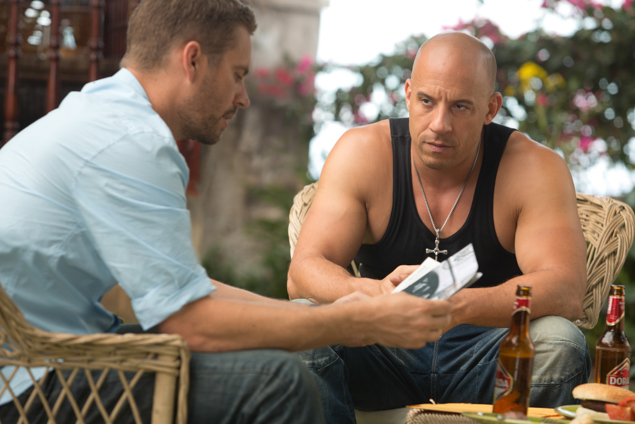
"Fast & Furious 6" (2013)

The Fast and Furious films function heavily on suspension of disbelief, in some ways more than other franchise films. This has become increasingly true as the films have embraced their cartoon-y, dumb-fun nature. Fast Five marked a new era for the franchise, which has extended into Fast & Furious 6, establishing a byzantine mythology and crafting action setpieces that defy logic. The film’s new ace in the hole was behind the camera; director Justin Lin stream-lined the meathead lunacy. Action films have the good fortune of not necessarily needing exceptional content. All they require is good formal considerations for how that content is shot. Lin does just this, pulling off the action sequences with coherence, clarity and proficiency. But Lin’s efficiency extends beyond this as well. The backstory has become exceedingly complicated and the film is juggling a large ensemble, but Lin brings economy and balance to how this is dealt with. He moves past set-up, admittedly wanting, in order to get to good-natured banter and no-nonsense action. Though Fast & Furious 6 at times wears it bloat on its sleeves, even more than the already unwieldy Fast Five, that typically has more to do with the series crushing under the ridiculous, dense, dedicated continuity. But simply praising the series for its action, which is tune-in, drop-out, gloriously unhinged technical spectacle at its most effective, sells its short. Fast & Furious 6 is successful for the diversity of its cast and its interest in giving its female characters, though only supporting roles, more to do than to simply look pretty and be saved. Its characters don’t have exceptionally deep characterizations but they’re well-written enough to remain recognizable and believable no matter how absurd the plot around them becomes. Also, not to overstate things, but it’s a very American film in its values, reaffirming family and marriage, and sacrifice and subsuming yourself to a greater cause. While none of this is especially nuanced, when there’s a car chase involving a tank, does it really matter?

Grade: B

"The Red Shoes" (1948)

Ambition is roughly equal parts possessiveness and obsession; it’s a desire that grows out of trying to grasp something just out of reach. But it’s also formed out of a feeling that whatever we’re trying to claim could end up as not ours, and no one, no matter how modest their ambitions might be, wants that. The Red Shoes is about ambitious individuals driven by their passions and their aching aspirations towards greatness and memorialization. It’s a film about a ballet company, and the compromises and questionable behavior taken in the name of success and artistry. The film uses the Hans Christen Anderson fairy tale of the same name, turned into a ballet performance, and utilizes it as mirror for the story of the theater company. Anderson’s dark fable told the story of a girl who bought a pair of red shoes and couldn’t stop dancing once she had put them on. Like many fairy tales in their original forms, it ends rather dark, with the girl dead. The upstart dancer Vicky Page (Moira Shearer) tells us that she values dancing above life; she wishes to be a famous dancer above all else. The manager of the company Boris Lermontov (Anton Walbrook) takes a shine to her; he is unsettlingly possessive of her, for reasons that are never entirely clear, possibly sexual or paternal. These feelings of possession severely deepen when the dancer falls madly in love with the company’s young composer Julian Craster (Marius Goring), who has written the score for The Red Shoes opera. Jack Cardiff's beautiful cinematography is saturated in bright colors. It envelops us, particularly during the film’s dance sequence, featuring surreal, dream-like imagery. The characters’ passions seem to seep out into reality, turning the even more solidly built traditional storytelling aspects into something that feels sinister. When the events of the play start displaying themselves in reality, we can tell where it’s all heading, but it’s still shocking and electrifying. 

Grade: A

Sunday, February 9, 2014

"My Night at Maud's" (1969)

Conversation, especially really good conversation, has a way of contorting and bending in on itself; it rambles, meanders and digresses. Above all it has the ability to take on a life of its own, to engross us thoroughly in its peculiarities. Writer-director Eric Rohmer’s script for My Night at Maud’s has lovely dialogue. The film is predicated on us listening to the conversation of a handful of characters, and these conversations are witty, sophisticated, involving and often surprisingly true to the rhythms of casual conversation, where the profound and profane sit comfortably side by side. Rohmer is interested in using the conversations and diverging perspectives of the characters to examine morality (this was one of his “Six Moral Tales” series), relationships, romance and love. Devoted, principled Catholic Jean-Louis (Jean-Louise Trintignant) has given up his frivolous bachelor ways for a more pious, simple life. His views are thrown into question when he runs into an old school friend, a professor who questions Jean-Louise’s rigorous religious principles, particularly on marriage. The friend introduces Jean-Louise to areligious divorcee Maud (Francoise Fabian), and Jean-Louise’s convictions in his beliefs in Catholic-based love and romance are put to the test. Maud is intrigued by Jean-Louise, whose opposing views and frankness fascinate her. They’re clearly attracted to one another, and the night unfolds with the unspoken question of an affair as the subtext. However, Jean-Louise’s ideal woman is a young blonde churchgoer he has pined for from afar and intends to befriend. He’s torn between what his principles tell him he needs versus what his base instincts tell him he wants – framed as moral choice for him and an amusing character fault by his compatriots. While Rohmer certainly has some thematic concerns he’s working over, he also simply likes his characters, and subtly examines them in depth through the dialogue. The dialogue is worth appreciating for its own sake though: how often is dialogue this good still written?  

Grade: A

"Nausicaa: Of the Valley of the Wind" (1984)

Post-apocalyptic worlds often work best when they feel fully inhabited, as if, no matter how implausible, this strange world is only a few steps out of sync with the one we’re familiar with. To create that lived-in quality requires careful world building, and that makes director Hayao Miyazaki with Nausicaa: Valley of the Wind a well-suited match for crafting a world that bears almost no resemblance to our own yet eerily feels like the remnants of some formerly great civilization. In all of his films, Miyazaki cares an awful lot about attention to detail, and he often seems more concerned with world building than actually telling a story – it’s as much about texture, tone and atmosphere as plot and narrative. Nausicaa is an anti-war film and a conservationist tale, but it’s foremost about stepping into a fully formed world and being dazzled by the wonders that exist in it. This world feels something like a cross between Game of Thrones and Mad Max, but despite the violence and power politics the film’s world is filtered through far too much of a whimsical, bittersweet perspective to completely bare resemblance to anything else. This is partially due to seeing much of this world through the eyes of the protagonist Nausicaa, a free-spirited princess who is carefully attuned to the beauty of the natural environment. Nausicaa’s world is set in a time after the industrialized world has imploded in on its own destructive tendencies. Much of the environment bares this mark, bereft of vegetation or signs of human life. The few places where forests still exist are inhabited by super-evolved bugs and toxic atmospheres. Nausicaa gets caught in the middle of in-fighting between various feudal-like states vying for global domination. While the film often seems like an epic medieval struggle, it has a lot more of the qualities of a Japanese fable, drawing out deep emotion and themes from a seemingly simple narrative about human nature.  

Grade: A

Friday, February 7, 2014

This Years Oscars and 2013 in Film

The editor of my school's newspaper altered a fair bit of the language of my article on the Oscars and 2013 in film, making some of it a bit questionably hyperbolic ("golden era" is really oversimplified wording that I don't really stand by, and didn't write) and cutting out some of the things I had to say about The Bling Ring and Spring Breakers. But on the whole, this sticks to what I wanted to say; 2013 was a very good year for film, and the Oscars don't acknowledge that fact in all its totality.

Tuesday, February 4, 2014

My Review of "Dallas Buyers Club"

I've been really fortunate in the opportunities I've been given over at my school's newspaper, The Lafayette, where I have a lot of freedom to write about essentially whatever I please on the subject of film, so long as its fit to print. I'm excited about the article coming out this week related to the Oscars and 2013 in film, and I hope if you're interested you'll look out for it, but in the meantime here is my review of Dallas Buyers Club. I had previously discussed it in far less detail on the blog, but this new review goes more extensively in-detail on my thoughts on the film, as well as my broader feelings on films like Buyers Club.

Monday, February 3, 2014

"Byzantium" (2013)

Vampires have to be one of the most miserable fictional creations. The world changes, people die, but they remain the same, infinitely stuck at the point they were sired. Vampires, of the modern Anne Rice conception, don’t experience things so intensely because they have heightened senses, but because after 200 years of loss and regret they have to live life with an intense passion or else they might as well feel numb. Vampires are nothing less than manic depressives with a blood addiction. Byzantium is about how isolating this type of existence must be -- constantly moving, barely making connections, and debasing oneself to survive in a world that would hunt you down if it knew your secrets. Byzantium may be romanticized, but it’s far from romantic; this is brutal, unforgiving world that occasionally is sexy in that way moping loners can sometimes be. Director Neil Jordan (Interview with the Vampire) and cinematographer Sean Bobbit create a film that tonally aches with unbearable, unrequited yearning. It’s the film’s exquisite longing that make it feel worth inhabiting even when its plotting and pacing feel a little out of sorts. The film is mired, particularly in the middle, in a series of clumsily handled flashbacks depicting the terrible life events that have made the film’s two characters, mother and daughter vampire duo Clara and Eleanor (Gemma Arterton, proudly using her looks as a potent asset and weapon, and Saoirse Ronan), such passionate brooders. What sets apart Byzantium from most vampire tales though is its emphasis on the desires and troubles of female vampires first and foremost. The story uses its vampire trappings to hone in on the exploitation and mistreatment of women across the centuries. While that might sound too broad or under thought, and it occasionally is, the film finds way to show the complicity, as well as the empowerment, of its characters in the systems that limit them. But before I get too serious and overwrought: Byzantium is primarily a moody, sensuous vampire story. It's a high melodrama about characters with passions and temperaments that are volatile and intoxicating in equal measure. And that is an under-appreciated pleasure all its own.

Grade: ★★★