Monday, January 27, 2014

"Blue is the Warmest Color" (2013)

Controversy has been both a blessing and a curse for Blue is the Warmest Color, keeping the film in the public spot light but also distracting from the film's real strengths. Did director Abdellatif Kechiche push his two leads too far? Is the film's infamous ten minute sex scene too explicit? These are interesting questions but they're not nearly as important as some have made them out to be. Blue is the Warmest Color is primarily interested in the intense, fiery passions of first love and the bitter embers of love faded away, and Keniche gets Adele Exarchopoulos and Lea Seydoux to commit to the film's riveting sense of intimacy and ecstasy. Furthermore, I wonder if we would even be having these conversations if these two character, Adele and Emma, were a man and a woman rather than two females. Yes, this is a film about lesbian lovers but much of what occurs could happen to any sexual and gender variation, and that's exactly the point. The story is specific to to these two unique, interesting individuals and non-hetero romance, but it's also universally true in the themes it explores and questions it poses. The sex scene has been called pornographic, which is false; it's explicit, but frankly, those who have used "pornographic" as a descriptor have either never seen porn or are uncomfortable with seeing such honest and raw homosexual sexual experiences. Keniche's camera trains itself to never blink at anything it puts its eye towards observing. In its observations, Keniche captures the rhythms of various environments (schools, bars), events (rallies, parties) and relationships. Adele (Earchopoulos) starts out as a senior in high school, and Keniche explores her interests and her boredom, her desire to escape. The beats of school life are accurate, especially the gossip and the awkward romances. Keniche gets right the sliding scale of bi-sexuality. Adele is stuck in expected heternormativity, and is interested in men but finds herself drawn more to woman. She spots Emma (Seydoux) from afar and is immediately drawn to her. She's confused about her real feelings, and she knows her infatuation from afar is somewhat strange. But then her infatuation is reciprocated: Emma is endeared to it. They tentatively get to know one another, and falls into the throes of passion of love at first sight. Their relationship is beautiful because it feels real, and Keniche proceeds past the early bliss of the relationship to discover the fading passions of a relationship that no longer has the immediacy of initial love. When Keniche points out the differences between Adele and Emma that make them incompatible as much as what binds them makes them right for eachother, it's painful but earnest. Ultimately though, this is Adele's story (the original French title was The Life of Adele), and most of the film is close ups of Exarchopoulos' face. Exarchopoulos has an wonderful face. It's normal and plain yet interesting and unique. It's a face that earns the right to be looked at for nearly the majority of the three hour run time, as Exarchopoulos makes us care about everything that takes place, no matter how seemingly trivial. It is Adele's story though in ways beyond the romance. We see her come into her own, and grow into an adult. We witness her start up a career as a teacher and move out on her own. Her time with Emma is simply the first of many lessons about the harsh realities of life and adulthood.

Grade: ★★★★

Saturday, January 25, 2014

"The Purge" (2013)

The Purge has an underlying metaphor so obvious that the film seems to increasingly become self-aware that its whole premise is in service of that metaphor: class warfare. There's an unnecessary literalness to the film that would make it all feel redundant if all that thinly veiled, and not very deep, social commentary weren't in service of a souped-up home invasion horror-thriller. Thankfully the film makes the most out of its premise to create something with a constant sense of anxiety, and it has enough gear shifts in storytelling that it never feels like its spinning its wheels. It's slight but it's also consistently intense and fleet.

Grade: ★★ 

"In the House" (2013)

Though it's infrequently discussed, there's an certain ethical nature to writing. What you can and cannot write about, and, more importantly, how you should or should not write about something. Strictly speaking, nothing is off limits for telling a story, but some stories or how those stories are crafted can be questionable or objectionable. In the House is interested in testing where that line of objectionableness lies. As an English teacher comes across a student with a budding gift for writing, he encourages the student to keep writing while the real life events the students draws his material from make everything more than a little inappropriate. But the teacher sees such promise in the student that he overlooks any potentially sticky ethical concerns. The student has befriended a classmate in order to go over to his nice house repeatedly, and then once in there he snoops on the family secrets and ingratiates himself to the mother who he's attracted to. Meanwhile, the teacher reads the various installments of the story to his wife, uncertain of the means by which they're obtained -- or if some of this is being fabricated -- and gives lessons to the student in how to better write his stories. When the teacher treats the writing as simply just "fiction" in his writing sessions, his methods continually feel purposely designed to side-step the realities of meddling in other people's lives. While the student seems to have fictionalized some elements, the core of the story is based in reality. The teacher tells the student to deepen the characterizations of his characters but that sounds grossly ironic and condescending. The more he pushes the student, the more his personal life is drawn into the story until he realizes that it isn't merely just a story but people's real lives he's messing around with. Early on, In the House treats much of this for thrilling and humorous effect, but as the film progresses it acknowledges the misconduct at hand and doesn't let its characters off the hook for their ethical breaches.  

★★★

"Dallas Buyers Club" (2013)

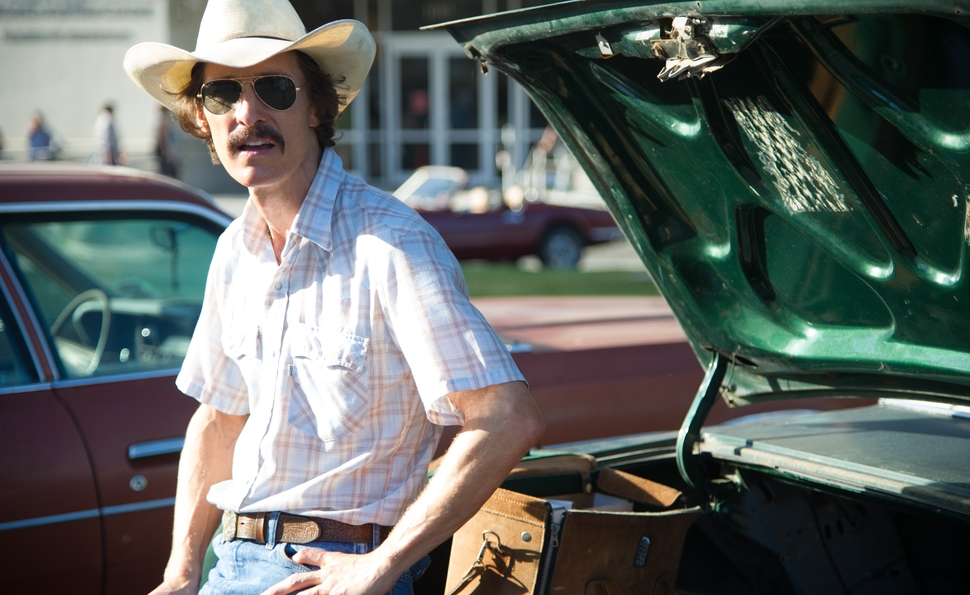
Since the late 80's and early 90's, the cause for people with HIV and AIDs has advanced tremendously. Though a stigma still remains surrounding people who have the disease, most have come to accept those who have it and regret how not so long ago we were ignorant and foolish regarding its existence and those who suffered from it. We're familiar with it, and we're familiar with the stories about it, and familiarity in a story means it makes it difficult to create a story that seems like we haven't heard it before. Based on a true story, Dallas Buyers Club is about homophobic Texan Ron Woodroof (Matthew McConaughey) who eventually changes the tune of his drum as he contracts HIV, and later full-blown AIDS, and sells unapproved drugs to a largely homosexual and transgendered clientele. What begins as a cash grab quickly transforms the man. While its sympathy for both those afflicted with the disease and the gay community is nice to see, Buyers Club feels far too calculated in its eagerness to get an emotional response from us. The film treats its subject as a sentimental, weepy melodrama, glossing over some of the darker elements at work in the narrative. Dallas Buyers Club could take a cue from its lead: McConaunghey's emotional nakedness stands in sharp relief to the material he's working with, elevating an unremarkable film.

Grade: ★★★

Friday, January 24, 2014

"Me and You and Everyone We Know" (2005)

At a glance, Me and You and Everyone We Know sounds like a quirk-fest, a series of scenes of whimsey and eccentricity that exist nowhere in the real world. We see this time and again in independent films that mistake quirks for depth and complexity. But in writer-director Miranda July's film, quirks are more destructive than endearing. Every character is frightened of being themselves. They have opened themselves up to people before and they have been hurt. In fact, they've done this so many times that they're forced to take deeply transgressive actions to feel any sort of connection. July has her characters skirt the lines of sexual deviancy and yet we never feel anything but sympathy for them. July empathizes with her characters, and so do we. The film strikes a daringly fragile tone that could be disastrous in the wrong hands -- warm, inviting, maddening, enchanting. As said, there is quirkiness here, and in characters who would be manic-pixie dream archetypes if they didn't seem so lonely and desperate, and like they were barely keeping it together. July grounds the disparate yet interconnected stories in a strong central theme. The film understands the difficulty of making connections, and coming into our own, in a relationship or as a young person. Being inside the film is like wrapping oneself up in a cozy blanket: the broken world is still out there, but there is still a chance to not feel so lonely and confused. This shouldn't work, but it's delicate and wise, and aware of its cuteness.

Grade: ★★★

"All is Lost" (2013)

Many have described All is Lost as The Old Man and the Sea, and it's a fitting label: a seventy-some year old man (Robert Redford) tries to survive out in the ocean when his boat is damaged. And yet, the film is better described as Man versus Environment, or, better still, Man versus Death. We never learn the man's name and barely hear him speak an utterance and while much of what happens to him is specific to survival in the waters, the physical toll and psychological tear could be transplanted to any a number of circumstances. Like its largely wordless, visually powerful 2013 counterpart Gravity, All is Lost is a film about human endurance and ingenuity under impossible circumstances. The majority of the film is simply watching Redford confront one escalating problem after the next until it seems that the film's title will become true. It's not an easy task to command screen-time so long by oneself, with no dialogue minus an opening voice-over, but Redford brings his legendary film star status forth to draw us in. In Redford's face, his weariness, we read a troubled past: he's lost many things before this moment; he's lived a long life and has seen some trying times. As the man deals with crises, he shows collected determination. He does the tasks he needs to do and doesn't crack under pressure. He's apparently a longtime seaman who knows what's to be done in these circumstances, and he keeps anticipating that things will smooth themselves out before they get any worse. They don't, and yet he keeps persevering, in ways that many people, even ones much younger than him, might not. He keeps preserving to a point where we get a sense that the only thing that has kept him alive this long, in life generally, is dogged persistence. The film is filled with simple, powerful imagery. It takes advantage of the vastness of the ocean, and emphasizes how easily the man could be swallowed up. Watching to find out is exciting and moving in equal measure.

★★★

"The To Do List" (2013)

During the late 80's and early 90's, teen comedies were able to do something few other films were capable of. At their best, under directors like John Hughes and Amy Heckerling, they could tell stories about teens that took their characters' concerns and lives seriously, and on top of this they were often really funny. Mixing raunch with swigs of sweetness, these stories could capture the milieu of high school, commenting on it but rarely judging it. The To Do List unsuccessfully tries to ape the conventions of early 90's teen comedies -- it's even set in 1993 -- but it's nowhere near as insightful and only intermittently humorous -- relying heavily on gross out moments that seem in the film almost entirely to get a reaction out of us. While Aubrey Plaza is a likable lead and a solid center for the story, the film feels slapdashed together, borrowing from so many different genre elements that it barely tells a story of its own. The film is refreshingly free of any sexual double standards, letting Plaza's summer of sexual discovery play out as completely natural and normal. However, the point of all this sexual check-listing is unclear. The To Do List has cartoony impulses that continually clash with its occasional attempts at pathos and realism. John Hughes' movies seem almost quaint these days. They're filled with a sincerity and lack of cynicism, qualities largely absent here. The To Do List feels like a teen movie trying to be an expected teen movie, and being all the qualities that give the genre a bad name.

Grade: ★★