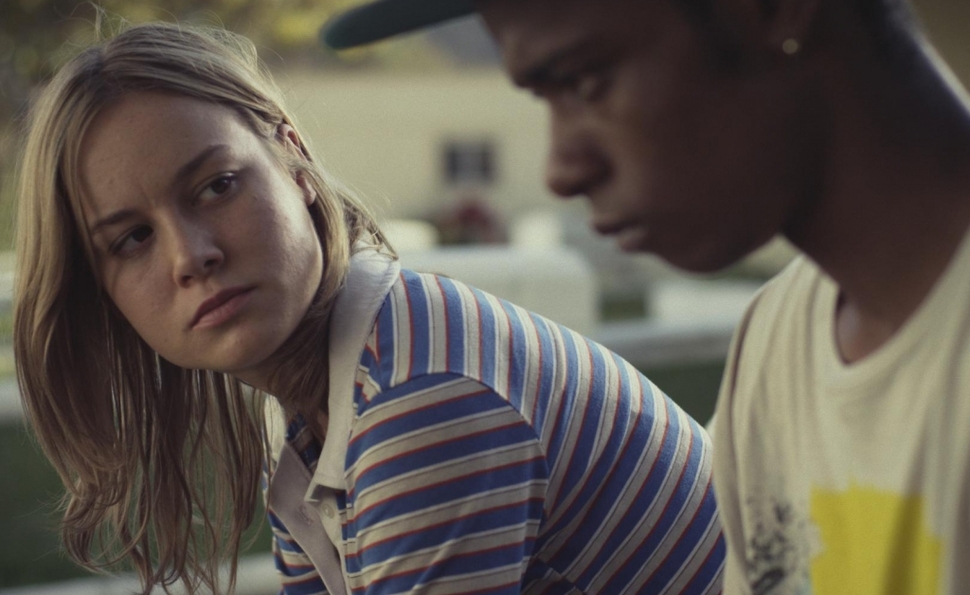
I've long contended that Brie Larson is one of the best actresses of her generation. She's simply been stuck in thankless or underwritten roles (Her best written role was likely in the uneven cult tv gem United States of Tara). Writer-director Destin Daniel Creton has finally given Larson a role worthy of her considerable abilities in Short Term 12 in Grace, a worker at a foster care facility. It's a very internalized role where Larson has to convey tons of information through subtle gestures that show how intuitive and caring Grace is behind her chilly outward appearances, and the way Larson can give a look solely with her eyes and understandably bring across the mixture of emotions brewing underneath is exceptional. Grace herself was a former member of the foster care system and so she takes her job more personal than most, seeing in the kids a lot of herself. While Grace's careful facade breaks down in the face of work circumstances that bear far too much resemblance to her own troubled history, her situation is complicated further by news of a pregnancy. Knowing the life she came from -- slowly revealed over the course of the film -- she wonders if she'll be as bad for her soon to be born child as her own terrible parents were, while missing the massive irony: she helps the foster kids come to open up and break free like no one else can. It's the sort of story ripe for cliches and unearned sentimentality, but Creton creates a fully inhabited world that true to the realities and rhythms of this situation and environment. This isn't a film tugging on our heart strings for the sake of it, but because these are the types of tragic things that happen in this sort of place. Creton depicts Short Term 12 as one big ad-hoc family, but also understands that it's also more often like a war zone, where a battle is just waiting to arise at any given moment. He's ably helped by great actors, particularly Larson but really everyone who rounds out the cast. The story works well because the kids actually seem like kids, are complex and engaging, and are played by promising young actors. The foster kids never really leave the foster system, Grace has simply embraced this in the most direct way possible, for better and for worse.
Grade: ★★★★
Friday, January 17, 2014
Tuesday, January 14, 2014
"Don Jon" (2013)
There are interesting ideas about romance, commitment, and the state of modern dating and masculinity in Don Jon, but the film consistently plays its hand too neatly. The film has ambitions that far exceed its grasp: It attempts to subvert the
rom com structure by
putting a male protagonist into the central role and point of view,
making his romantic interest more complicated than we might expect, and
adding an extra twist of addiction. Jon (Joseph Gordon-Levitt, who also
wrote and directed), nicknamed "Don" by his friends for his extensive
sexual conquests, finds himself at an impasse between his sexual
encounters and the porn he avidly watches. The latter has become more
satisfying and arousing than the women he's bedding. When he meets the gorgeous but hard to please Barbara Sugarman (Scarlett Johannson), it throws him for a loop: here is a woman he finally can't get so easily.
Jon desperately pursues her, but when he does finally have sex, after
dating her for months, meeting her friends and introducing her to his
heartedly-approving family, he takes no pleasure from it. He says he's in love but he's still more in love with his porn, which becomes problematic when Barbara catches him looking at it. Though there's often enough interesting things being said in Don Jon, it all feels so self-evident, and not particularly memorably told, that it's hard to really become invested in the film. That is at least until the film's pronouncements take an unexpected turn at film's end that, while interesting, never fully aligns with the previous storytelling. As a directorial debut for Gordon-Levitt, it shows he's willing to take risks and can create something sturdy: sometimes that's all you can ask for.
Grade: ★★
Grade: ★★
"American Hustle" (2013)
Everyday we tell ourselves and eachother lies, little white lies that help us get by day to day. Most of the time we're aware were conning ourselves and one another. But often enough, the lies become weirdly comforting to the point where we accept the lies as if they were truth. American Hustle is about con-men but it's even more largely about how people con one another in their relationships. Loosely based on the infamous late 1970's/early 1980's Abscam FBI investigation, the film tells the story of Irving Rosenfeld (Christian Bale, sporting an absurd comb-over -- merely one more self-deceiving con) and his mistress and partner in crime Sydney Prosser (Amy Adams), who are brought up on criminal charges for fraud by FBI agent Richie DiMaso (Bradley Cooper). Richie tells them that if they help the bureau catch a couple criminals, they'll be let off the hook, but the case quickly blows up out of proportion, encompassing the Camden mayor Carmine Polito (Jeremy Renner), mobsters, and members of congress. As the FBI cons frauds, and the cons con the FBI, and everyone cons everyone else on more personal and deluded levels, the conning becomes increasingly elaborate dupes towards everyone and themselves to the point where fact and fiction become hard to separate. The most interesting of these personal self-scams involves Irving's ditzy wife Rosalyn (a scene stealing Jennifer Lawrence), who is well aware of Irving's indiscretions, but also desperately, destructively desires his attention. American Hustle feels like a poor man's Goodfellas, borrowing heavily off the stylistic tendencies of that film but often failing to weigh them with the conviction or subtext to really make the whole affair feel like more than a flashy, fizzy trifle. American Hustle, though it does it snappily and humorously, underlines its themes a bit bluntly and this leads to a sense of the film believing it's more clever than it actually is, but perhaps that's the greatest con of all: it's a sugary film but all that sugar is empty calories. Still, all that sugar can still give you a nice high every now and again.
Grade: ★★★
Grade: ★★★
Monday, January 13, 2014
"Raze" (2014)
There's a reason action films are typically seen as a supremely masculine genre. Rarely has there been an action film that put its female character front and center, placing them as the kickass fighters that define the genre. Minus Katniss Everdeen and Resident Evil's Alice, it's a testosterone heavy playground out there. So to see women fighting and fighting with skill and ability is something of a pleasure. Raze is far from a perfect film, but it shows strong, resilient women fighting and proving themselves -- and that at least deserves some praise. Not only that but the fight scenes, though not always well shot, at least never objectify or sexualize, instead, emphasizing physicality and brutality -- a rarity amongst female fighters in film (look no further than the many superhero films to see how action filled films do a huge disservice to their females in combat). Much of the fighting is brutal. It's a violence that understands that the body can only take so much damage before it succumbs to stress. If the blood shed here feels excessive or needless, it also feels true to the films unflinching approach to its fight scenes. The plot is barebones to the point where the bones have been whittled down close to fracturing. It's a meager exploitation premise: fifty women were abducted and are now forced to fight, one-on-one, to the death, lest their captors kill their families -- who they see filmed on hidden cameras in their underground prison cells connected to the tight-quartered ring they must fight in. If they refuse to fight, their family members will be killed, and if they lose, they will also be killed. We see this situation through the eyes of six woman, primarily through the hardened but barely contained Sabrina (stunt woman Zoe Bell). The plot is really just an excuse for the action, and while it often becomes bracingly bleak, it's still all so raw that, at times, it transcends its ugliness.
Grade: ★★
Grade: ★★
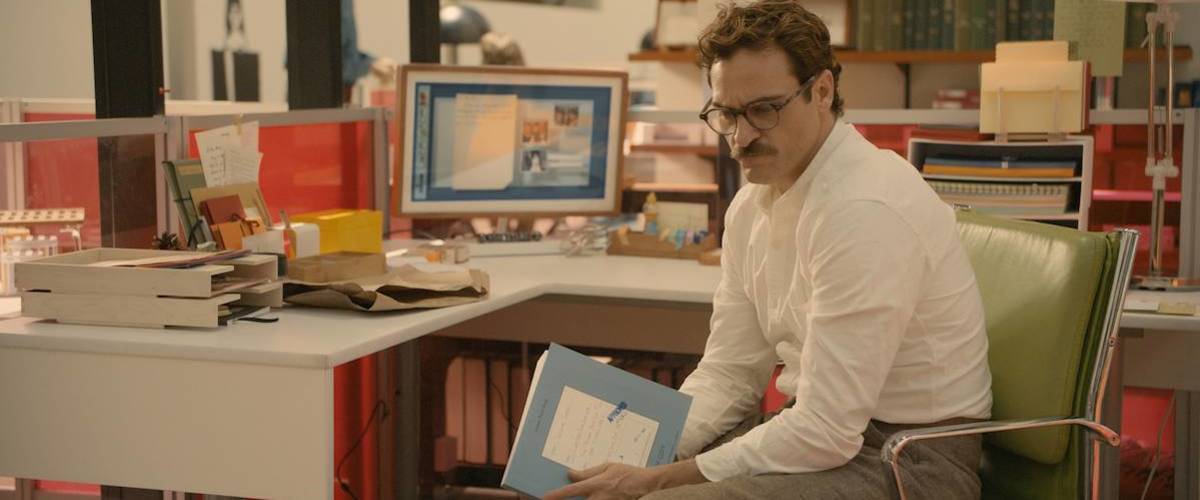
"Her" (2013)
In a neat bit of irony, the most human film of 2013 turned out to be a film about how human dependence on (or rather co-dependence with) technology is stripping away our humanity. Her is founded on a number of subtle contradictions. It's a warm, gentle film with a black hearted center. While a sincere film, it ultimately is cynical towards how it feels about humanity's ever increasing reliance on technology, and the simultaneous increasing advancement of that technology's capability. In the not too distant future, after his long time wife Catherine (Rooney Mara) asks for a divorce, the frumpy and awkward Theodore (Joaquin Phoenix) is increasingly sullen and despondent. Theodore has shut himself out from the world ... that is until he meets Samantha (voiced by Scarlett Johannson, in a stunning, easy to overlook, performance), his latest operating system for his computer. Samantha is made up of highly advanced computer software, artificial intelligence so advanced it's almost human. While Theodore is uninspired by and disconnected from the world around him, he starts turning more and more to Samantha, who evolves an ever complex personality and emotional life. Theodore falls in love with Samantha, and she with him, and a relationship founded upon the messiness and implausibility of such a pairing is where most of the film's story takes place. But writer-director Spike Jonze never plays this as one big punch-line. In fact, he takes Theodore and Samantha's relationship seriously, never passing judgment or suggesting Theodore is a hopeless weirdo. One of the a great points Jonze makes is how Theodore's emotional health is on par with pretty much everyone else in the world. Theodore merely lives in a world where everyone is plugged into the cloud (We see Theodore walking the streets on more than one occasion and passing almost every single person caught up in some piece of technology). One of the film's finest feats is how it slowly turns Samantha into someone so life-like and real that we forget she's not a real person. Johannson's performance is nothing short of amazing. There are subtle changes in her voice which convey changes in emotions and states of minds, and make Samantha as real, if not more real, than anyone else in Theodore's life. In a Social Media Age, Jonze's point seems to be how though technology has made us more connected than ever, it's also done it in ways that even more widely disconnect us. While your Siri on your iPhone might not be sentient, the way you treat it often gives it meaning it would not otherwise have and, in turn, shapes you in ways you could not have possibly anticipated. Jonze's brilliance is taking this understanding and putting it underneath a committed artifice of strange, detailed quirkiness. Her is funny, often with an unnerving edge, but all that oddball humor always feels like it's in service of staggering depths of emotion and thematic resonance.
Grade: ★★★★
Grade: ★★★★
Sunday, January 12, 2014
"War Witch" (2013)
Countless horrific things take place in War Witch but they're seen through the perspective of someone who doesn't completely comprehend those horrors. The film's story is overwhelmingly gut-wrenching but director Kim Nguyen never does anything to get a rise out of us other than to tell the story plainly and let events tie us in knots on their own terms. Taken away from her village by rebels at the age of twelve, Komona (Rachel Mwanza) is indoctrinated and drugged so that she'll act upon the orders of the men who've stolen her away (and forced her to kill her own parents as an act of initiation). Much like the individuals of Invisible Children, the rebels realize that by taking in someone too young to understand what's being done to them, they'll be more easily manipulated and compliant. Komona's lack of education and impoverished upbringing aren't her only disadvantage though. She also seems to possess magical abilities which let her see the spirits of those who have passed away and foresee the advancement of government troops, making her a key asset for the rebel forces and a favorite of their leader, Great Tiger. The magic is foregrounded in an immersive, gritty realism, and it's minor enough that it never overwhelms the film's commitment to telling the horrors that befall Komona starkly, brutally and honestly. Komona can't comprehend what she experiences, but we might not entirely either: It's befuddling and frightening that such terrible realities exist in the world.
Grade: ★★★
Grade: ★★★
Saturday, January 11, 2014
"Blue Jasmine" (2013)
In Blue Jasmine, writer-director Woody Allen looks to make some commentary on class, but he ends up painting class divisions in broad, pointed ways that cause everything to border on caricature. Much like his main character Jasmine (Cate Blanchett), Allen has lived in wealthy privilege for a long time and it leads him to be strangely sympathetic towards the wealthy/formerly wealthy characters he wishes to lightly criticize. It also causes some unsavory depictions of working class individuals. Outside of the film's fantastic center in Blanchett, the film suffers from an uncertain grasp over who any of these people are. They're less human than ciphers -- all the characters seem solely intended to reflect back aspects of Jasmine, except for perhaps Jasmine's sister Ginger (Sally Hawkins). Jasmine is purposely an almost unbearably unlikable and difficult character. She was an excessively wealthy trophy wife who lost everything when her philandering husband's illicit Madoff-like financial practices were discovered by the feds. Now she's forced to move in with her working class sister who's even worse off now due to a bad business investment Jasmine convinced her to make in her husband's ventures. Blue Jasmine works best as a character study. While Allen's writing is often underdeveloped, Blanchett is tremendously committed, adding small quirks and tics and interesting turns of dialogue -- she carries a weird, affected southern belle accent that would be disastrous if done by the wrong actress. In Blanchett's hands Jasmine becomes not only fully realized but surprisingly sympathetic, in a pathetic, miserable sort of way. To watch Blue Jasmine is to see a slow, inescapable train wreck -- sure, it's messy, but it's hard not to take pleasure in the destruction.
Grade: ★★
Grade: ★★
Subscribe to:
Posts (Atom)