In a neat bit of irony, the most human film of 2013 turned out to be a film about how human dependence on (or rather co-dependence with) technology is stripping away our humanity. Her is founded on a number of subtle contradictions. It's a warm, gentle film with a black hearted center. While a sincere film, it ultimately is cynical towards how it feels about humanity's ever increasing reliance on technology, and the simultaneous increasing advancement of that technology's capability. In the not too distant future, after his long time wife Catherine (Rooney Mara) asks for a divorce, the frumpy and awkward Theodore (Joaquin Phoenix) is increasingly sullen and despondent. Theodore has shut himself out from the world ... that is until he meets Samantha (voiced by Scarlett Johannson, in a stunning, easy to overlook, performance), his latest operating system for his computer. Samantha is made up of highly advanced computer software, artificial intelligence so advanced it's almost human. While Theodore is uninspired by and disconnected from the world around him, he starts turning more and more to Samantha, who evolves an ever complex personality and emotional life. Theodore falls in love with Samantha, and she with him, and a relationship founded upon the messiness and implausibility of such a pairing is where most of the film's story takes place. But writer-director Spike Jonze never plays this as one big punch-line. In fact, he takes Theodore and Samantha's relationship seriously, never passing judgment or suggesting Theodore is a hopeless weirdo. One of the a great points Jonze makes is how Theodore's emotional health is on par with pretty much everyone else in the world. Theodore merely lives in a world where everyone is plugged into the cloud (We see Theodore walking the streets on more than one occasion and passing almost every single person caught up in some piece of technology). One of the film's finest feats is how it slowly turns Samantha into someone so life-like and real that we forget she's not a real person. Johannson's performance is nothing short of amazing. There are subtle changes in her voice which convey changes in emotions and states of minds, and make Samantha as real, if not more real, than anyone else in Theodore's life. In a Social Media Age, Jonze's point seems to be how though technology has made us more connected than ever, it's also done it in ways that even more widely disconnect us. While your Siri on your iPhone might not be sentient, the way you treat it often gives it meaning it would not otherwise have and, in turn, shapes you in ways you could not have possibly anticipated. Jonze's brilliance is taking this understanding and putting it underneath a committed artifice of strange, detailed quirkiness. Her is funny, often with an unnerving edge, but all that oddball humor always feels like it's in service of staggering depths of emotion and thematic resonance.
Grade: ★★★★
Monday, January 13, 2014
Sunday, January 12, 2014
"War Witch" (2013)
Countless horrific things take place in War Witch but they're seen through the perspective of someone who doesn't completely comprehend those horrors. The film's story is overwhelmingly gut-wrenching but director Kim Nguyen never does anything to get a rise out of us other than to tell the story plainly and let events tie us in knots on their own terms. Taken away from her village by rebels at the age of twelve, Komona (Rachel Mwanza) is indoctrinated and drugged so that she'll act upon the orders of the men who've stolen her away (and forced her to kill her own parents as an act of initiation). Much like the individuals of Invisible Children, the rebels realize that by taking in someone too young to understand what's being done to them, they'll be more easily manipulated and compliant. Komona's lack of education and impoverished upbringing aren't her only disadvantage though. She also seems to possess magical abilities which let her see the spirits of those who have passed away and foresee the advancement of government troops, making her a key asset for the rebel forces and a favorite of their leader, Great Tiger. The magic is foregrounded in an immersive, gritty realism, and it's minor enough that it never overwhelms the film's commitment to telling the horrors that befall Komona starkly, brutally and honestly. Komona can't comprehend what she experiences, but we might not entirely either: It's befuddling and frightening that such terrible realities exist in the world.
Grade: ★★★
Grade: ★★★
Saturday, January 11, 2014
"Blue Jasmine" (2013)
In Blue Jasmine, writer-director Woody Allen looks to make some commentary on class, but he ends up painting class divisions in broad, pointed ways that cause everything to border on caricature. Much like his main character Jasmine (Cate Blanchett), Allen has lived in wealthy privilege for a long time and it leads him to be strangely sympathetic towards the wealthy/formerly wealthy characters he wishes to lightly criticize. It also causes some unsavory depictions of working class individuals. Outside of the film's fantastic center in Blanchett, the film suffers from an uncertain grasp over who any of these people are. They're less human than ciphers -- all the characters seem solely intended to reflect back aspects of Jasmine, except for perhaps Jasmine's sister Ginger (Sally Hawkins). Jasmine is purposely an almost unbearably unlikable and difficult character. She was an excessively wealthy trophy wife who lost everything when her philandering husband's illicit Madoff-like financial practices were discovered by the feds. Now she's forced to move in with her working class sister who's even worse off now due to a bad business investment Jasmine convinced her to make in her husband's ventures. Blue Jasmine works best as a character study. While Allen's writing is often underdeveloped, Blanchett is tremendously committed, adding small quirks and tics and interesting turns of dialogue -- she carries a weird, affected southern belle accent that would be disastrous if done by the wrong actress. In Blanchett's hands Jasmine becomes not only fully realized but surprisingly sympathetic, in a pathetic, miserable sort of way. To watch Blue Jasmine is to see a slow, inescapable train wreck -- sure, it's messy, but it's hard not to take pleasure in the destruction.
Grade: ★★
Grade: ★★
Friday, January 10, 2014
"The Soft Skin" (1964)
Has there ever been an adulterous affair as sweetly depicted as the one in The Soft Skin? Much credit for this is owed to director Francois Truffaut who tells the affair with a breezy lightheartedness that makes it all feel more straightforward and earnest than just about any affair has ever been portrayed. Truffaut never treats the affair as scandalous or worthy of judgement. In stead, Truffaut seems more concerned with getting inside the headspace of an affair from the giddy highs of getting away with something secret and naughty to the despairing lows of guilt and anxiety over getting caught. Truffaut probably doesn't spends enough time with the apparently crumbling marriage to really justify or get us to understand the motivations at work, but when he's showing two people caught up in the worldwind of desire, passion and reckless abandon he makes us feel as enthusiastic and excited as his characters. The sentimentality and the sweetness would feel out of place if they weren't in service of really digging into an affair and understanding how it can be simultaneously effervescent and volatile, built on the thinnest of foundations and all but ready to implode at any given moment, as it eventually, and inevitably, does in the film's knockout capping scene.
Grade: ★★★
Grade: ★★★
Thursday, January 9, 2014
"Enough Said" (2013)
Enough Said's title is deceptive. More than enough has been said, and yet we could still stand to hear a bit more and not feel as though too much had been said or that it had not been said well. Writer-director Nicole Holofcener's dialogue sparkles and it rings true. It's spoken by actors well-equipped to dish low-key, witty, smart banter. Eva (Julia Louis-Drefyus) is a divorced and currently single forty-something. She's a masseuse growing tired of the strange customers her profession draws, and a mother who feels as though she's slowly losing touch with her college bound daughter. She meets Albert (James Gandolfini) at a party and soon after begins dating him, but unbeknownst to her she has also met Albert's ex-wife Marianne (Katherine Keener), who becomes her latest client. There are screwy comedic machinations at work that cause Eva to build strong relationships with Albert and Marianne before making the connection that they're former spouses. But if you look past these plot contrivances there is a wonderful and honest looks at people of a certain age. Eva and Albert's romance is sweet and earnest, and tempered by an uncertainty towards dating at this point in their life. They bond over their mutual circumstances, divorces and children about to leave home, and Holofcener takes seriously these small, personal conflicts and drama. The world's not at stake but in its intimate, warm, inviting way Enough Said makes us care for and understand these people. We can recognize a bit of ourselves or perhaps people in our own lives.
Grade: ★★★
Tuesday, January 7, 2014
"Barry Lyndon" (1975)
In Barry Lyndon, we meet Barry Lyndon (Ryan O'Neal) as a naive, selfish, petty young man and we leave him as an older but no more wiser or less selfish individual -- though more pitiful and destitute. In between, he duels, cheats (in multiple senses of the term), fights in the Seven Years War (for more than one side), and marries for wealth and power rather than love. We rarely feel anything for him because director Stanley Kubrick refuses to allow a deep sense of emotion to arise. Kubrick is typically detached and cool, examining the insignificant life of Barry as if he were a laboratory frog being dissected. Though Lyndon is an opaque, albeit narcissistic, slate, there's plenty of colorful and extraordinary things happening around him. Kubrick pays a tremendous amount of attention to the period detail of 18th century Europe, and the lavish and extravagant sets and costume are beautiful. Lyndon's vapidness is right at home amongst the upper class luxury he sneakily and opportunistically climbs his way into. Most of these characters are so trapped inside their privilege and their wealth that they can think of little better to do than to cook up the next scheme to liven up the emptiness of their existence. They're monsters aiming to be gods but Kubrick keeps reminding us that they're mere mortals, just really fucking awful ones.
Grade: ★★★★
Grade: ★★★★
"You're Next" (2013)
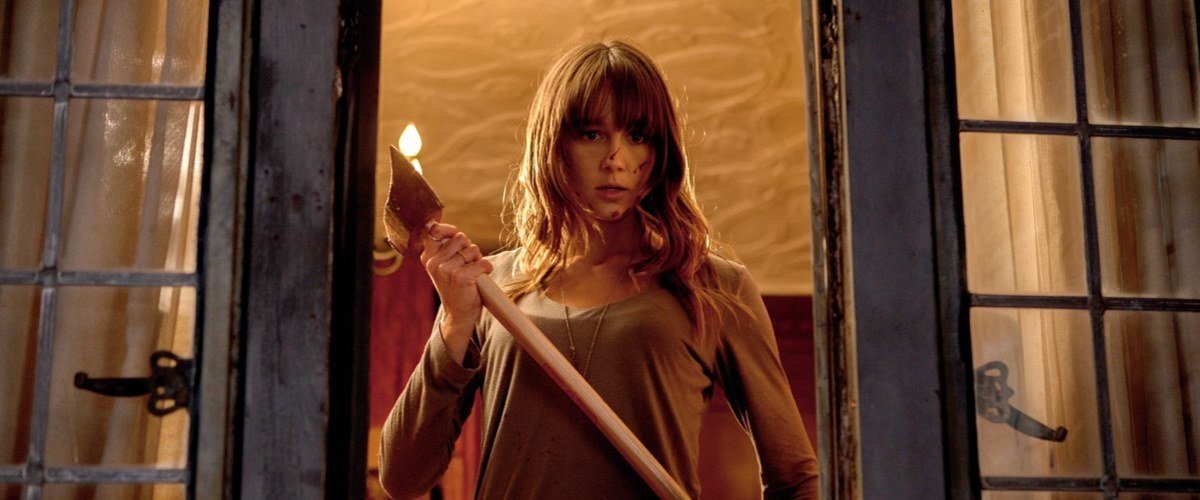
You've heard this one before: a group of attractive people hole up in a remote house when suddenly they're attacked by unrelenting killers. Slowly they're picked off one by one, and we begin to wonder who will be the next victim. It's the plot of countless horror films and the entire basis for the slasher subgenre. By its initial appearances, You're Next is a typical, though intelligently and confidently mounted, slasher film. However, this sells it short. There's more personality, affection and inventive thrills in the film than there is in most of the horror fare currently out there. You're Next also proves itself stickier and more surprising than we might anticipate a slasher to be in an age of "been there, done that, seen it all". The film starts off like a storyteller telling a good old scary campfire yarn and slowly mounts into something more daring and unexpected. The film carefully and brilliantly plays around with expectations and audience identification. You're Next, on one level, is about horror movies and how we watch them, but rather than getting all meta like Scream or Cabin in the Woods, it does it by more subtle and straightforward narrative means. For instance, you might think you have the so-called "Final Girl" pegged down, but the film knows you think you have things pegged down and throws you for a loop. Brimming with wildly imaginative ideas, pitch-black humor, and some excellent scares, You're Next is what every horror movie should be, fun, thrilling, frightening, without being all too showy about its own showmanship.
Grade: ★★★

Grade: ★★★
Subscribe to:
Posts (Atom)