Thursday, January 9, 2014

"Enough Said" (2013)


Enough Said's title is deceptive. More than enough has been said, and yet we could still stand to hear a bit more and not feel as though too much had been said or that it had not been said well. Writer-director Nicole Holofcener's dialogue sparkles and it rings true. It's spoken by actors well-equipped to dish low-key, witty, smart banter. Eva (Julia Louis-Drefyus) is a divorced and currently single forty-something. She's a masseuse growing tired of the strange customers her profession draws, and a mother who feels as though she's slowly losing touch with her college bound daughter. She meets Albert (James Gandolfini) at a party and soon after begins dating him, but unbeknownst to her she has also met Albert's ex-wife Marianne (Katherine Keener), who becomes her latest client. There are screwy comedic machinations at work that cause Eva to build strong relationships with Albert and Marianne before making the connection that they're former spouses. But if you look past these plot contrivances there is a wonderful and honest looks at people of a certain age. Eva and Albert's romance is sweet and earnest, and tempered by an uncertainty towards dating at this point in their life. They bond over their mutual circumstances, divorces and children about to leave home, and Holofcener takes seriously these small, personal conflicts and drama. The world's not at stake but in its intimate, warm, inviting way Enough Said makes us care for and understand these people. We can recognize a bit of ourselves or perhaps people in our own lives.

Grade: ★★★

Tuesday, January 7, 2014

"Barry Lyndon" (1975)

In Barry Lyndon, we meet Barry Lyndon (Ryan O'Neal) as a naive, selfish, petty young man and we leave him as an older but no more wiser or less selfish individual -- though more pitiful and destitute. In between, he duels, cheats (in multiple senses of the term), fights in the Seven Years War (for more than one side), and marries for wealth and power rather than love. We rarely feel anything for him because director Stanley Kubrick refuses to allow a deep sense of emotion to arise. Kubrick is typically detached and cool, examining the insignificant life of Barry as if he were a laboratory frog being dissected. Though Lyndon is an opaque, albeit narcissistic, slate, there's plenty of colorful and extraordinary things happening around him. Kubrick pays a tremendous amount of attention to the period detail of 18th century Europe, and the lavish and extravagant sets and costume are beautiful. Lyndon's vapidness is right at home amongst the upper class luxury he sneakily and opportunistically climbs his way into. Most of these characters are so trapped inside their privilege and their wealth that they can think of little better to do than to cook up the next scheme to liven up the emptiness of their existence. They're monsters aiming to be gods but Kubrick keeps reminding us that they're mere mortals, just really fucking awful ones.

 Grade: ★★★★

"You're Next" (2013)

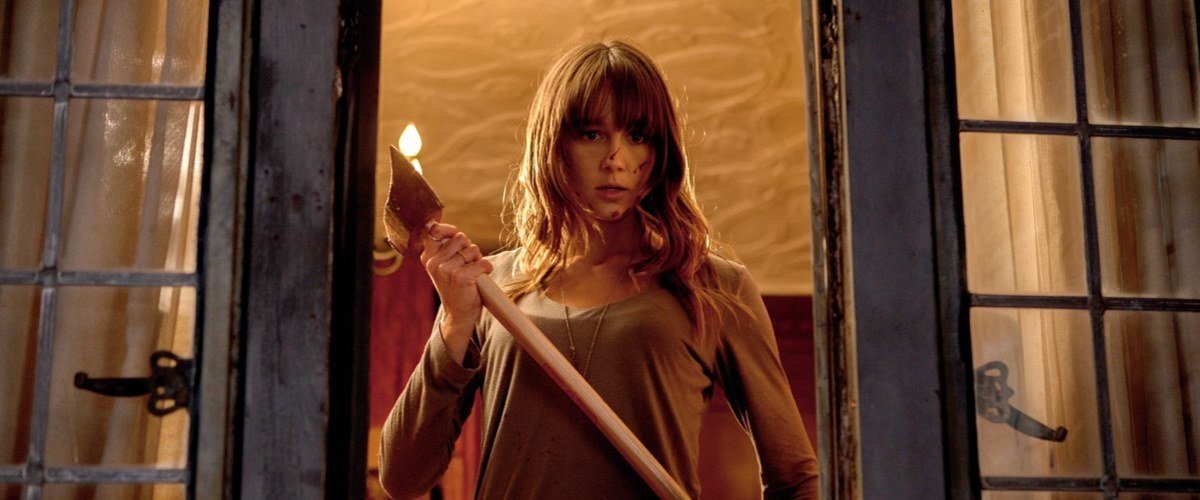
You've heard this one before: a group of attractive people hole up in a remote house when suddenly they're attacked by unrelenting killers. Slowly they're picked off one by one, and we begin to wonder who will be the next victim. It's the plot of countless horror films and the entire basis for the slasher subgenre. By its initial appearances, You're Next is a typical, though intelligently and confidently mounted, slasher film. However, this sells it short. There's more personality, affection and inventive thrills in the film than there is in most of the horror fare currently out there. You're Next also proves itself stickier and more surprising than we might anticipate a slasher to be in an age of "been there, done that, seen it all". The film starts off like a storyteller telling a good old scary campfire yarn and slowly mounts into something more daring and unexpected. The film carefully and brilliantly plays around with expectations and audience identification. You're Next, on one level, is about horror movies and how we watch them, but rather than getting all meta like Scream or Cabin in the Woods, it does it by more subtle and straightforward narrative means. For instance, you might think you have the so-called "Final Girl" pegged down, but the film knows you think you have things pegged down and throws you for a loop. Brimming with wildly imaginative ideas, pitch-black humor, and some excellent scares, You're Next is what every horror movie should be, fun, thrilling, frightening, without being all too showy about its own showmanship.

Grade: ★★★

"Peep Show", Sociopathy, and Social Theatrics

After getting a few episodes into the British television series Peep Show, I came to the conclusion that protagonists Marc and Jeremy were sociopaths, or perhaps as Steven Moffat's Sherlock might say, "high-functioning sociopath". Each character does terrible things in the name of their own satisfaction and they do it completely without remorse. But something slowly becomes apparent about the world of Peep Show: Marc and Jeremy aren't the only sociopaths. No, everyone is a sociopath. It's just most obviously apparent to see this in Marc and Jeremy because the show lets us hear their inner thoughts, and thus all the awful internal logic that gets them to do the things they do.

However, though the plotting of the show purposely causes cringe-inducing, unsettling situations where Marc and Jeremy compromise any sense of self-worth or morality, it would be almost too strong to describe them as sociopaths in the fullest sense of the term. The show more largely seems to get at this point: everyone in their own way is a bit of a sociopath. If you heard the running thoughts inside my head, you might come to see me as an awful, even atrocious, person. I have a filter though and keep out some of the more despicable and questionable ramblings in my head safely tucked away.

Ultimately, Marc and Jeremy are most concerned with self-preservation. This becomes clearest in the season four story arc about Marc marrying Sofie, a woman he's marrying out of a false sense of necessity, desperation and obsession with appearances. He would rather go into a loveless marriage than end up with egg on his face. Yet in his miserable, uncomfortable quest to prevent coming off like an ass and nominally be happy, he ends up doing the exact opposite. He ends up looking like the terrible person he wants the world to believe he's not. If Marc is a sociopath, he is awful at being one.

What Peep Show understands really well is the dramaturgy of social interactions. There's the person we outwardly present ourselves as to the world, and then there's the person we really are deep down but suppress for the sake of appearances. But there's an intersection of these two versions of ourselves. The latter version of ourselves wants highly selfish things but realizes that we likely can't get them by completely revealing our inner self. So we utilize the outward facade of ourselves to get the baser things we desire. Marc and Jeremy constantly botch this by revealing too much of their inner selves or by other people more successfully navigating the intersection. In other words, they're like you and me, just in more self-consciously heightened comical scenarios. 

"The Act of Killing" (2013)

In Indonesia in 1965, a genocide occurred, taking the lives of at least half a million. Globally most people have forgotten that this happened, but not those who orchestrated the deaths of communists and communist sympathizers. The state used paramilitary forces and gangsters to kill citizens, and now many of the people who participated in the genocide are some of the governments top ranking officials. Director Joshua Oppenheimer does a number of remarkable things in the The Act of Killing but the most remarkable thing may be the film's premise itself: getting the former killers to re-stage their murders. Oppenheimer gives them a budget and lets them roam free filming it however they see fit. These men are all too pleased to show the world what they see as a necessary, righteous thing, and they go about re-enacting the killings in the style of various genres of films. The gangsters are fond of Hollywood films, especially gangster films -- who they self-stylize after -- and they stage their memories as if they were scenes in some popular film. It leads to some simultaneously surreal and disturbing moments. Oppenheimer tries to understand how anyone could commit such terrible acts. Though the gangsters claim to be unrepentant, re-enacting the murders proves how they have more complicated and buried feelings about the genocide than they may have cared to initially admit. The best moments of the film find the gangsters playing the parts of their victims and coming to identify with their victims' experiences and how awful that must have been. The look in their eyes in these moments is stunning: mortified, frightened, deeply regretful, confused, sickened. Why does genocide keep happening? Sometimes those who willingly participate in them can't explain it either -- and that may be the scariest truth of all.

Grade: ★★★★

"The Unspeakable Act" (2013)

The titular act of The Unspeakable Act actually gets spoken about quite a lot throughout the film so lets take a similar tact: it's incest. But the film is never being judgmental of the deeply personal, co-dependent relationship of the sister and brother Jackie and Matthew Kimball (Tallie Medel and Sky Hirschkron) of the film. Their family has come to accept the strange, slightly questionable bond that exists, and similarly the film accepts it as a matter of fact. In stead, the film chooses to delve into Jackie's perspective to try and understand her feelings. In time, we come to accept it as matter of factually as the film wants us to. Jackie and Matthews relationships stems from social awkwardness and complicated family history, slowly doled out over the course of the film. Though they never consummated the relationship, Matthew, probably correctly, believes that if he doesn't form relationships beyond Jackie he, as well as his sister, will be stunted and nonfunctional later in life. Thus he gets a girlfriend, which causes Jackie to explore why she's so drawn to her brother. We come to like Jackie in time; she has a weird, wryly funny, singular personality and a outspoken and unique point of view -- suggestive of a writer in the making. She's perceptive on many things -- just on one thing she can't quite fully speak of.

Grade: ★★★

Sunday, January 5, 2014

"Safety Last!" (1923)

One of silent cinema's most iconic images is Harold Lloyd precariously hanging from the minute hand of a building clock in Safety Last!. The moment comes at the end of a lengthy, exciting sequence involving Lloyd climbing up the side of a twelve-story building. Since this was made in an era before almost any kind of special effects, it all actually happens. Lloyd is actually climbing the building and doing exceptional, highly dangerous physical comedy and slapstick. It's simultaneously one of cinema's most thrilling and funniest scenes, but it comes as the cherry on top in a film that continually shows off Lloyd's genuine comedic talent. Lloyd plays his Glasses character as a constantly beleaguered indvidual who has no idea how he's managed to stay afloat one incident to the next. We're not quite sure how he does it but neither does Lloyd. Lloyd moves constantly from a squirming, baffled facial expression to a can-do attitude covering for a lack of confidence or any clear idea what he's doing, including climbing up a building for a PR stunt.

Grade: ★★★★