Tuesday, January 7, 2014

"Peep Show", Sociopathy, and Social Theatrics

After getting a few episodes into the British television series Peep Show, I came to the conclusion that protagonists Marc and Jeremy were sociopaths, or perhaps as Steven Moffat's Sherlock might say, "high-functioning sociopath". Each character does terrible things in the name of their own satisfaction and they do it completely without remorse. But something slowly becomes apparent about the world of Peep Show: Marc and Jeremy aren't the only sociopaths. No, everyone is a sociopath. It's just most obviously apparent to see this in Marc and Jeremy because the show lets us hear their inner thoughts, and thus all the awful internal logic that gets them to do the things they do.

However, though the plotting of the show purposely causes cringe-inducing, unsettling situations where Marc and Jeremy compromise any sense of self-worth or morality, it would be almost too strong to describe them as sociopaths in the fullest sense of the term. The show more largely seems to get at this point: everyone in their own way is a bit of a sociopath. If you heard the running thoughts inside my head, you might come to see me as an awful, even atrocious, person. I have a filter though and keep out some of the more despicable and questionable ramblings in my head safely tucked away.

Ultimately, Marc and Jeremy are most concerned with self-preservation. This becomes clearest in the season four story arc about Marc marrying Sofie, a woman he's marrying out of a false sense of necessity, desperation and obsession with appearances. He would rather go into a loveless marriage than end up with egg on his face. Yet in his miserable, uncomfortable quest to prevent coming off like an ass and nominally be happy, he ends up doing the exact opposite. He ends up looking like the terrible person he wants the world to believe he's not. If Marc is a sociopath, he is awful at being one.

What Peep Show understands really well is the dramaturgy of social interactions. There's the person we outwardly present ourselves as to the world, and then there's the person we really are deep down but suppress for the sake of appearances. But there's an intersection of these two versions of ourselves. The latter version of ourselves wants highly selfish things but realizes that we likely can't get them by completely revealing our inner self. So we utilize the outward facade of ourselves to get the baser things we desire. Marc and Jeremy constantly botch this by revealing too much of their inner selves or by other people more successfully navigating the intersection. In other words, they're like you and me, just in more self-consciously heightened comical scenarios. 

"The Act of Killing" (2013)

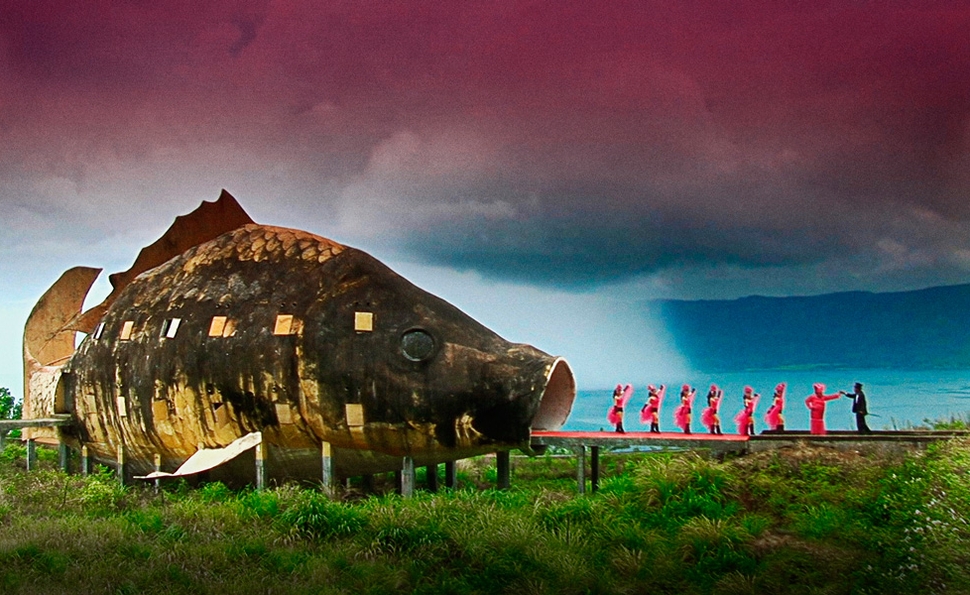
In Indonesia in 1965, a genocide occurred, taking the lives of at least half a million. Globally most people have forgotten that this happened, but not those who orchestrated the deaths of communists and communist sympathizers. The state used paramilitary forces and gangsters to kill citizens, and now many of the people who participated in the genocide are some of the governments top ranking officials. Director Joshua Oppenheimer does a number of remarkable things in the The Act of Killing but the most remarkable thing may be the film's premise itself: getting the former killers to re-stage their murders. Oppenheimer gives them a budget and lets them roam free filming it however they see fit. These men are all too pleased to show the world what they see as a necessary, righteous thing, and they go about re-enacting the killings in the style of various genres of films. The gangsters are fond of Hollywood films, especially gangster films -- who they self-stylize after -- and they stage their memories as if they were scenes in some popular film. It leads to some simultaneously surreal and disturbing moments. Oppenheimer tries to understand how anyone could commit such terrible acts. Though the gangsters claim to be unrepentant, re-enacting the murders proves how they have more complicated and buried feelings about the genocide than they may have cared to initially admit. The best moments of the film find the gangsters playing the parts of their victims and coming to identify with their victims' experiences and how awful that must have been. The look in their eyes in these moments is stunning: mortified, frightened, deeply regretful, confused, sickened. Why does genocide keep happening? Sometimes those who willingly participate in them can't explain it either -- and that may be the scariest truth of all.

Grade: ★★★★

"The Unspeakable Act" (2013)

The titular act of The Unspeakable Act actually gets spoken about quite a lot throughout the film so lets take a similar tact: it's incest. But the film is never being judgmental of the deeply personal, co-dependent relationship of the sister and brother Jackie and Matthew Kimball (Tallie Medel and Sky Hirschkron) of the film. Their family has come to accept the strange, slightly questionable bond that exists, and similarly the film accepts it as a matter of fact. In stead, the film chooses to delve into Jackie's perspective to try and understand her feelings. In time, we come to accept it as matter of factually as the film wants us to. Jackie and Matthews relationships stems from social awkwardness and complicated family history, slowly doled out over the course of the film. Though they never consummated the relationship, Matthew, probably correctly, believes that if he doesn't form relationships beyond Jackie he, as well as his sister, will be stunted and nonfunctional later in life. Thus he gets a girlfriend, which causes Jackie to explore why she's so drawn to her brother. We come to like Jackie in time; she has a weird, wryly funny, singular personality and a outspoken and unique point of view -- suggestive of a writer in the making. She's perceptive on many things -- just on one thing she can't quite fully speak of.

Grade: ★★★

Sunday, January 5, 2014

"Safety Last!" (1923)

One of silent cinema's most iconic images is Harold Lloyd precariously hanging from the minute hand of a building clock in Safety Last!. The moment comes at the end of a lengthy, exciting sequence involving Lloyd climbing up the side of a twelve-story building. Since this was made in an era before almost any kind of special effects, it all actually happens. Lloyd is actually climbing the building and doing exceptional, highly dangerous physical comedy and slapstick. It's simultaneously one of cinema's most thrilling and funniest scenes, but it comes as the cherry on top in a film that continually shows off Lloyd's genuine comedic talent. Lloyd plays his Glasses character as a constantly beleaguered indvidual who has no idea how he's managed to stay afloat one incident to the next. We're not quite sure how he does it but neither does Lloyd. Lloyd moves constantly from a squirming, baffled facial expression to a can-do attitude covering for a lack of confidence or any clear idea what he's doing, including climbing up a building for a PR stunt.

Grade: ★★★★

"Prisoners" (2013)

Prisoners is a film that feels haunted in just about every frame. Set in late fall, the film features a rich autumnal color palette (reminds me of Halloween) which sets the tone for the film. It's a bleak story about children kidnapped and the father (Hugh Jackman) and police officer (Jake Gyllenhaal, a great performance in a less than great film) who take very different yet equally ceaseless approaches to find them. There are overt but appropriate tinges of post-9/11 anxiety around the corners of the film -- in the desperate, questionable measures of justice enacted. Jackman's character crosses several lines in his search for answers, and his actions continually push us to feel uncomfortable rooting for him. The film takes storytelling routes that make us really feel the devastation of the families -- sometimes far too bluntly in the case of Jackson's character. However, the kidnapping never seems to exist as a convenient plot device for thrills. Even when there is tangible results and justice doled out, it's never fully rewarded -- trauma lingers, and life keeps going on as best as it can. Though more than a little rote, Prisoners delivers the goods: it's consistently thrilling, and the production is well-mounted under director Denis Villeneuve, who creates a textured environment that feels worth langouring in.

Grade: ★★★

Friday, January 3, 2014

"Blackfish" (2013)

Blackfish is a message movie that somehow transcends being a message movie. All the film has to do is convince you of the negligence, greed and horrors of Sea World, and yet there's more at work in the film. The documentary deals with the vicious, atrocious track record of trainers killed or injured by the famed sea park's killer whales -- stretching back to the earliest days of the company in the 1970's but only really gaining attention in the past decade. But the film is more broadly about the way capitalist structures and interests cause people to do awful things in the name of money and appearances, and why people tow the company line even when they consciously know that line of thinking is unjustifiable. The latter point matters because, as the film notes, there is a deeply moral quandary at its heart. Sea World has mistreated its killer whales for decades, abusing them and turning them into the very killers their name implies. On top of this, they've covered up these abuses and sold a rose-colored image of themselves. Blackfish is one-sided but it really has no intent to see Sea World as anything other than inhumane, potentially deadly and unjustifiable. The film passionately argues its point of view and leaves us shaken enough that we can't help but agree with its sentiments.

Grade: ★★★

"Exiled" (2007)

Exiled is a fascinating look at male social bonds and the ways codes of honor manifest themselves amongst male friendships and ... Oh, who am I kidding! Exiled is an exceptionally well-crafted genre thriller. The film does it best impression of urban Leone-Peckinpah. Exiled is heavy on atmosphere and minimal on plot and theme, and in director Johnny To's capable hands the film becomes a seductively moody and tense piece of gun-play. The film is essentially a series of a wonderfully mounted action setpieces pulled off with panache, and there's just enough plot to get from action sequence to action sequence. There's a hit out on the gangster Mr. Wo, but the men who come to take him out can't go through with it -- turns out they're childhood friends and they just don't have it in them. Wo says he'll leave town if he can get enough money to support his wife and newly born son. So the team gets back together for one last score. This is complicated by the mob boss who put the hit out on Wo, and throws a kink in their plan to get Wo a nest egg. Exiled is lean, deftly told, fluidly paced, and directed by someone with a deep affection for this genre and who hopes to offer up nothing more than a damn good time -- boy, does To ever succeed.

 Grade: ★★★