Friday, December 20, 2013

"Drug War" (2013)

Drug Wars is a relentlessly taut crime thriller, always seeming like it's on the verge of spilling over into explosive action or extensive bloodletting. Though it owes much to a number of East Asian genre films including John Woo's oeuvre and Infernal Affairs, it's wholly its own work and often more thematically hefty than its genre counterparts.

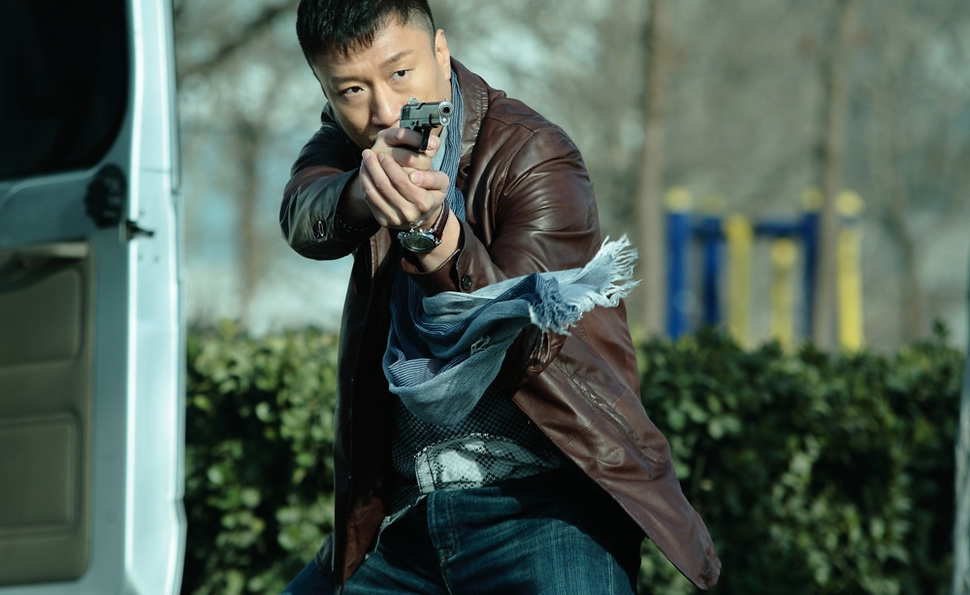
When the police attempt to stop a drug ring specializing in methamphetamine, they discover a complex hierarchy of connections and players out for a piece of the pie. In the middle of this is, a drug manufacturer taken in by the police who makes a deal to take down the illegal enterprise in exchange for suspending his death sentence. Much of the film's tense excitement comes from wondering whether Timmy Choi (Louis Koo) will keep his promise to the police. Timmy appears to be playing the criminals to bring them to justice but it consistently becomes hard to tell how much of this he's also doing for his own self-gain, and potentially at the expense of the police. The police captain Zhang Lei (Honglei Sun) gives him the benefit of the doubt while his colleagues are more skeptical, and it's the relationship between the captain and Timmy that stands out most sharply. A begrudging partnership is created between the two men where they tentatively trust one another even as they harbor major, justified reservations.

The film goes out of its way to humanize both the criminals and police. This isn't a film that condemns the criminal lifestyle or choosing to be involved in drug trafficking. The police are often not nearly as competent or smart as they believe themselves to be, and though there's some bungling on the part of the drug pushers, they show skill and intelligence in their own way and, at times, outwit their pursuers. The film is more of an indictment of drug wars of any kind. It's critical of the cost of waging war on drug trafficking; how it only increases violence and instability and makes selling and manufacturing drugs more profitable and thus more likely to continue regardless.

The expense of gazing into the abyss though plays out in the background. The film is firstly an expertly crafted crime drama, unfolding with the assured deliberation of a procedural but acting more like a game of cat and mouse. The film reveals all the gritty details of the process involved in the creation and sale of illegal drugs. The police follow up the food chain, moving away from petty low-lifes making chump change to the heads of the operation. Through it all, the police try to stay one step ahead of their targets with the uncertain help of Choi. The task is at its most intense when police members put on disguises and pretend to be members of the criminal operations, wondering whether they've been left out to hang high and dry. 

Grade: ★★★

"Something in the Air" (2013)

 
Something in the Air is director Olivier Assayas semi-autobiographical, bittersweet love letter to the peak of the 1960's revolutionary activity in France. High school student Gilles (Clement Metayer) and his friends live in the uncertainty of post-1968, where it has become less and less certain as to what makes a person still true to the rebellious spirit of yesteryear. As point of proof, Gilles often seems like he's taking on the affectation of a revolutionary. He comes off as someone who likes the outward appearances of the movement, even as he's not sure he likes the more radical tendencies of the counter-cultural movement and reactionaries.

The movie is first the giddy high of sticking it to the man, and experimenting with drugs and sex. But this is followed by a sobering come down from the rush of discovery and youthful abandonment. The characters start as wayward high schoolers spraying graffiti on their school's front wall, and they all end up in different places but broken and with it only just dawning on them the indvidual loss they've made in the name of various causes. As Gilles, and everyone more generally, becomes disillusioned with the world, and, more importantly, the people around them, they are left uncertain as to where they stand and what to do with their lives. It was easy to hand out some pamphlets to some classmates and more difficult to try to grasp how hard it is to actually create meaningful large scale change.

Assayas' film is at its best when it subtly suggests how the personal and political intersect, grounding it in the specific cultural milieu of the era. In the film, people, especially Gilles, do things for highly selfish reasons that frequently have little to do with any political motivation. Assayas' directions suggests a strong affection for this time and place, but he rarely filters it through nostalgia, drawing into question some of the stickier and more questionable and contradictory aspects of the counterculture, sexual liberation and political radicalism.

Ultimately Assayas' nostalgia comes through his protagonist, who seems to stand in for the director himself. There's an earnestness to Gilles' journey, part coming of age story, and part episodic reminiscence of the time. Assayas may not go far enough in his depiction of the era, simplifying many aspects, but the journey is sweet and yet still grounded in a weary awareness.

Grade: ★★★

Thursday, December 19, 2013

"The Big Knife" (1955)

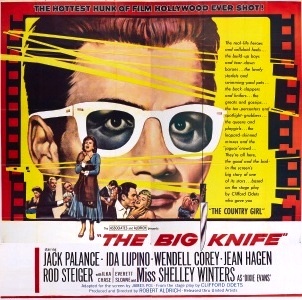
Hollywood as an all consuming hell-hole is a story that has been told many times but few quite as compellingly as The Big Knife. Director Robert Aldrich turns Hollywood into a seedy and violent place where even a pristine Beverly Hills home -- the sole shooting location -- can seem like not just a corporeally empty setting, but a highly rotten one. Aldrich also emphasizes the treachery of Hollywood by portraying characters who, though flawed, are good people. They're chewed up and spit right back out by the machinery of the studio system and its interest in money and power. Charlie Castle (Jack Palance) wants to make pictures with meaning and substance and believes in movies as a potentially great art-form with great opportunities for actors, but he simultaneously finds himself blackmailed into a seven year contract to make films with profit-minded producer Stanley Shriner Hoff (Rod Steiger). What's at stake is not only Charlie's artistic integrity but also what little remains of his soul, which has slowly been eaten away by being a Hollywood insider for far too long.

Grade: ★★★

Wednesday, December 18, 2013

"The Lone Ranger" (2013)

Of all the potential adaptable properties out there, the television series The Lone Ranger surely must be one of the least logical, and box-office receipts seemed to confirm this when its film adaptation tanked at the box office. The other reason may have been due to how much of an oddball film Lone Ranger is. Rather than aping the kitsch-ieness or quaintness of its source, Lone Ranger goes for dark, brooding and overblown. There's very little of the lightheartedness that defined the television series -- perhaps due to an assumption this would be too corny or cheesy. Though the film starts with a rather playful, old school pulp serial vibe, it quickly devolves into a sprawling, bloated western epic that draws into question the myths of the western, historically, nationally and cinematically.

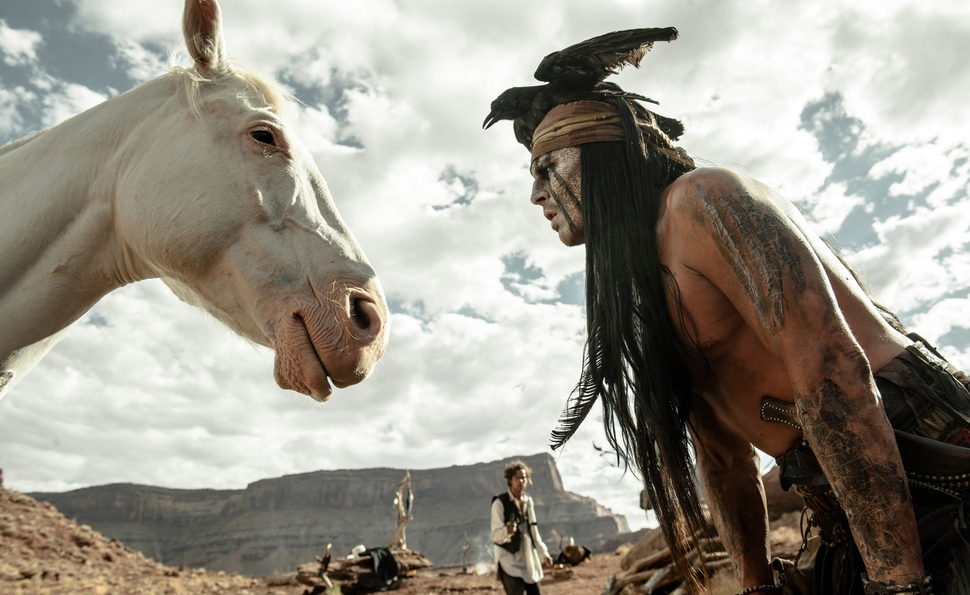
The film shares a lot of qualities with director Gore Verbinski and producer Jerry Bruckheimer's efforts on The Pirates of the Caribbean. Most apparently, Johnny Depp returns for another eccentric, garishly-garbed supporting role that, for better and for worse, ends up stealing the spotlight. Depp plays Tonto, the Native American who plays stone-faced companion and frenemy to Armie Hammer's Lone Ranger, a lawyer forced to turn vigilante when his brother and posse are viciously murdered by bandits. Ranger features the Pirate series' expansive sweep, and pyrotechnic, overwrought action and storytelling.

It's ultimately the self-involved, exceedingly complicated and overdrawn narrative which brings Ranger crashing to a screeching halt. The film tells its story in sputtering fragments of clashing tonalities -- silly slapstick is closely followed on the heels of tremendous violence -- and intentions. It's consistently an overlong slog to get through with the film never truly picking up momentum.

The film's haltering pacing also is, in part, due to weird thematic ambitions. The film boils down to a massive indictment of the skeletons in America's closet, in particular the genocide of the Native Americans and the nation's failure to fully atone for its past sins. The film questions the myths the country was founded upon and how we collectively and actively write these myths at the expense of historical truth.

Though the film does manage to use its scope and its excess for some lively action sequences, they come far and few between in a story that's often tedious to get through due to how uncertainly and unevenly told it is.

 Grade: ★★

"Berberian Sound Studio" (2013)

Some people just can't tolerate horror films. The scares, the blood and the apparent tastlessness of the genre turn off more than a few. Even the staunchest cinephiles have objections. Sound designer Gilderoy (Toby jones) seems like exactly the type of person who should not be working on the production of a horror film no matter the circumstances. He's a mild-mannered, soft-spoken Brit, and he's completely out of his element as he works at Berberian Sound Studio on one of Italy's infamous, fantastically ludicrous exploitations films, the giallo.

Berberian Sound Studio is set in the heyday of the giallo's peak popularity, in the 1970's. At first it seems like the film is taking on the path of a homage to the genre. The film has the look and feel of the giallo, taking on its sumptuous imagery and sexy stars. The film slowly drops hints of something more insidious just around the edges of the film's production and a growing sense of dread kicks in.

However, the film takes on a less bloody and less giallo-esque route. The film treats itself more like an unhinged psychological drama. In due time, the film resembles Muholland Drive more than Bird with the Crystal Plumage. Director Peter Strickland creates a hypnotically dreamlike state where reality and fiction begin to blur.

The sound designer is used to working on prestigious dramas not trashy horror flicks. The more he works on the film, the more uneasy he becomes working on such an exploitative film. Though the exploitation at hand appears to be over the young actresses degrading themselves to make a break in the industry, perhaps the greater exploitation is of the sound designer, whose fragile psyche can barely withstand this environment. He stabs melons and to him it's wickedly close to stabbing an actual person. And it is: it's a shiny knife piercing his own constitution.      

 Grade: ★★★

Tuesday, December 17, 2013

"Sightseers" (2013)

It's all too fitting that The Cars' pop hit "Tainted Love" should play over the opening credits of Sightseers. But tainted here implies less of a love gone bad than a love that is totally fucked up. Initially Sightseers seems like a fairly conventional, quirky indie about a couple (Alice Lowe, Steve Oram) who goes on a roadtrip of discovery. Chris is a would-be writer hoping to gain some inspiration; Tina is trying to escape her overbearing mother (Eileen Davies) who still blames her for the death of the family dog.

But a growing sense of inexplicable surrealism -- there from the the film's opening moments but hard to pin down until a little ways in -- starts to creep into the film's narrative. Chris advises another man to pick up a piece of litter, and when the man refuses to do so, Chris backs the car over him. Chris plays it off as a morbid accident and Tina with her desperate optimism overlooks the incident. However, as they start going from campground to campground with the trailer, Chris begins picking off more people for perceived slights and wrongdoings. Once it becomes clear that Chris is responsible, Tina is at first unsettled but soon reveals a strange attraction to this behavior, demonstrating her own brand of subdued psychopathy.

The film from here turns into a series of escalating acts of needless, brutal violence against people who upset the two of them in one way or another. But their own worst enemy is one another; each of them spurs on even more destructive, narcissistic, and pathological actions and ways of thinking.

In many ways, the film feels like a watered-down Badlands. The protagonists are remorseless, seemingly killing for the sake of killing, and their actions take place against beautiful natural landscapes that dwarf them. The film also leaves events and actions muted and purposely under-explained. At times, the film has the dark edged, heightened absurdism of a Charlie Kaufman film, though softer and less boldly and insightfully used. It's a darkly funny film, a mocking tale piercing jagged daggers at codependency and the honeymoon phase of relationships. However, its absurdity and quirkiness often make it as conventionally, banally indie-whimsical as it tries not to be.

 Grade: ★★

"Cutie and the Boxer" (2013)

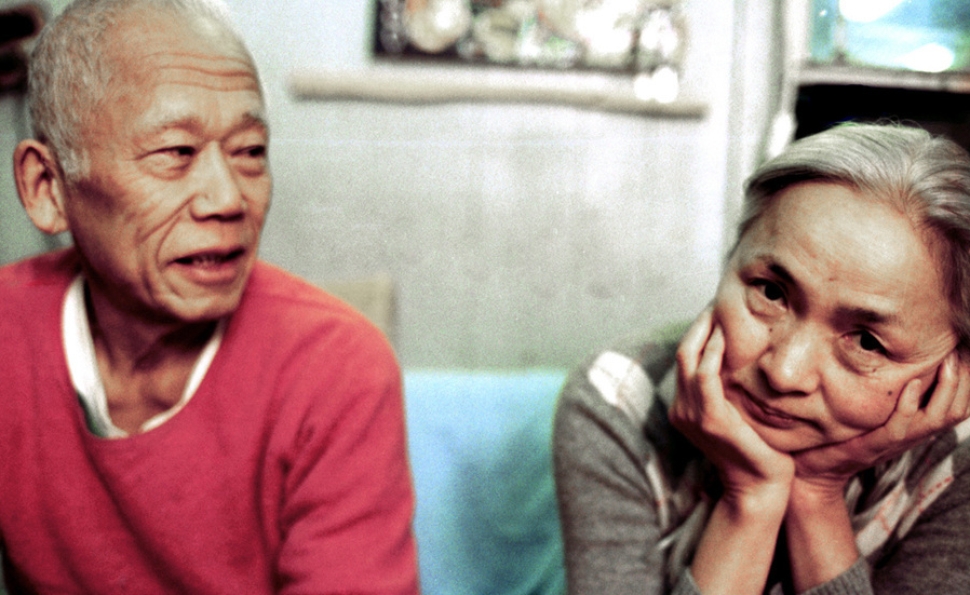
Ushio and Noriko Shinohara are married artists. Noriko met Ushio when she was only nineteen and he was in his forties, and they shortly after married and had a son. Ushio has just turned eighty at the start of the film, and Noriko is just shy of sixty. Ushio was a well-known avant-garde artist in Japan who moved to New York in the 1960's. He makes action-paintings by putting on boxing gloves and punching at the canvas, and he makes sculptures out of cardboard, mostly of motorcycles.

Ushio has always had more fame and notoriety for his artwork than Noriko. He calls Noriko his "assistant", a term she resents. She has her own art, but she has often had to set it aside for the sake of Ushio and her son, Alex. Noriko makes paintings, and is currently working a graphical novel-like series of images about the struggles of her marriage. The film animates a number of her works to illustrate some of the couple's history. Old home movie footage is also used -- some powerful and surprising -- but it's mostly footage filmed in the present and their day to day lives in their small New York City apartment. 

Cutie and the Boxer is a documentary about their relationship as much if not more so than it is about their art. The film spends much of its time quietly giving voice to Noriko's justified grievances in her thirty-nine year long marriage. Ushio is selfish and an alcoholic who has put his addictions and art above his family. When she was younger, Noriko appreciated Ushio's love of art above all else and no matter the cost. As time has past though, she regrets not considering a more stable and secure lifestyle. The couple is barely making rent, and have difficulty finding buyers for Ushio's art. Ushio sells a sculpture for several thousand less than its price just to make money of any kind.

The film is a beautiful exploration of a longstanding marriage. Noriko has her regrets and resents Ushio at times, and Ushio doesn't always understand what bothers his wife. But they still love eachother in spite of their differences and difficulties. These problems aren't settled and they likely never completely will be, but such is often the case with the compromises in a marriage.

Grade: ★★★