Thursday, December 19, 2013

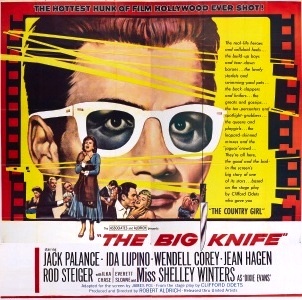
"The Big Knife" (1955)

Hollywood as an all consuming hell-hole is a story that has been told many times but few quite as compellingly as The Big Knife. Director Robert Aldrich turns Hollywood into a seedy and violent place where even a pristine Beverly Hills home -- the sole shooting location -- can seem like not just a corporeally empty setting, but a highly rotten one. Aldrich also emphasizes the treachery of Hollywood by portraying characters who, though flawed, are good people. They're chewed up and spit right back out by the machinery of the studio system and its interest in money and power. Charlie Castle (Jack Palance) wants to make pictures with meaning and substance and believes in movies as a potentially great art-form with great opportunities for actors, but he simultaneously finds himself blackmailed into a seven year contract to make films with profit-minded producer Stanley Shriner Hoff (Rod Steiger). What's at stake is not only Charlie's artistic integrity but also what little remains of his soul, which has slowly been eaten away by being a Hollywood insider for far too long.

Grade: ★★★

Wednesday, December 18, 2013

"The Lone Ranger" (2013)

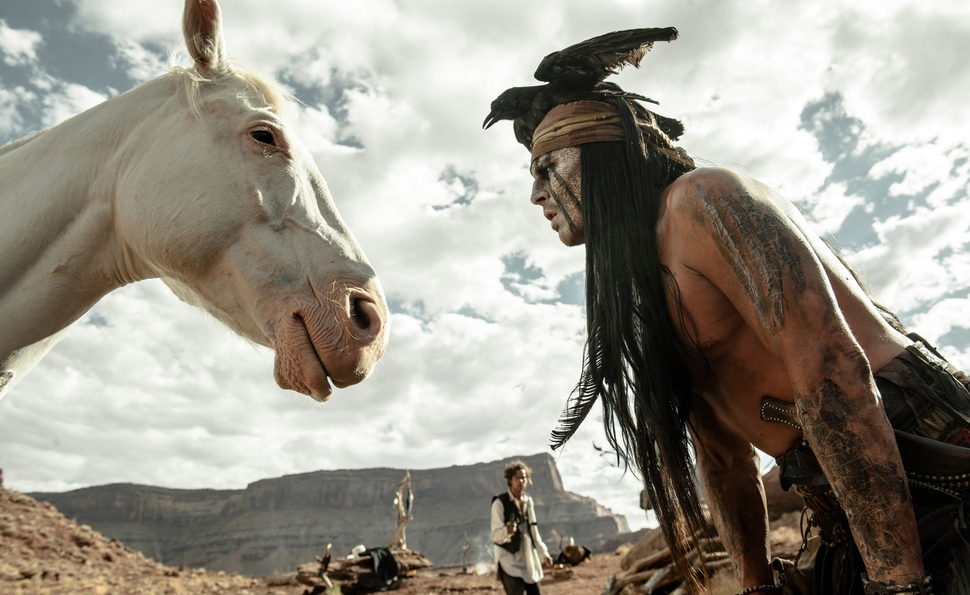
Of all the potential adaptable properties out there, the television series The Lone Ranger surely must be one of the least logical, and box-office receipts seemed to confirm this when its film adaptation tanked at the box office. The other reason may have been due to how much of an oddball film Lone Ranger is. Rather than aping the kitsch-ieness or quaintness of its source, Lone Ranger goes for dark, brooding and overblown. There's very little of the lightheartedness that defined the television series -- perhaps due to an assumption this would be too corny or cheesy. Though the film starts with a rather playful, old school pulp serial vibe, it quickly devolves into a sprawling, bloated western epic that draws into question the myths of the western, historically, nationally and cinematically.

The film shares a lot of qualities with director Gore Verbinski and producer Jerry Bruckheimer's efforts on The Pirates of the Caribbean. Most apparently, Johnny Depp returns for another eccentric, garishly-garbed supporting role that, for better and for worse, ends up stealing the spotlight. Depp plays Tonto, the Native American who plays stone-faced companion and frenemy to Armie Hammer's Lone Ranger, a lawyer forced to turn vigilante when his brother and posse are viciously murdered by bandits. Ranger features the Pirate series' expansive sweep, and pyrotechnic, overwrought action and storytelling.

It's ultimately the self-involved, exceedingly complicated and overdrawn narrative which brings Ranger crashing to a screeching halt. The film tells its story in sputtering fragments of clashing tonalities -- silly slapstick is closely followed on the heels of tremendous violence -- and intentions. It's consistently an overlong slog to get through with the film never truly picking up momentum.

The film's haltering pacing also is, in part, due to weird thematic ambitions. The film boils down to a massive indictment of the skeletons in America's closet, in particular the genocide of the Native Americans and the nation's failure to fully atone for its past sins. The film questions the myths the country was founded upon and how we collectively and actively write these myths at the expense of historical truth.

Though the film does manage to use its scope and its excess for some lively action sequences, they come far and few between in a story that's often tedious to get through due to how uncertainly and unevenly told it is.

 Grade: ★★

"Berberian Sound Studio" (2013)

Some people just can't tolerate horror films. The scares, the blood and the apparent tastlessness of the genre turn off more than a few. Even the staunchest cinephiles have objections. Sound designer Gilderoy (Toby jones) seems like exactly the type of person who should not be working on the production of a horror film no matter the circumstances. He's a mild-mannered, soft-spoken Brit, and he's completely out of his element as he works at Berberian Sound Studio on one of Italy's infamous, fantastically ludicrous exploitations films, the giallo.

Berberian Sound Studio is set in the heyday of the giallo's peak popularity, in the 1970's. At first it seems like the film is taking on the path of a homage to the genre. The film has the look and feel of the giallo, taking on its sumptuous imagery and sexy stars. The film slowly drops hints of something more insidious just around the edges of the film's production and a growing sense of dread kicks in.

However, the film takes on a less bloody and less giallo-esque route. The film treats itself more like an unhinged psychological drama. In due time, the film resembles Muholland Drive more than Bird with the Crystal Plumage. Director Peter Strickland creates a hypnotically dreamlike state where reality and fiction begin to blur.

The sound designer is used to working on prestigious dramas not trashy horror flicks. The more he works on the film, the more uneasy he becomes working on such an exploitative film. Though the exploitation at hand appears to be over the young actresses degrading themselves to make a break in the industry, perhaps the greater exploitation is of the sound designer, whose fragile psyche can barely withstand this environment. He stabs melons and to him it's wickedly close to stabbing an actual person. And it is: it's a shiny knife piercing his own constitution.      

 Grade: ★★★

Tuesday, December 17, 2013

"Sightseers" (2013)

It's all too fitting that The Cars' pop hit "Tainted Love" should play over the opening credits of Sightseers. But tainted here implies less of a love gone bad than a love that is totally fucked up. Initially Sightseers seems like a fairly conventional, quirky indie about a couple (Alice Lowe, Steve Oram) who goes on a roadtrip of discovery. Chris is a would-be writer hoping to gain some inspiration; Tina is trying to escape her overbearing mother (Eileen Davies) who still blames her for the death of the family dog.

But a growing sense of inexplicable surrealism -- there from the the film's opening moments but hard to pin down until a little ways in -- starts to creep into the film's narrative. Chris advises another man to pick up a piece of litter, and when the man refuses to do so, Chris backs the car over him. Chris plays it off as a morbid accident and Tina with her desperate optimism overlooks the incident. However, as they start going from campground to campground with the trailer, Chris begins picking off more people for perceived slights and wrongdoings. Once it becomes clear that Chris is responsible, Tina is at first unsettled but soon reveals a strange attraction to this behavior, demonstrating her own brand of subdued psychopathy.

The film from here turns into a series of escalating acts of needless, brutal violence against people who upset the two of them in one way or another. But their own worst enemy is one another; each of them spurs on even more destructive, narcissistic, and pathological actions and ways of thinking.

In many ways, the film feels like a watered-down Badlands. The protagonists are remorseless, seemingly killing for the sake of killing, and their actions take place against beautiful natural landscapes that dwarf them. The film also leaves events and actions muted and purposely under-explained. At times, the film has the dark edged, heightened absurdism of a Charlie Kaufman film, though softer and less boldly and insightfully used. It's a darkly funny film, a mocking tale piercing jagged daggers at codependency and the honeymoon phase of relationships. However, its absurdity and quirkiness often make it as conventionally, banally indie-whimsical as it tries not to be.

 Grade: ★★

"Cutie and the Boxer" (2013)

Ushio and Noriko Shinohara are married artists. Noriko met Ushio when she was only nineteen and he was in his forties, and they shortly after married and had a son. Ushio has just turned eighty at the start of the film, and Noriko is just shy of sixty. Ushio was a well-known avant-garde artist in Japan who moved to New York in the 1960's. He makes action-paintings by putting on boxing gloves and punching at the canvas, and he makes sculptures out of cardboard, mostly of motorcycles.

Ushio has always had more fame and notoriety for his artwork than Noriko. He calls Noriko his "assistant", a term she resents. She has her own art, but she has often had to set it aside for the sake of Ushio and her son, Alex. Noriko makes paintings, and is currently working a graphical novel-like series of images about the struggles of her marriage. The film animates a number of her works to illustrate some of the couple's history. Old home movie footage is also used -- some powerful and surprising -- but it's mostly footage filmed in the present and their day to day lives in their small New York City apartment. 

Cutie and the Boxer is a documentary about their relationship as much if not more so than it is about their art. The film spends much of its time quietly giving voice to Noriko's justified grievances in her thirty-nine year long marriage. Ushio is selfish and an alcoholic who has put his addictions and art above his family. When she was younger, Noriko appreciated Ushio's love of art above all else and no matter the cost. As time has past though, she regrets not considering a more stable and secure lifestyle. The couple is barely making rent, and have difficulty finding buyers for Ushio's art. Ushio sells a sculpture for several thousand less than its price just to make money of any kind.

The film is a beautiful exploration of a longstanding marriage. Noriko has her regrets and resents Ushio at times, and Ushio doesn't always understand what bothers his wife. But they still love eachother in spite of their differences and difficulties. These problems aren't settled and they likely never completely will be, but such is often the case with the compromises in a marriage.

Grade: ★★★

"Pain & Gain" (2013)

Of all the working directors, arguably the one who would seem the least well-suited for making a satire is Michael Bay. Bay has made a career out of making low substance action films. He's come to represent bankrupt film culture, with ADHD editing, thin characters and thin plots and an emphasis on action over narrative. But somehow all these qualities make him well-suited for making Pain & Gain, a broad critique of, well, the kind of people who worship at the altar of Michael Bay films. It's a film about the type of people who surely must think Armageddon is a certified masterpiece, who party and drink like it's their life mission, and vainly, unhealthily work-out. Bay cuts back on his typically excessive action, but maintains his distinctive, hyperactive style, and uses it to poke fun at the meat-head American subculture -- and is legitimately funny in the process. But though its jabs are often coarse and simple, the film is weirdly sympathetic towards its protagonists Daniel Lugo (Mark Wahlberg), Paul Doyle (Dwayne Johnson) and Adrian Doorbal (Anthony Mackie), bodybuilders who want their piece of the American pie but feel like they've been left behind. It recognizes their stupidity, and increasingly self-destructive and misguided actions they take to make bank -- namely kidnapping a wealthy narcissistic client of the gym they work at. Yet it also understands what's led them to obsess over their appearances and to desire success and wealth at any cost. It's a vulgar and violent look at the fallacy of the American Dream. The film seems willfully, intentionally designed to be divisive, consistently stooping to the same level of idiocy and self-indulgence as its characters -- cheap, childish, broad humor and loud, brash stylistic choices -- and often losing its intended message in the process. Yet there's still an odd vibrancy to the film, and it's undoubtedly the best work Bay has done in ages.

 Grade: ★★★

Monday, December 16, 2013

"The Hunger Games: Catching Fire" (2013)

The opening scene of Catching Fire, the second film in the Hunger Game film trilogy, opens with Katniss Everdeen (Jennifer Lawrence), winner of the police state of Panem's Hunger Game competition in the last film, out in the wilderness, doing essentially nothing for a few minutes. The moment is simply us watching her think, trying to understand what's going on inside her head. It's Lawrence's nicely expressive face and quiet contemplation. It's ballsy; blockbuster films don't stop to consider the consequences or stakes of their world. Yet the Catching Fire essentially does exactly that for half its run time.

It's underneath the Hollywood gloss and crowd-pleasing. Catching Fire is surprisingly subversive, taking jabs at the film and media culture that, weirdly enough, allows for this type of big budgeted film to exist in the first place. It's not too far of a stretch to see Panem's propaganda spouted by its all-seeing news programs as not that far removed from today's partisan, attention grabbing news. The gaudy neon-pop look of the Capitol and those who live there is a conspicuous but all too spot-on consideration of empty, crass reality tv culture and disgusting wealthy privilege and ignorance. The film is also suspicious of those in power and seriously asks for political reform, and fears how political power can so easily slide into corruption, fear and inscrutability. Sure, the studio could care less about the underlying messages as long as lots of money is made off ticket and DVD sales, but they've unwittingly made a film that criticizes the very excess they promote.

But for those who want their ideas to go down easy, there's plenty of eye-candy spectacle, romance, colorful characters, and sweeping action. And granted, inevitably these elements become the film's primary concern, and that's totally okay. Catching Fire is a thrilling and fun film first and foremost, and it's a handsomely mounted production with a stellar cast -- with returning stars like Elizabeth Banks, Stanley Tucci and Woody Harrelson, as well as newcomers like Jenna Malone, Sam Caflin and Jeffery Wright.

The President (Donald Sutherland -- turning cuddly paternalism into something wickedly unsettling) fears the symbolic and revolutionary status Katniss and Peeta (Josh Hutcherson) have taken on since their victory in the previous games. The story comes down to the president in conjunction with the showrunner of the next year's game Plutarch Heavensbee (Phillip Seymour Hoffman) plotting to dismantle this status in hopes of shutting down rebellious undertones in the country. Katniss and Peeta have to prove their fake love created in the last game is real and not an image designed by the state to keep citizens submissive. When this fails, the president cracks down harder on the state, but he soon realizes that his only out is to ensure that Katniss dies. He can't do this directly, however -- lest it create more problems of rebellion -- and Heavensbee comes up with the idea to force her and other former victors to fight in the games once again -- for the stated purpose of the 75th anniversary of the games.

The games are deep into the film though. The film takes its time getting to the big moments, especially those of the game itself. In stead, the film delves into the consequences of the events of the first films and how they've affected the world and the characters. Katniss is going through PTSD during much of the early parts of the film, guilty over her survival. She's also coming to terms with the fact that though she lives, her life is never going to be her own as long as the state carefully watches her every move. Yes, she's also sorting out her feelings between Peeta and Gale (Liam Hemworth), but the film, thankfully, treats this as just one tiny portion of her life, and certainly never the most important. Katniss is a bundle of contradictions, impulses, wants, and needs. She's vulnerable at times, but never weak -- an important distinction.

By the time the film gets to its finish, with a surprising amount of economy and verve despite its length, the film has been a quite satisfying studio blockbuster that's not entirely short of introspection. More importantly, it leaves you wanting more, prepared for the next installment. I can't say many other of this year's blockbusters achieved a similar effect.

Grade: ★★★