Monday, December 16, 2013

"The Hunger Games: Catching Fire" (2013)

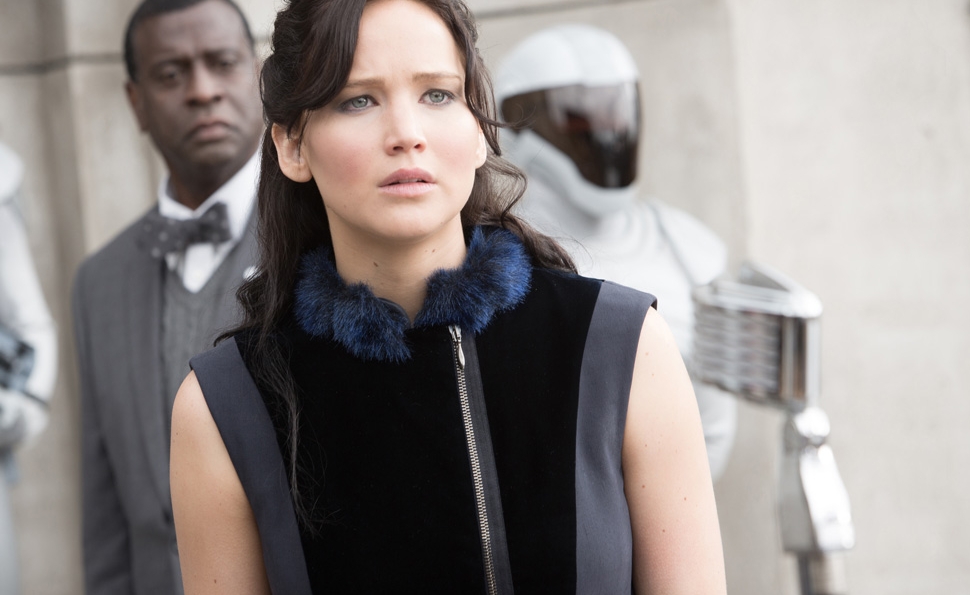
The opening scene of Catching Fire, the second film in the Hunger Game film trilogy, opens with Katniss Everdeen (Jennifer Lawrence), winner of the police state of Panem's Hunger Game competition in the last film, out in the wilderness, doing essentially nothing for a few minutes. The moment is simply us watching her think, trying to understand what's going on inside her head. It's Lawrence's nicely expressive face and quiet contemplation. It's ballsy; blockbuster films don't stop to consider the consequences or stakes of their world. Yet the Catching Fire essentially does exactly that for half its run time.

It's underneath the Hollywood gloss and crowd-pleasing. Catching Fire is surprisingly subversive, taking jabs at the film and media culture that, weirdly enough, allows for this type of big budgeted film to exist in the first place. It's not too far of a stretch to see Panem's propaganda spouted by its all-seeing news programs as not that far removed from today's partisan, attention grabbing news. The gaudy neon-pop look of the Capitol and those who live there is a conspicuous but all too spot-on consideration of empty, crass reality tv culture and disgusting wealthy privilege and ignorance. The film is also suspicious of those in power and seriously asks for political reform, and fears how political power can so easily slide into corruption, fear and inscrutability. Sure, the studio could care less about the underlying messages as long as lots of money is made off ticket and DVD sales, but they've unwittingly made a film that criticizes the very excess they promote.

But for those who want their ideas to go down easy, there's plenty of eye-candy spectacle, romance, colorful characters, and sweeping action. And granted, inevitably these elements become the film's primary concern, and that's totally okay. Catching Fire is a thrilling and fun film first and foremost, and it's a handsomely mounted production with a stellar cast -- with returning stars like Elizabeth Banks, Stanley Tucci and Woody Harrelson, as well as newcomers like Jenna Malone, Sam Caflin and Jeffery Wright.

The President (Donald Sutherland -- turning cuddly paternalism into something wickedly unsettling) fears the symbolic and revolutionary status Katniss and Peeta (Josh Hutcherson) have taken on since their victory in the previous games. The story comes down to the president in conjunction with the showrunner of the next year's game Plutarch Heavensbee (Phillip Seymour Hoffman) plotting to dismantle this status in hopes of shutting down rebellious undertones in the country. Katniss and Peeta have to prove their fake love created in the last game is real and not an image designed by the state to keep citizens submissive. When this fails, the president cracks down harder on the state, but he soon realizes that his only out is to ensure that Katniss dies. He can't do this directly, however -- lest it create more problems of rebellion -- and Heavensbee comes up with the idea to force her and other former victors to fight in the games once again -- for the stated purpose of the 75th anniversary of the games.

The games are deep into the film though. The film takes its time getting to the big moments, especially those of the game itself. In stead, the film delves into the consequences of the events of the first films and how they've affected the world and the characters. Katniss is going through PTSD during much of the early parts of the film, guilty over her survival. She's also coming to terms with the fact that though she lives, her life is never going to be her own as long as the state carefully watches her every move. Yes, she's also sorting out her feelings between Peeta and Gale (Liam Hemworth), but the film, thankfully, treats this as just one tiny portion of her life, and certainly never the most important. Katniss is a bundle of contradictions, impulses, wants, and needs. She's vulnerable at times, but never weak -- an important distinction.

By the time the film gets to its finish, with a surprising amount of economy and verve despite its length, the film has been a quite satisfying studio blockbuster that's not entirely short of introspection. More importantly, it leaves you wanting more, prepared for the next installment. I can't say many other of this year's blockbusters achieved a similar effect.

Grade: ★★★

Sunday, December 15, 2013

"White House Down" (2013)

When people discuss the state of the modern movie blockbuster, they talk about how loud, dumb, and crass the films being produced are. White House Down appears to be another one of those dumb blockbusters -- and that's true: it's a big, bombastic action film.

And yet, that's why White House Down is worth lightly praising. It knows it's dumb. It never pretends to have any deep substance underneath. It's a bloody, close quarters shoot-em-up in the vein of Die Hard, a film it loosely borrows plot and character elements from. While it lack some of the heart, sharp characterization and general charm of Die Hard, White House Down feels like an older brand of stupidly fun action film.

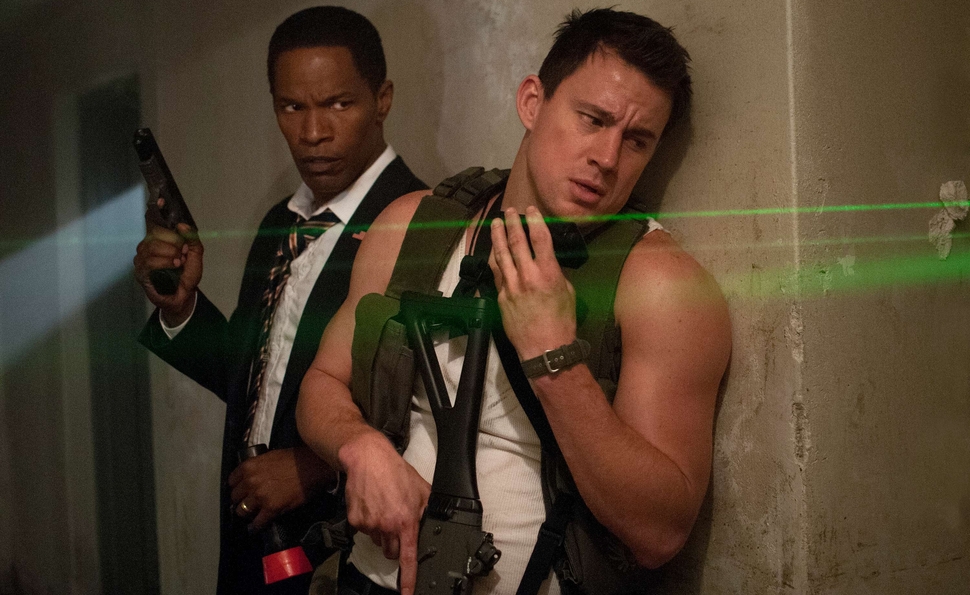
John Cale (Channing Tatum) desperately hopes to get a job as a secret service member and finds himself, with his politically savvy eleven year old daughter Emily (Joey King), in the White House right as domestic terrorists siege the building. The daughter, tourists and members of the presidential cabinet are taken hostage. Cale becomes the sole force to stop the attackers, picking off the paramilitary forces and saving President James Sawyer (Jaimie Foxx) from harms way.

As the president and Cale team up to take down the eclectic bad guys (at one point literally referred to as "the bad guys" because that's the sort of movie this is), director Roland Emmerich creates a series of rapid-fire fight scenes. These scenes are unapologetic, uncomplicated popcorn entertainment. There's "good guys", and there's "bad guys", and they fight. Tatum and the president are outnumbered but find creative strategies to survive and win. Henchmen die without an eyelash being batted over the cost of violence. And while Martin Walker (James Wood) has reasonable motives, the film never really takes him as seriously as it should. His son died in military combat. The interesting thing here is that Walker's son died in covert fighting in Iran. But beyond the vaguest conception of "patriotism", the film isn't especially political.

Beyond its interior gunfights though, the film runs into problems. Emmerich can't resist his desire for spectacle (Independence Day, 2012). The stakes of the scenario keep getting raised and the CGI extravaganza sets in. None of this is ever as fun as the straight-up, tight-spaced brawls.

White House Down is filled with a lot of good performers, Maggie Ghyllenhall, Richard Jenkins, Jason Clarke, Jimmi Simpson, Lance Reddick. It's nothing meaty but they all make the most of what they're given. Tatum has the looks and charisma to be an action star; it's a wonder no one has thought to do this sooner.

Don't expect depth in White House Down. It's a shoot-first-ask-questions-later, bullets-blazing action film unafraid to simply be an unembellished good time. It's bloated and unwieldy in places, but for a good two hours of mindless fun it serves its purpose nicely.

 Grade: ★★

Friday, December 13, 2013

"Take This Waltz" (2011)

"New things get old," a woman sagely informs Margot (Michelle Williams) and Geraldine (Sarah Silverman) about relationships early in Take This Waltz. And it's this platitude which Take This Waltz ponders over throughout its story. Margot's five year marriage with Lou (Seth Rogen) has grown stagnant. When she meets Daniel (Luke Kirby), in meet-cute fashion, Margot is torn, considering having an affair but desiring to stay loyal to Lou as if she can fix things between them.

Take This Waltz almost feels like the second chapter to so many romantic comedies; this is what happily ever after is really like. It's an anti-romantic story told through romantic conventions and indie quirks. The conversations Margot and Lou have, when they're actually speaking to eachother at all, sound like the pillow-talk from Punch Drunk Love. They playfully describe gruesome ways they wish to hurt or kill one another. It's the only way they can actually muster up any form of talk, uncomfortably babbling in baby talk as if it's cute PDA. Their play-fighting is cringe humor that consistently descends more into painful cringeness than uncomfortable hilarity

The film deals with the inevitability of relationships to be sapped of their initial spark. Margot wonders whether her marriage with Lou is irreparably broken, but she also has to confront the fact that if she jumped ship for a relationship with Daniel things could end up just as dissatisfying in time.

Yet despite this sourness, writer-director Sarah Polley is generous with her characters. Polley, like in her film Away From Her, shoots the film with a sort of outwardly glowing warmth. The pain comes from how human and real the film's story is under its romantic mask.

Grade: ★★★

"Faster, Pussycat! Kill! Kill!" (1965) and Subversion of Gender Roles

"Women! They let 'em vote, smoke and drive - even put 'em in pants! And what happens" -Old Man

Early on in Faster, Pussycat! Kill! Kill!, Varla, Rosie, and Billie stop to get gas. The gas attendant makes idle chatter, but we can tell he's partially doing it to get a glance at Varla's cleavage. "Now that's what I believe in, seeing America first," he tells Varla. Varla reproachfully quips, "You won't find it down there, Columbus!" The film features all its female characters in tight, revealing clothing, and this is partly due to Russ Meyer making a lurid exploitation film which would draw in a crowd. But it also largely makes sense for the characters; these are self-empowered, no-nonsense, sexually liberated females, and though the film sometimes displays them this way simply for some T and A action, there's more at play here than all that.

It's hard to initially pick up on this subtext though. The earliest moments of the film find Billie splashing around in water, and catfighting with Rosie. The fourth female character who rounds out the cast, Linda, is purposely made to be shrill and she inexplicably spends almost the entirety of the film in a two-piece swimsuit -- stranger still since she's the film's stand-in for prudishness.

However, these are our protagonists and they drive the action of the narrative. The men, by contrast, are weak, helpless or are beaten up at the hands of the Varla, Rosie and Billie (The Old Man is wheelchair bound, his one son is mentally challenged, and his other son is meek and mild-mannered). The three main characters are "go-go dancers" and the film's opening moments are of them dancing, but Meyer undercuts the moment. It's not meant for our enjoyment but rather to acknowledge the grossness of their objectification. The film keeps cutting to the ogling male customers, souring the moments and removing the pleasure of it.

From here, we watch the three women joyride around. They play a game of chicken with their cars, for the reckless fun of it; they're thrill seekers. When a man, Tommy, shows up, they challenge him to a race; the girls win, but they send the guy's car off course in the process. Angry, he fights Varla, who ends up killing him. The fighting of the film never sexualizes the women; it's straight-up brawling.

Fearful of Tommy's girlfriend Linda ratting on them, the three drug and kidnap her. At the gas station, the attendant tells them about the recently acquired wealth of the Old Man. They go to his house with eyes for the cash, and use Linda as bait.

The quote that opens this piece, spoken by the Old Man, highlights the film's hidden feminist subtext. The Old Man criticizes the women, but ends up revealing social hypocrisies in the process. And the three eventually exact vengeance and retribution for this sexism. Though their violence and greed is ultimately punished, it's at the hands of Linda, not by any man. In deed, the men fight back but prove incapable of stopping them.

The film is often as entertaining and smart as it due to subverting gender roles. Kirk is weak to the sexual magnetism of Varla. "You're a beautiful animal... and I'm weak, and I want you," he tells her as he succumbs to her. The women are kickass fighters who use their sexuality to get what they want. It's a tricky line the film's walking, and it fails to stay on it at times. They know they're getting sexualized and they use it to their advantage. Does the film fail to achieve this idea at times? Sure. The direction isn't nearly as sensitive or rigorous as it ought to be for what it's attempting. It wants to have its cake and eat it too with the depictions of these female characters, but it's still pleasing see a conscious effort to flip the script.

Thursday, December 12, 2013

"The Great Gatsby" (2013)

Going into The Great Gatsby, it's important you don't approach it as an adaptation. It doesn't matter whether it's a good adaptation (for the record: not so much). But when a novel so widely considered to be a literary classic is made into a movie, how it is as an adaptation immediately becomes one of the most pressing questions -- probably unnecessarily so.

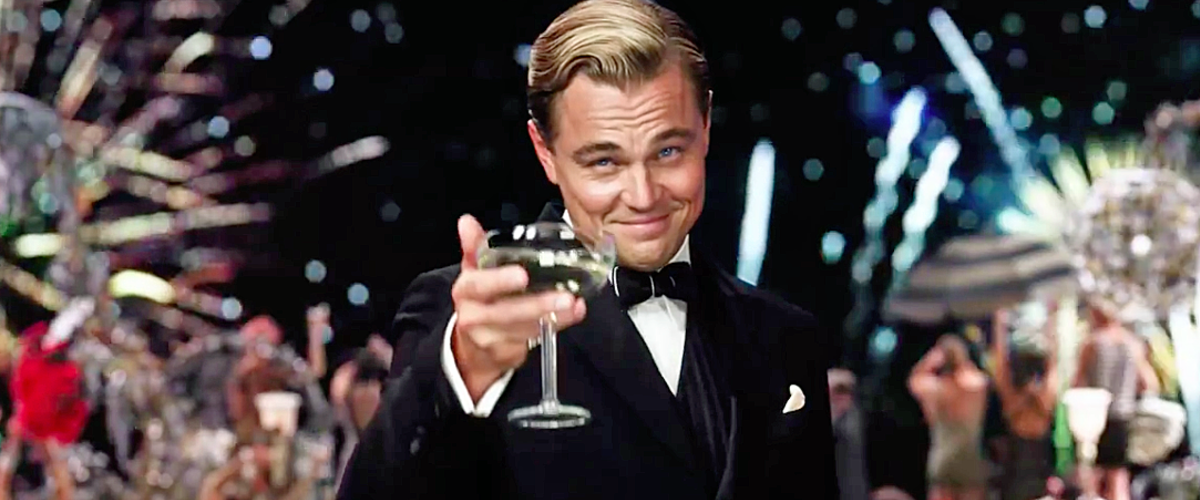
Director Baz Lurhmann doesn't seem concerned with the story but rather using the structure of the narrative to play around with his particular stylistic sensibility. Lurhmann takes his lush, grand visual style from Romeo + Juliet and Moulin Rouge, and just lets it roam free. Thought Moulin Rouge was indulgent? Well, Gatsby makes it look tame by comparison. This is cinematic, directorial navel-gazing on overdrive.

Lurhmann turns the film into a sensory overload. There isn't a moment, a story beat, that can't be made more extravagant and grand-eloquently melodramatic. "What's the most over the top way this could be shot?" Lurhmann appears to ask himself at every turn. Where its literary source was subtle, the film is blunt and on-the-nose in really embarrassing ways. "Dr. T.J. Ecklberg is the eyes of God!" Nick essentially shouts at one point. Thanks Spark Notes!

The grandeur of Lurhmann's style leads to an abundance of excess. It's a film that's at least a thirty minutes too long, if not more. Give Lurhmann credit for one thing though; he somehow manages to keep every major moment from the book, at multiple points to the film's detriment. Gatsby is a good story but one that's highly uncinematic. If stripped bare for parts, and re-shuffled, it might be a doable story as a movie, but not in its literal form.

Granted, the look of the film is luscious and resplendent, but eventually it becomes repetitive. Lurhmann seems to have so little actual interest in telling the story that it becomes hard to become invested. The novel is emotionally sedated but Lurhmann, by contrast, treats the material as if there's a life-or-death spectacle. It's this disconnect that makes the film drag.

It's only in Gatsby's head that everything seems so romantically exaggerated, but the film isn't from his perspective. It's from Nick's, the quiet, unassuming confidant; the film adds a new story where Nick ends up in a psych ward recounting the story to cope with the loss of Gatsby, but it's just an excuse to create false drama. We're at an emotional disconnect from the events even though the film seems to believe we're feeling All Of The Emotions!

There are some good performances -- particularly Leonardo DiCaprio as Old Gatsby -- but they're stifled by Lurhmann's visual proclivities, which suffocate any underlying sense of intimacy. Sure, there's the initial giddily inebriated rush of that big party you wanted to go to, but soon the hangover starts setting in. 

 Grade: ★★

Tuesday, December 10, 2013

"The Good, the Bad, and the Weird" (2008)

The Good, the Bad, and the Weird reveals its intentions right in the title. It's a dazzling throwback to the spaghetti western, playing fast and loose with the plot of The Good, the Bad, and the Ugly and referencing or paying tribute to countless classics of the genre. Three colorful gunslingers, each representing the titular personality types, set out to find a buried treasure at the center of a complicated East Asian geopolitical, military struggle in the 1930's, just on the cusp of World War II. Bumbling, good-natured Yoon Tae-goo (Song Kang-ho) stumbles upon the map to a hidden national treasure accidentally while robbing a train. Coincidentally, the charmingly sadistic Park Chang-yi (Lee Byung-hun) has designs to rob the train as well, and the stoic bounty hunter Park Do-won (Jung Woo-sung) is on Chang-yi's tail to pick up the bounty on his head. Once Tae-goo acquires the map, it's off the races as the three try to retrieve the map while still other forces, including the Manchurian army, attempt to lay claim to the map.

The train heist is merely the film's first action setpiece. From there the film stages action sequence after action sequence, each more intense and stylish than the last. Director Kim Jee-woon is a stylist of the first order, and each action scene is deliriously frenetic, deliberately calibrated for maximum thrilling entertainment. Jee-woon is excellent at choreographing complicated action and placing us right in the midst of the drama. The film is exciting for staging chaotic, complex action, and yet making it all, not only coherent, but all go off like a masterful piece of well-planned clockwork. The film gives a delightful sense of constant giddy headrush. But Jee-woon, perhaps most significantly, keeps one-eye towards the film's cinematic heritage, while keeping another looking forward to crafting something unique and modern.

There are some subtler things going on the background suggestive of Korean-Japanese relations. Japan turned Korea into a colony in the early 20th century. This was tied up with complicated military and political plans in Manchuria, where Japan placed a puppet state in that region of China. There are criticisms of Japans war crimes and generally brutal behavior in the region and towards Korea, and frequent discussions of Korea's bitter, desperate attempts at regaining independence at the time. The film is critical of Japan in this rehard, but this more generally serves as information to add to the verisimilitude of the historical setting. It's the backdrop for the more personal, character-based conflict between the three main characters, giving their singular quest a sense of operatic scope. The politics are the least of the film's concerns; a rollicking good time is its primary interest and it amply provides with affection and pizazz.

 Grade: ★★★

Monday, December 9, 2013

"Cries and Whispers" (1972) and Cutting to Red

Ingmar Bergman's Cries and Whispers features a unique stylistic choice. Every time the films chooses to fade out, rather than fading to black, it fades to a jarring red. This is the type of stylistic decision that purposely draws attention to itself and begs to be questioned. Red is a prominent color throughout the film. Bergman emphasizes red, black and white in the mis-en-scene, but he especially makes red stand out. It's the color of curtains, bedspreads, chairs and furniture, and wallpaper. The three distant sisters, Karin, Marina and Agnes, are surrounded by the color red. It hangs over them like an inescapable cloud.

We learn that the siblings have never been very close. When Agnes is close to a premature death from cancer, the three are forced to re-evaluate their history and their memories. The red at once seems to represent the still bleeding wounds of the past, never fully healed or sealed up. In the film, the past isn't something that happened to people but is still happening to them. If moments faded to black, it would feel as if we were closing the book on that chapter of the story. But with the fade to red, it's as if the moment is accented, more greatly asserted; it causes each moment to bleed into the next; the feeling and sentiment of the previous scene lingers into the following.

The red is not just a figurative suggestion of blood but a literal one as well. It emphasizes the blood ties between the siblings. They may be detached but they don't necessarily want to be. They just don't know how not to be. They were kept from forming stronger bonds by their mother who played favorites with them. Yet even in the face of one of their deaths, they can't seem to fix things. "I hate you," Karin informs Marina with all the intent that it should hurt her. They don't seem to know how to not hurt one another. Marina is psychoanalyzed by her doctor lover at one point and he notes how she is selfish, but he might as well be speaking for all of them. It's not until the end of her life that Agnes comes to forgive her sisters and let go of the past.

Agnes has greater anxieties though than those just in the distant past. She's looking forward to the judgement of God. Cries and Whispers is a highly spiritual film concerned with the ever-watchful eye of God. Agnes, with the clarity of death at hand, sees the pettiness of conflict between her and her sister as meaningless and destructive. At times the red feels like its the specter of God here on Earth, casting judgement upon the sisters and their actions.    

Even after Karin and Marina talk things out and appear to reconcile their differences, when Karin asks Marina if they'll stay true to the promises they made, Marina remains hesitant. She says "yes", but the way she says it belies the truth that nothing has actually changed. They can't escape the past or their self-centered behavior. It runs as hot as their bitter blood.