Films with serious, delicate topics deserve tact and sensitivity; for American audiences, serious, adult subject is not in the purview of animation -- they're seemingly incapable of approaching more difficult topics or narratives. For decades, Disney has built up the idea in American film-goers' minds that animated films is interchangeable with kids films. Even the more serious of Disney, even Pixar, films sell themselves first as family friendly fair and only secondly as anything else. It's hard to imagine an American film studio producing a film like Grave of the Fireflies, an animated film that looks unlike any American animated film and tells a story that's weighty and tragic. Fireflies is set in Japan during World War II and follows Seita and his four year old sister, recently orphaned after the American military bombed their hometown.
The film's early moments set the film's tone. Seita's mother dies within the first few minutes, but though this happens offscreen, the film actually shows her body. Head-to-toe covered in bloodied and charred bandages, it's one of the film's first of many harrowing moments. Seita attempts to cover up the death from his sister, whose innocence he wishes to protect; it's a noble task and we sympathize it, but Seita stands no chance at protecting his sister from the evils of the world, especially not in the face of the tragedy and hardship of war. In deed, the film's title derives from a makeshift grave Seita's sister builds for fireflies that perished inside their mosquito netting. "Why do fireflies have to do die so soon?" she earnestly asks. The symbolism of lost innocence is obvious but the film doesn't go out of its way to make a big point of it, and the presence of the fireflies dovetails in hauntingly beautiful ways with the fates of the two characters.
Seita struggles to keep his sister safe, and keep both of them fed. But rationing starts growing thinner and thinner, and money becomes tighter and tighter. The aunt who reluctantly takes the two of them in after the initial bombing, continually finds them to be a burden. It's hard to rationalize her behavior while watching, as the moment is from Seita and his sister's perspective, but it's just a case of people selfishly looking out for themselves and their own. (She has a point about Seita helping out but she goes about it in a really careless way). Seita and his sister quickly choose to head out on their own, turning a bomb shelter into a make-shift home. Soon anything that could go wrong does; they slowly run out of supplies, and Seita is forced to resort to stealing from people, an act finds most proactive during the American bombing raids. Seita doesn't want to live this life or make these kinds of compromises. He's forced to grow up faster than he ought to have due to the terrible circumstances.
This is why the animation works so well for the story it's trying to tell. The look of the film is indelibly wistful. Director Isao Takahata creates lush, sublime pastoral visions of rural Japan. There are moments of indescribable, transcendent beauty, wordlessly conveyed through disarmingly elegiac, radiant imagery. Grave of the Fireflies is about the cost of war; the innocence taken away at its expense. Fireflies directly confronts this gently yet painfully and perceptively.
Grade: ★★★★
Sunday, December 8, 2013
Friday, December 6, 2013
"Dogtooth" (2010)
Dogtooth is a fiercely original and highly bizarre film. It's steeped in a disturbing, uncomfortable, almost Lynch-ian sense of humor. The film's brutal, uncanny surrealness derives from its world-building, establishing the dynamics of a codependent, cult-like family. The father (Christos Stergioglou) has shut his three children (Aggeliki Papoulia, Mary Tsoni, Hristos Passalis) off from the outside world, causing them to become stunted, barely functioning adults who have no conception of the universe beyond the deeply skewed vision of the world their parents have sold them on. The father's assertion of dominance at all costs at times seems to come from a real, twisted, paternal concern over protecting his progeny from the evils of the world, but it stems even more largely from an absolute, sociopathic need to be in control. The children have never left their home, and have been mislead about nearly every facet of nearly everything around them; even the definition of words have been re-written to keep them sheltered.
The foundation of this control starts to crack when the father starts bringing in a woman to sleep with his son -- to subdue him and his sexual urges. It's part and parcel with the unholy sense of parental responsibility and authority, which manifests itself in weird, specific forms of censorship and revision. This is perhaps most strikingly seen in the fictional missing brother the siblings keep referring to and attempting to communicate with; the parents claim he left for the outside world and the evils just beyond the home's compound-like fences did him in.
Underneath the dark premise is some biting satire about the modern increase in individuals pushing off the responsibilities of adulthood further and further, and the parents who encourage the behavior. The satire, however, is underneath a purposely opaque facade. It's also easy to forget the social commentary on occasion as the film becomes excruciatingly painful to watch, pierced with moments of heavy violence and unnerving indoctrination.
Grade: ★★★
Thursday, December 5, 2013
"Frances Ha" (2013)
Director Noah Baumbach has made a career out of telling stories about prickly, selfish, at times highly unlikable, characters. In Frances Ha, Greta Gerwig, Baumbach's muse he discovered for his last film Greenberg and who co-wrote Frances Ha's script with Baumbach, takes center stage as Frances Halliday, a twenty-seven year old with a failing dance career and barely enough money to make rent. While Frances watches everyone around her grow up, she staunchly refuses to, partly because she doesn't want to but also because she has no idea what growing up even requires. Frances is a film filled with people who ought to have figured out their lives by this point in their lives but haven't, and at its heart, it's a film about youthful listlessness and the awkward in-between phase separating college and thirty-something adulthood.
Frances is stuck in the past, longing for her college days. Her roommate and self-proclaimed best friend since college Sofie (Mickey Sumner) has formed a strangely co-dependent relationship with Frances. The film is, at its core, a lovely treatise on female friendship and how old friendships evolve in the face of change. Their bond is put to the test when Sofie starts getting her shit together, getting a better apartment, creating a stable romantic long-term romantic relationship, and obtaining a nice job. This causes Frances to flounder and take a hard look at her life even as she extensively goes out of her way to avoid taking responsibility for herself. In deed, the film is essentially a series of episodes in which Frances goes out of her way to make an even bigger mess of her life and further prove her immaturity. The choices she makes with her life become highly untenable and desperate, demonstrating the lengths Frances consciously and unconsciously goes to in order to stay childlike and unchanged.
Baumbach shoots the film in a gorgeous black and white, reminiscent of Woody Allen's Manhattan and many French New Wave films (stylistically, visually and musically the film is highly indebted to Francois Truffaut and Jean-Luc Godard, among others). Frances even recklessly goes to Paris at one point, creating a stark contrast between the old romantic French classics she loves and the real world. Frances has bought into the novel romanticism of these films and uses it as a filter for judging and understanding her world. Note the title: Frances Ha. France and then a laugh; as if the film is poking holes in the myths formed by French cinema.
Though Frances is a difficult character and one frequently intentionally hard to sympathize with, she's still relatable. Frances is a product of our time; a Millenial struggling to exist in and come to terms with a world which has privileged and coddled her for so long.
Grade: ★★★★
Wednesday, December 4, 2013
"Mysterious Skins" (2005)
"I wanted to tell Brian it was over now and everything would be okay. But
that was a lie... I wish there was some
way for us to go back and undo the past. But there wasn't. There was
nothing we could do" -Neil, Mysterious Skins
Mysterious Skins is specifically about the fallout from the child molestation of its two protagonists, Neil (Joseph Gordon-Levitt) and Brian (Brady Corbet), but it's more generally about trauma and the inescapable lingering effects of trauma. The film is unflinching in its depiction of this trauma, in particular with Neil, whose experience is complicated further by his self-identified homosexuality -- which existed prior to the experience and grows into something more complex and troubling in the wake of the summer where he was sexually abused by his baseball coach (Bill Sage). Though Brian and Neil take very different paths towards coping with what they experienced, the film keeps coming back to how this one event has come to forever shape their lives and who they fundamentally are. While Brian's coping mechanism, blocking out the experience and substituting the fragments of it with a belief in alien abduction, is treated as though it's more light, even comical, the story recognizes how people deal with trauma in very different ways. Neil's story is more immediately compelling, in part due to a committed performance by Gordon-Levitt, but it's also related to how Neil writes the trauma into even the tiniest elements of his personality and behavior. This is most obviously seen in Neil's choice to become a male prostitute, in some ways reliving the experience through his work, first in his hometown in Missouri and later in New York City at the peak of the AIDS scare -- leading to a harrowing encounter with one client. The film eventually has the two young men come to terms with what they went through as children, with Brian seeking out Neil to understand what happened, but the film also acknowledges, as noted in the above quote from the film's touching and painful final scene, that they'll never be able to escape what happened to them.
Grade: ★★★
"The Descent" (2006)
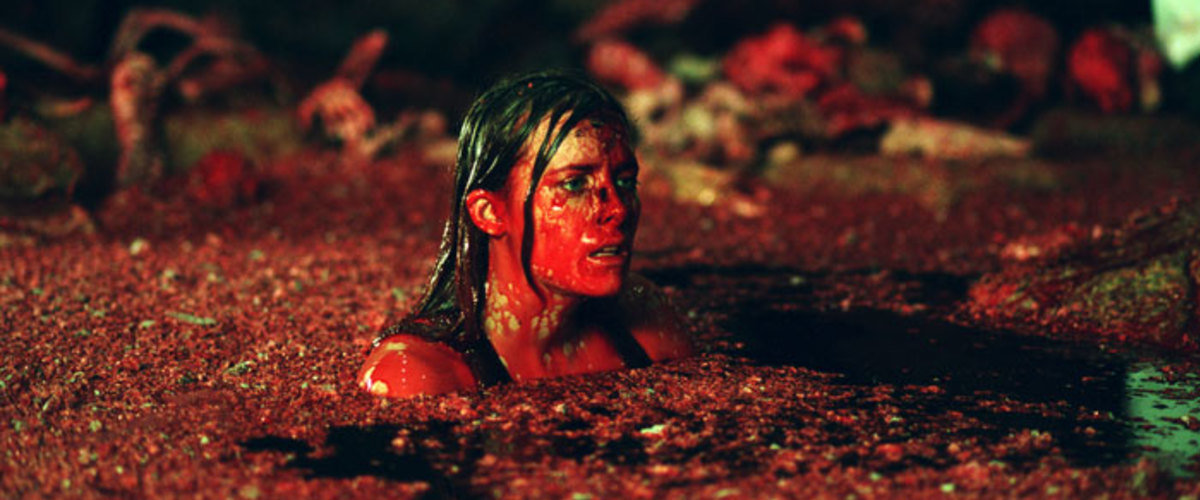
Long before the traditional horror elements start kicking in, The Descent is a surefootedly scary film. Making excellent use of its cave setting to establish a primordial sense of creepiness, the film is tense far in advance of the appearance of the beasties lurking just around the corner. The difficult spelunking we see the characters attempt could so easily be problematic on its own, and that's before we even learn that they've unknowingly gone into uncharted caverns. Early on the tension and frights derive from the hikers finding themselves up against the vagaries of their environment.
The film nicely delineates into two halves. The first portion of the film sees the characters confront the complications of their trek down into the dark abyss. But suddenly the film turns on dime and all hell breaks loose. The film's backhalf is frenetic and heart-pounding, taking the clear survival instinct of the characters displayed rigorously earlier and putting them to the test. The bizarre, bat-like creatures which live below the surface and feast on human flesh are damn freaky and unsettling on their own, but the film also uses the twisting tunnels, impenetrable darkness, and great, disturbing use of light to truly get under our skin. The film gives its Gollum-esque monsters a sense of physicality and specificity which only makes the uneasiness of the situation more palpable.
If the horror bonafide thrills weren't enough, the film actually has a fair amount of depth, pun intended. The film takes its sweet time getting around to the horror. Sarah (Shauna MacDonald) loses her daughter early in the film, and the rock climbing takes place a year later. Sarah has yet to fully recover from the incident, and her friends hope to use the outing to help her get her mind off the past. The descent down into the cave neatly acts as metaphor for Sarah going down and confronting the inner demons of her psyche and her past.
The subtext is there for anyone hoping for a bit more to their genre-fare, but it wouldn't matter nearly as much if the film weren't so thoroughly thrilling. The Descent slowly gets under your skin and refuses to get out from underneath it.
Grade: ★★★
"Blancanieves" (2013)
Blancanieves is a silent black and white re-telling of Snow White. It's a modern update, often using modern film techniques, but it still feels very traditional, drawing upon the original rendition of the story rather than more recent adaptations. The film's conception of the tale is more Brothers Grimm than Walt Disney. The film discovers dark, sinister undercurrents to the narrative; however, it does this not by making the story look and feel gritty, as many recent reboots have, but, in stead, by falling back on the stark tragedy underneath the original tale. Though it's a consciously simple story, it is one filled with deep emotion. Silent storytelling is not a gimmick here -- in fact, it's hard to imagine why anyone would use the convention anymore unless they truly believed in it. By stripping cinematic conventions to their bare-bones, the film, telling an already simple narrative, emphasizes the profundity lying just around the corner of the classic fairytale.
Carmencita's mother dies giving birth to her. Her father, a bullfighter (Daniel Giminez Cacho) badly injured in the film's opening, is snatched up by a social climbing nurse Encarna (Maribel Verdu), standing in for the evil stepmother. Carmen's father mistakes Encarna's initial kindness in restoring his health as actual affection and concern, but soon Encarna has him locked up in huge, Gothic mansion. Carmen (Sofia Oria, and later Macarena Garcia) is raised, for most of her early days, by her grandmother, yearning to be with and know her father. When her grandmother passes away, however, Carmen is forced to stay with her stepmother who treats her as an ungrateful nuisance. In due time, she reconnects with her father, to the jealous anger of Encarna. We see Carmen, at first, as a young girl, a sneaky scrapper, and later as an adult, a beautiful young woman.
It's largely by the books of the familiar, old story; even the seven dwarfs appear, as does the poison apple and the wait for true love's kiss. Yet it's how the story treats these story elements. They never feel like a means to an ends towards the film's messages (Messages and themes far weightier than the Disney version -- the cruelty of the world, the impossibility of letting go of the past). Moments play out with an engrossing love for detail in the environment, flavored with a distinctly Spanish cultural vibe.
Silent films speak a universal language. This is not an English language production, as this is a Spanish film, and yet every idea, every story beat, and every emotion conveyed reads clearly and crisply. The film is speaking in the language of pure cinema; film is a visual medium and its power, first and foremost, comes from its imagery. And what beautiful visuals Blancanieves has. This is a film precisely composed. There's a fluidity to the images and scenes; one moment passing into the next, frequently transitioning with excellent match cuts that emphasize continuity even as they note significant change. Cinematographer Kiko de la Rica creates gorgeous visuals; this is a film that is lovely to look at. At times expressionistic, at others naturalistic; at times a whimsical fairytale, at others a rebuke to those naive stories.
Grade: ★★★★
Sunday, December 1, 2013
"Young Mr. Lincoln" (1939) and Mythologizing Our History
In the first scene we get of Henry Fonda as Abraham Lincoln in John Ford's Young Mr. Lincoln, Lincoln humbly speaks before a small crowd. He's running for the legislature, and he tells them, "I'm not here to make a speech". He informs them of his political principles and lets them speak for him. But it's the manner in which Fonda delivers the monologue and his dialogue that follows that's equally as important as what he's saying. Fonda slows down his words to a Kentuckian, slow-as-molasses drawl. He punctuates breaks between lines by looking down at his feet as if he's uncomfortable in his own skin, and doesn't care much for making a big show or drawing much attention to himself.
Fonda isn't Lincoln in the film so much as he's the Lincoln we imagine the man to have been. He's the Lincoln of folk tales and high school history textbooks. This isn't the raging candor of Daniel Day-Lewis' performance in Steven Spielberg's Lincoln. The film is purposely obfuscating some of the truth about the man. To quote another Ford film, "When the legend becomes fact, print the legend". This is the aw-shucks, gee-whiz country boy who believed truth, justice, and the American way. It's the formative years of the man. He's free of wrinkles and weary signs of age. He's, in stead, a fresh, youthful idealist.
In the central story of the film, he takes on a court case for two young men accused of murder; he saves them from a lynching, and makes the town realize its civility and morality. Everyone deserves a proper trial by a jury of their peers, and Lincoln gains the moral high ground by preaching the necessity of justice. For most of the case, it seems Lincoln is defending men who are guilty, not because he agrees with their actions, but because they are only human and citizens of this great nation. But, perhaps unsurprisingly, Lincoln finds a way to win the case, and impresses everyone (Although, it's a surprisingly morally complex situation up until that impossible reversal).
Lincoln is placed on an impossibly high pedestal. He calls himself "simple"; he's a soft-spoke individual of integrity and wit. When he gets a law book, he looks at it not as a daunting task but rather with honest excitement at the potential to discover. He pauses after reading a passage that interests him, and notes how right is right, and wrong is wrong. He's so darn earnest we can tell he believes it.
The film is an act of mythologizing, but Fonda's performance is still a good one. He's pretty perfect for this version of Lincoln. Not only does he fit the part, but he almost makes us believe in the sincerity of his character. His body movement is as measured as his speech patterns; he looks like he's constantly considering his words. This is only one story of Lincoln, the legendary figure; the film ends with him walking away, probably to save some other innocent with his folksy wisdom.
Subscribe to:
Posts (Atom)