Au Hasard Balthazar begins with a highly sentimental montage about the childhood of of a handful of its prominent characters. Everything after these early scenes, however, is brutally unsentimental. Writer-director Robert Bresson goes extensively out of his way to show how innocent and naive his characters were at this age, and how much has changed since then.
Bresson uses the framing device of the life of the donkey Balthazar to weave the the various stories throughout together. Balthazar witnesses events but since he's only a donkey he takes everything in stride as a beast of burden. And this is important because he sees and experiences awful things throughout his short life; yet he never passes judgement. In deed, the film is often shot from lower angles, from the height level of Balthazar, and turns the perspective of the donkey into an objective observer of the film's story. The film is elliptical and minimalist, suggesting large information through small moments and episodes rather than a more straightforward narrative. While Bresson's style suggests an emotional distance from his story, he makes us feel deep emotion underneath the cool, objective gaze.
The film connects Balthazar with the timid Mari (Anne Wiazemsky), whose known the donkey since her childhood. Mari's quiet demeanor causes her to be misunderstood or abused by nearly every person around her. She wants to escape her her stifling life, but when her adventures away from home prove too much, she can't seem to settle down either. Balthazar, similarly, is repeatedly and needlessly beaten by individuals using his labor. Balthazar's trials abroad from the small farm also end badly, but in its own ways the farm life isn't much better. Perhaps saddest of all, Mari's only true friendship was with Balthazar, but she slowly forgets about the animal. It's an unconventional friendship but the two got something out of it for a time, but as Balthazar increasingly starts to become emblematic of a youth long since fade into memory, he too is forgotten and overlooked.
The film is unafraid to make its characters come off as terrible people, but it also forms complex characters who aren't simply good or evil. Mari represents broken innocence. She's raped early in the film, and her treatment only becomes more depressing and miserable as the film goes on. But the film doesn't treat her like a convenient symbol; she has unforgivable things done at her expense, but the film makes her a full character who has complicated and plausible reasons for being complicit in her circumstances and treatment.
Balthazar offers so much to the people he helps and they offer almost nothing in return. The film depicts him in almost religious terms. He's called a saint at one point, and his death at the film's conclusion has a Biblical quality; Balthazar lies down in green pastures amongst a shepherd and his sheep, as if Balthazar is a Christ figure. He's suffered at the expense of the sins of his various owners, and he ultimately dies due to those sins.
It's undeniably a purposely challenging film, but its accumulated, deeply affecting weight about human existence is powerful and beautiful.
Grade: ★★★★
Wednesday, November 27, 2013
Monday, November 25, 2013
Doctor Who: "The Day of the Doctor"
Very early on under the auspices of Russel T. Davies' time as showrunner of Doctor Who, it became apparent that one writer stood a cut above the rest. He didn't write a lot of episodes, but whenever he did, every Doctor Who fan began to stop and take notice. His name, as you have probably already guessed, was Steven Moffat, a long time fan of the revived cult television series. Moffat had a flare for ambitious, inventive storytelling that pushed the limits of what the show would try to do on a week-to-week basis, and many of his episodes are considered the best of the bunch of the rebooted series. His episode "Blink" is widely regarded as one of the best episodes of the show ever, not just since the revival. And it makes sense; "Blink" tests what Who is capable of; it's knotty without becoming too heady; it's playful and suspenseful, but the fun is in service of a well-told story that never loses sight of its themes or characters.
When Moffat was handed over the mantle of showrunner, it seemed like a no brainer. Give the best writer the task of making the show the best it could be. Moffat, however, increasingly took the show in a rather different direction from his predecessor. Davies liked big emotions and melodrama, emphasizing plot over character. Moffat preferred big ideas and cerebral science fiction, focusing on plot over character. Moffat's not a bad writer (in fact, I would argue that season five, the first season under his guidance, is the best of new Who), but he's a bit of one trick pony. Granted so was Davies, but his emphasis on character made you forgive him just a little bit more when he faltered. If Doctor Who has had a problem in the Moffat era, it's due to Moffat creating wildly ambitious and complex narratives. The narratives are often so self-involved and intricate that it sometimes feels like Moffat is showing off how insane and awesome he can make his stories be. And in the process he's lost a little bit of the reason the show is so good to watch. I love cool stories, but Doctor Who has always been so much more than cool stories. It's been cool stories through a very specific message about humanity, and humanity as seen through the Doctor and his current companion.
"The Day of the Doctor" felt, to an extent, like a return to form for Moffat. It's still a story filled with energetic grandeur but it's in the service of some real, well-earned emotion. Though I'm still not sure how to feel about the retconning that takes place in the episode, there is simply too much in the episode representative of what the new Doctor Who has been at its best. The Doctor has to make a difficult decision, one with large consequences and emotional and moral complexity, and he has to do it in the face of his past and the show's history. The episode draws upon the events of the Time War, the darkest material of the new series, and it uses it in order to examine who the Doctor is and why he does what he does. A fact made most poignantly when Clara, the current companion and stand-in for us and humanity at large, steps up to remind the Doctor what that truly means. Moffat is audacious in returning to events seemingly tied up for good, but he never seems to be doing it to simply shake up the waters. In stead, he reminds us why we watch the show in the first place. This is a very fun episode, starting from the team up of the three incarnations of the Doctor, including John Hurt building an entire character in such a brief amount of time. But beyond filling the episode with nifty ideas and liveliness, Moffat also puts the show in conversation with its fifty year history while creating a road map for the future.
Doctor Who is one of the few television shows which can shift quite easily between deep emotion and entertaining comfort, high concept and quiet intimacy, small premises and big ideas, silly humor and compelling philosophy. It's a small show, but darn if it doesn't have so much more to offer on the inside, and this special was proof that it still has plenty to still do and say for a long time to come. Happy 50th Anniversary Doctor Who! Here's to fifty more.
Sunday, November 24, 2013
"Ninotchka" (1939)
Ninotchka's views on Russians, the Soviet Union and communism are largely as terrible as one might expect a film produced in 1939 would be. The film presents a very simple divide between capitalism and socialism, and it inevitably favors and reaffirms American cultural values (There's also some American cultural imperialistic connotations). The later scenes set in Russia are embarrassingly stereotypical and even a bit propaghandistic.
But I'd like to offer up why all those unfortunate elements don't matter. Greta Garbo has genuine and hilarious comedic timing as Ninotchka, the stone-faced, overly rational Russian agent sent by the Soviet government to fix a botched deal to sell Russian jewels. For instance, take this scene where Ninotchka and her love interest Count Leon d'Algout (Melvyn Douglas) talk past one another:
"Your general appearance is not distasteful," Ninotchka says without a hint of irony. I can't remember the last time I laughed so hard at a single line. Ninotchka is a funny movie with a love for sharp dialogue and wit. The screenplay by Charles Brackett, Billy Wilder and Walter Reisch (based on the story by Melchior Lengyel) goes a long ways towards creating sympathetic and recognizable characters, turning stock characters into flesh and blood figures -- including Sig Ruman, Felix Bressart, and Alexander Granach as the bumbling diplomatic envoy who goes ahead of Ninchotka. And even if they're restrained by the antics of the comedy and romance of director Ernst Lubitsch's production, Lubitsch never seems to be mocking them, so much as he appears to be poking fun at human nature more generally, and the Soviet Union specifically. Lubitsch also gives the production -- with his so-called "Lubitsch Touch" -- a sense of elegance and luxuriance. The film looks gorgeous. The people, the outfits, and the locales all look gorgeous, for that matter.
But, more importantly, the film actually gives a surprisingly detailed conversation, for its time, underneath its satire of the Soviet Union, about the Soviet-American divide. People discuss the merits of both philosophies and countries (even if it's highly reductive and not the film's primary concern, and even if the film looks down on the Russian side of things). America is often enough made to look silly in its habits and ways of thinking, and through Ninotchka -- and in contrast to her rival Grand Dutchess Swana (Ina Claire) -- the film offers up the possibility of there being some worthwhile qualities to Russia -- and, possibly strangest and most interesting of all, argues in favor of the Russian monarchy's overthrow (a point made all the weirder when you consider that the film is throwing satirical jabs at the oppression of the Soviet state). The film doesn't go far enough with this, but it's hard to fault a studio comedy, whose first concern was to be funny, with failing to be completely refined in its argument. It's refined in plenty of other regards to make up for its shortcomings.
Grade: ★★★
Saturday, November 23, 2013
Divergent's Romantic Elements Do a Disservice to Its Story
**Spoilers on Veronica Roth's book Divergent below**
Veronica Roth's young adult novel Divergent, the first book in a trilogy of dystopic narratives, is essentially a coming of age story dressed up in sci-fi genre components. In the future world of Divergent, society is divided into five different factions. Each believes that some fundamental, but different, character trait will be the salvation for humanity from preventing the same sort of catastrophe that caused the world to be dystopic in the first place -- currently none are right on that account, but they still fight passionately over the issue. At the age of sixteen, the members of all factions take a test which informs them what faction they are best suited for, and soon after they use the test to determine whether they wish to stick with their faction or leave their family behind for a faction that might just better suit their personality. Abandoning one's faction is perceived as equivalent to fratricide. It's a near treasonous act, not just because you can't see your family ever again, but because of the ferocious rivalries between the factions.
This is a compelling and largely original premise. Though the assignment of singular character traits to the factions is a bit on the nose, Roth uses the scenario to ask meaningful questions about identity, family and adolescence. Beatrice, the story's protagonist, is a member of the Abnegation faction, who preach selflessness, but Beatrice has always felt herself to be a black sheep. When Beatrice chooses Dauntless, who preaches bravery, and changes her name to Tris, Roth thoughtfully explores Tris' poignant and earnest awakening. Tris begins to realize a side of herself she never was able to express under the burden of Abnegation's restrictions. Yet at the same time, being Dauntless has its own rigors and strictures that are problematic in their own right. Neither experience is perfect, and both are limiting and freeing in different but crucial ways.
It's at this point in the story where Roth drops the ball. She inserts one of the most overused elements of the coming of age story: a romance. Tris is a complex and strong enough character without needing to rely on a guy, and her circumstances are fascinating enough that they don't need romantic elements to spice it up. Why can't a female-centric story tells its narrative without it involving her falling for a man? The romance detracts from Roth plumbing the psyche of her protagonist and the implications of the world she's built up. But the romance is also just as problematic on its own terms. Four, Tris' initiation instructor, is predatory in his advances, and Tris is ultimately overwhelmed by his infatuation rather than starting from a place of real interest and reciprocating feelings. Roth robs Tris of agency. It doesn't help that Roth treats Four as if he's in his forties before backtracking much later and saying, "No, it's cool. He's eighteen. Only a two year difference". The shift from dirty old man stalking to idealized teen romance is jarring, not least of which is due to the former reading more honestly (When she gets to the second side of the romance, it's as if Roth is writing the perfect romance rather than one specific to her characters and this fictional world or the realities of young love).
It doesn't help that Roth uses Four to excessively underline the themes of the book. Tris doesn't recognize the inner strength being revealed by her circumstances? Have Four tell her repeatedly. Because obviously if the story hadn't been showing us this rather than telling us this, it was unclear. Where Roth fails most with the romance is lack of subtlety. Perhaps she doesn't trust her target audience, but it's a poor excuse. Teens will get what you're trying to get at; they can handle dark, weighty ideas and content. The book's best moments possibly come in its final chapters, where Roth ratchets up the tension and forces Tris to be witness to awful, violent experiences -- in a book that's already had plenty of unflinchingly vicious acts. A revolution, long hinted at, occurs, but rather than emphasizing the scope of the conflict, Roth wisely articulates it through intimacy. Tris reconnects with her family only to watch most of the people she care about die before her eyes while she's unable to prevent it from happening. The most compelling part of the book is Tris coming to terms with her family and who she is in regards to both her faction and her family. The romance serves neither of those.
It's not like I'm a jaded cynic who isn't won over by romance in his stories. But the romantic elements of Divergent feel like they were written for a very different story, as if Roth felt pressured to include them due to recent genre expectations. But Tris' experience is interesting for what it tells us about a young teen's struggles with and conception of the world, whether it be in Roth's dystopia or our world, which it at times reflects, and the book doesn't need to get some teen smooching on in order to achieve this. In fact, it ultimately does a major disservice to the thematic strength and insight of the narrative. The teen experience is not just about the butterflies of first romance and a more significant interest in the opposite sex, and Roth deals with those other far less considered aspects of the experience -- family, friendship, body image issues, bullying -- pretty well up until the point that the gooey, pure romantic relationship rears its ugly head.
Friday, November 22, 2013
"La Notte" (1961)
There's a certain point in relationships where you have been together with someone for so long that it becomes difficult, if not impossible, to imagine that other person not being in your life. And when you add in marriage into the equation, this magnifies tenfold. Where you might not have been willing to forgive a small lapse in a longstanding partnership, you will be much more likely to forgive and forget transgressions when married. It is not only difficult to see yourself without the other person, but you just don't want to deal with the complications and difficulties that would come if you broke things off. But the other person also knows you better than anyone else, and you them, and, when you reach older and older ages, you just don't want to have to worry about and deal with being single and unsupported. This is exactly the point in a relationship La Notte's picks up with.
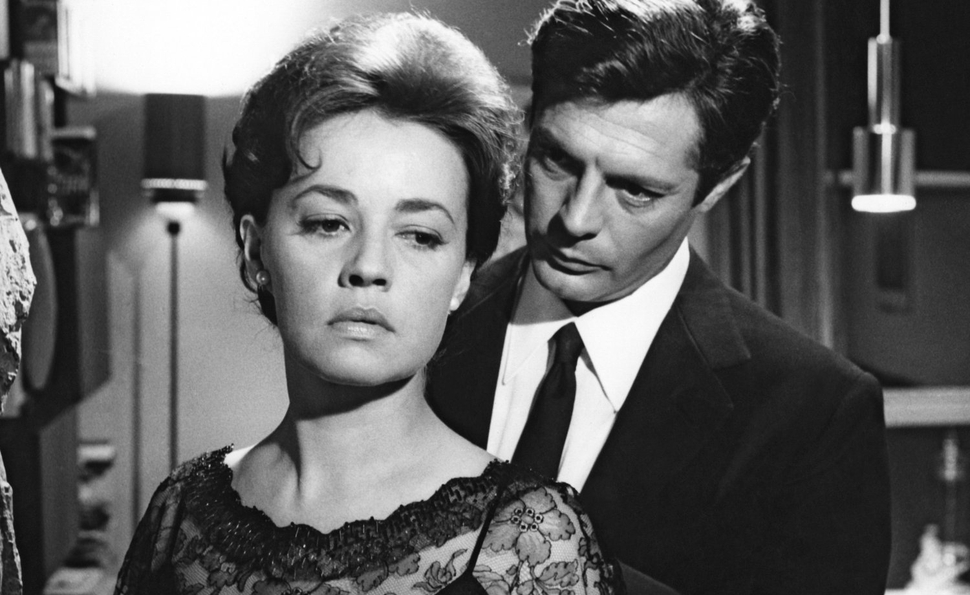
Giovanni (Marcello Mastroianni) and Lidia (Jeanne Moreau) don't love each other anymore. They tolerate one another, and they avoid the prickly subject matter of Giovanni's infidelity (which he has done on more than one occasion since the film began). They don't want to be together, but they also can't imagine not being together. Writer-director Michelangelo Antonioni purposely separates them for much of the story, as they can't seem to stand being around one other. Whenever they are together though, they're stilted and formal. Giovanni talks about only himself, and Lidia is tired of listening. Giovanni doesn't realize just how good he has it.
Cinematographer Gianni Di Venanzo emphasizes the loneliness, isolation and longing of the couple. The film is gorgeously moody. But Antonioni also trusts Moreau's face to convey the depths of her depression and unhappiness. It's a beautifully understated film, and nowhere is this more apparent than in Moreau's performance. Mastroianni's character is flashier; he's a brooding writer, trying to find muses in all the wrong places, when he should have long since been drawing inspiration from his wife.
Antonioni provides a clear-sighted and bittersweet portrait of a disaffected marriage on its last leg. The couple consistently finds themselves near or within crowds, particularly once they arrive at a party that neither wishes to be at. But both of them, for the most part, seem to be miles and miles away from those around them. Lidia offers up the suggestion that they go out and do something; it's a desperate last ditch effort to try to stir up whatever chemistry and connection exists between them. But they end up talking past one another (and that's when they're talking at all). Yet sometimes people would rather have someone to talk past, rather than no one to talk to at all. However, listening and hearing are often times very different things though. By the time Giovanni and Lidia do the latter, it's much too late.
Grade: ★★★
Wednesday, November 20, 2013
"Tie Me Up! Tie Me Down!" and the Horrors of Addiction (and Relationships)
Tie Me Up! Tie Me Down! is a film about addiction. Though it seems like a psycho-sexual drama, it often plays more like a horror film. The return of the repressed, Marina's (Victoria Abril) former heroin addiction, comes in the form of Ricky (Antonio Banderas). Ricky is obsessed with Marina, after a previous one night stand that she can't even recall, and kidnaps Marina in order to make her fall in love with him. Much of this plays out in protracted sequences where Ricky threatens Marina's life and limb if she does not cooperate with his crazed fantasy. After leaving a mental ward, Ricky sets about stalking her, like a horror villain eying his prey. Ricky believes he can will her into growing feelings for him. Through some unsettling Stockholm Syndrome, Marina begins slowly falling for her captor, embracing his disturbing sense of affection and romance. The highs and lows of Marina's twisted relationship with Ricky parallel those of her former addiction. Marina is beaten, bruised and mishandled, and yet unable to will herself to escape Ricky's clutches, as she finds herself oddly and strongly turned on by him. Granted, Ricky has a strong sexual magnetism of the Stanley Kowalski variety (He is, after all, Antonio Banderas). But it still doesn't distract from how alarming his actions are, no matter how erotically charged they may be.
The film opens itself up to be read this way by having Marina be a featured star in a horror movie. It's meant to be her big break into acting, after a career in pornography. Though she's been ostensibly exploited and objectified due to her former profession, the stigma carries with her. The aging director claims her as a muse, but his real motives appear to be getting her to desire him. But everyone in the film is strung up on some obsession or desire. Marina's sister wishes to be noticed by the director, but she is continually overlooked and never taken seriously. A journalist does interviews on the set of the horror film, only for us to discover she's done it as an excuse to "run into" an ex-boyfriend. Everyone is judging their self-worth based on their appearances or their sexual prowess. Oddly enough, Ricky never describes his interest for Marina in these terms, but it doesn't make the rest of his behavior any more tolerable.
But the film isn't using eroticism for the sake of eroticism. It's equating the power of Marina's addiction to an almost sexual control over her. "I don't know how to explain it," she tells her sister about the relationship, but that's because most people who've never had a drug addiction, or an abusive relationship, for that matter, hardly can begin to grasp what the person's experiencing. All that matters to the addict is getting the next fix; it doesn't matter how aware they are of the detrimental and destructive effects of their disease. They will pursue getting their high at any cost. Abusive relationships work in a similar regard to addiction in that people will find ways to justify or overlook their mistreatment or blame it on themselves rather than taking action against it and help themselves. It's this latter suggestion that writer-director uses for black comedic effect, pointing out the absurdity of the entire scenario. And it's ultimately through the film's humor that the unbearability of the premise becomes diffused.
Tie Me Up! Tie Me Down! feels like an incomplete film. It's unfocused, taking too long to get started up and finishing on a weirdly anticlimactic note. But there are still the nuggets of some great ideas throughout about relationships, addiction, obsession and genre.
Grade: ★★★
Saturday, November 16, 2013
"Robot & Frank" (2012)
On its face, Robot & Frank is a goofy little film about an elderly man, in the near distant future, whose estranged children give him a robot servant/companion to take care of him. The film is, for a large portion of its run-time, a buddy comedy with Frank (Frank Langella) playing straight-man to the overly rational robot (voiced by Peter Sarsgaard). But the film's playfulness, even its minor sci-fi elements (thankfully never overplayed), hide a deeper sense of longing and sadness. Frank is at the start of falling into Alzheimer's and his memory is slowly failing him, but that might be for the best, for him at least anyway, as his past doesn't appear to be something anyone on their last leg would want to dwell upon for too long. He was a terrible husband and a worse father, unsuccessfully pursuing cat burglary as a profession, at the expense of his familial ties. His relationships are now strained and his career is an unfulfilled dream. Frank is reluctant to have the robot around but he bonds with the bot, discovering his first real connection in ages, while the robot keeps reminding Frank he's not a human, even as he keeps referring to him as "friend" as if he is human. The film parallels Frank with the robot; it has the memory capacity, as well as the drive to improve Frank, that Frank so desperately needs. The story also contrasts Frank with the changing world; Frank is increasingly a relic in a digital age which makes his connection all the more amusing but also poignant. The film is funny, but its melancholic edge allows it to say meaningful things about growing old and yearning for the past. All of this leads to an ending that is surprisingly affecting but never sacrifices the film's oddball sense of humor.
Grade: ★★★
Grade: ★★★
Subscribe to:
Posts (Atom)