Monday, October 28, 2013

"Gangster Squad" (2013)

Tens Items or Less

A new writing segment, "Ten Items or Less" is an attempt to consciously cutback and restrict how much I write. I get ten sentences or less to discuss a movie. That's it. Let's see if some genius comes out of working around my self-made obstacle.  

Gangster Squad was a movie designed to make a pretty great movie trailer, but everything in between those trailer-worthy moments is some carelessly thought out padding. The film feels under-written. The characters are all uninteresting and have spelled-out-in-bold-letters clear, but far too often contradictory, motivations, and the story seems as though it's missing a few key scenes. I could go on about the missing story beats or how those story beats it does have are woefully bland -- seriously, for a movie attempting to appropriate the supposed sexiness of the Roaring Twenties, Gangster Squad is a surprisingly dull and tedious film -- or how its characters are handled by its actors pretty terribly -- Ryan Gosling and Sean Penn have some atrocious, overstated affected accents that are laughably unnecessary -- but lets get to the more, um, subtle problems to the film. The film is top-to-bottom filled with gender politics that at best overly simplified and at worst slightly offensive. Gangster Squad has a terrible representation of women, and that's when it's representing them at all; Emma Stone, in a miserably one note role, is one of two female characters. Though it has a diverser cast than most films, it still has racial stereotypes and biases -- the film has some embarrassing moments in its treatment of its sole Hispanic character. If you can make it through its plodding plot, Gangster Squad has a handful of somewhat entertaining action scenes, but you can watch the trailer and get that experience in a fraction of the time and pain.

Grade: 1.5/4 ★

Sunday, October 27, 2013

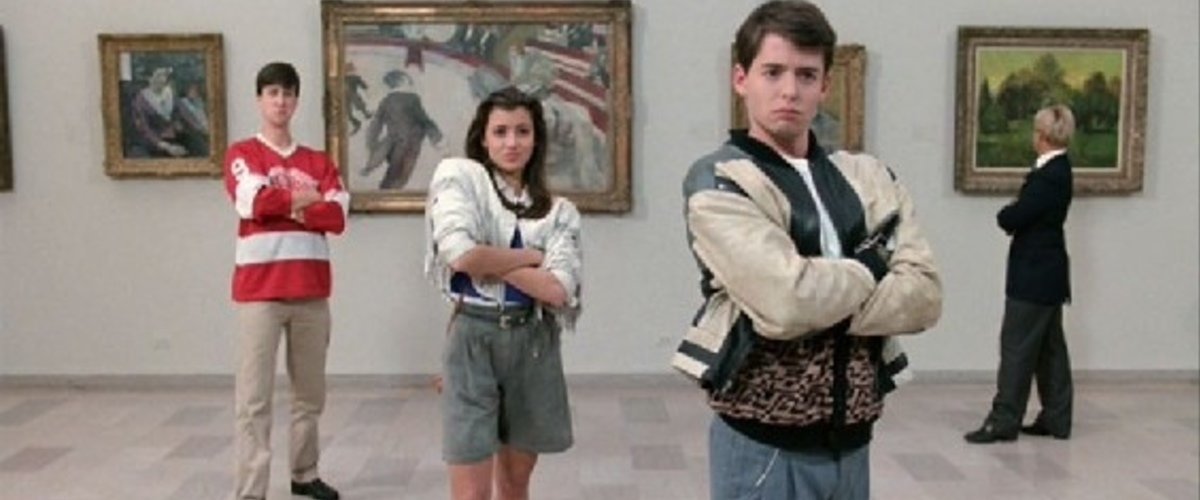
"Ferris Bueller's Day Off" (1986)

Tens Items or Less

A new writing segment, "Ten Items or Less" is an attempt to consciously cutback and restrict how much I write. I get ten sentences or less to discuss a movie. That's it. Let's see if some genius comes out of working around my self-made obstacle.  

Ferris Bueller's Day Off is one of the best teen comedies and one of writer-director John Hughes' strongest movies. It's firstly a very funny movie and it benefits from a number of spot-on casting decisions, starting with Matthew Broderick as Ferris, as well as Hughes' lighthearted but sharply focused script. Hughes' script and direction keep things moving, wasting little time with fat; Rooney (Jeffrey Jones) and Jeanie's (Jennifer Grey) screentime is brief but it gives us all we need to know about them. Beyond it's humorous moments, something not commented upon enough, is a story of three teens having one last hurrah before the end of an era. There's a dark heart at the center of Ferris Bueller hidden by its playful, occasionally silly tone and episodic gags. Ferris notes himself that he's uncertain of where he stands with Cameron (Alan Ruck) and Sloane (Mia Sara) and where they go from here once the school year is over. Ferris plays it cool because, yes, that's who he is, but also because as he tells us "life moves pretty fast" and he wants to look around for awhile while there's still a chance to. Ferris and Cameron's relationship is the heart of the story, and Cameron's journey is equally as important as Ferris'. Cameron's catharsis -- in part, a story arc about him overcoming depression -- allows Ferris to be more prepared to move on from this stage in his life. Or you can just take the film as smooth operator Ferris having an impossibly great day of hooky, either way, the film is very funny and very fun.

Grade: 3.5/4 ★★★

Friday, October 25, 2013

10 Items or Less: "The Long Goodbye" (1973)

A new writing segment, "Ten Items or Less" is an attempt to consciously cutback and restrict how much I write. I get ten sentences or less to discuss a movie. That's it. Let's see if some genius comes out of working around my self-made obstacle.  

Director Robert Altman's shaggy update to the noir genre The Long Goodbye dives headlong into the byzantine narratives, hardboiled personalities -- well, one of them anyway, in its protagonist -- and sharp dialogue that made the genre a classic staple of cinema. But he also gives it an unmistakable modern sensibility, more fitting for the 1970's. Elliott Gould as Phillip Marlowe is certainly a continuation of a long tradition of cynical detectives investigating an increasingly intricate and seedy case, but he's also a little less classically cut and a little more rough around the edges. Really this is another way to describe the film in general, which features a lot of Altman's roving camera -- including some zooms that occasionally get distracting -- and a narrative that's interested in weird quirks and digression. The Long Goodbye above all though is a really fun film with a great sense of character and dialogue and an engaging and surprising genre-bending story. There's a terrible and shocking scene that ends with the line: “Now that’s someone I love. Think what could happen to you.” And there's another unexpected moment at film's end that's a great, surprising capper. Altman wants to take what we know about this genre and shake it up.

Grade: 3.5/4★★★

Wednesday, October 23, 2013

The Walking Dead: "Infected"

In its finest moments, The Walking Dead is a show with a stark, brutal grace. The action, intensity, atmosphere and narrative come together to produce something that has a cold, morbid logic to it. Too often -- okay most of time -- the show doesn't earn this and that's why it, in part, can seem like the show is dragging its heels. But, for the most part, "Infected" was an hour of television that shows The Walking Dead at it's most clear-sighted -- give or take a few moments that dragged. It's somewhat exciting to have some action take place -- especially when it's frequently as inventive and propulsive as this -- but the further the show considers the consequences of what occurred the more disturbing it becomes.

That subplot with Carole and the two kids is not always well-executed -- it's not entirely clear what the point is and the child actors aren't always up to snuff -- but it gets to the heart of what makes the show so appealing. There is a constant sense of foreboding hanging over the show. Awful things seem to happen on this show just to remind us that, yep, this is an awful world. It's been argued that death is its own character in the show and perhaps Death is what haunts the show constantly and gives it dark, haunted quality. But it's also something more -- something, at times, the show is too glib about. The title of the first chapter of the comic book series that the show is based on -- as well as the name given to the pilot -- is "Days Gone By". And I kept considering that as I watched "Infected". The episode begins with Tyreese telling Karen about how he misses what life was like before the zombie apocalypse, and he's essentially saying what's got to be at the back of every character's mind constantly in this universe.

When characters aren't mourning life as it was when civilization was still around, they must be mourning the terrible, dreadful things they have had to struggle through in their time as survivors of a zombie world. Rick's actions so far this season -- whether we buy them or not -- are informed by the many awful things he experienced last season, which have since driven him to be a mild-mannered farmer.

A minor point I noticed that bugged me, and was well-stated by Alan Sepinwall last season, is how the show treats Rick as a character. Sepinwall noted, "'The Walking Dead' operates from the default that Rick is and always should be the one everyone else takes their cues from. And, certainly, he has a good track record, especially with the way they cleared out and claimed the prison. But other than Andrew Lincoln having top billing, there's nothing magical about Rick. He's a good man with good tactical ideas, but he has flaws ... I think it would be interesting to get a stretch of episodes where Glen really was in charge - or Carol (who's much more up to the job than we would have imagined even last season) or Maggie or Daryl". And Sepinwall was discussing this back when Rick had completely gone bonkers and was seeing weird visions of Laurie, and when it might have made logical sense for someone to be taken seriously as a new candidate for running things. The show keeps trying to force Rick back into a leadership position as if it both makes sense and is an interesting narrative direction, which I don't think in either cases it is.

What the show does get right are the moments where it embraces the brutality of this world. The girls watching their father die is heartbreaking and difficult to sit through. The moment where Rick cuts the legs of the pigs to give them up as zombie chow, and the camera briefly lingers on Rick's deeply pained face, is one of the better scenes the show has done in recent memory as well as a perfect encapsulation of how this world takes and takes until there's nothing left. Rick's expression is one of him having to give up one more damn thing -- and right after he thought things were actually looking up. The sacrifices of the world of The Walking Dead are excruciating, whether it's giving up piglets you were just giving names to yesterday or suspiciously burning bodies.

This brutality isn't enough to carry the show, but it'll do for now.

Grade: B

10 Items or Less: "The Purple Rose of Cairo" (1985)

A new writing segment, "Ten Items or Less" is an attempt to consciously cutback and restrict how much I write. I get ten sentences or less to discuss a movie. That's it. Let's see if some genius comes out of working around my self-made obstacle. 

Woody Allen's fantastical and hilarious The Purple Rose of Cairo has a charming, warm premise with a sneakily profound and thoughtful things to say about fiction and films. When mild-mannered film character Tom Baxter pops out from the titular Depression era film to court mild mannered film lover Cecilia (Mia Farrow), it creates havoc for the characters still stuck in the film, the film studio, and the real life actor who plays Tom, Gil Shepherd. The film really picks up when Jeff Daniels starts playing both Gil and Tom with Allen considering the odd implications of what's taking place to farcical and self-effacing effect, while also questioning the gap between the fiction films sell us and the harsh realities they ignore. Gordon Willis' cinematography really recaptures the Great Depression look and feel with a gloomy, color-drained design. Cecilia's life is all kinds of miserable, even for someone living during this time and place. She's a battered wife, to the obnoxious Monk (Danny Aiello), and works a terrible, minimum-wage waitress job. She gets no respect, affection or happiness anywhere she goes except when she goes to the movie theater. The film is in some ways a homage to the films of the 1930's, especially screwball comedies and the many feel good films of the era that depicted a world far, far removed from the poverty and struggles of reality.

Grade: 4/4 ★★★★

Tuesday, October 22, 2013

A Temporary Cut-Back in Writing

Unfortunately, it has officially become that time in the semester where I can no longer in good conscience continue to write about movies, at least not daily and, even more likely, not at the, already shortened, lengths that I have. I'm not sure who out there reads my reviews, even just partially, but I'm deeply appreciative all the same. I know my little blog here is very hit or miss in terms of quality -- and at times even grammar and syntax (That's what you get when you're your own editor and attempt to squeeze reviews out in between real life obligations). Writing is a time consuming process and, although I ultimately enjoy it a great deal, I just don't have time for it anymore. Watching films has been and will continue to be a very fun and very personal hobby, whether I'm writing about them or not. Hopefully I'll get the ball rolling again when I don't have to worry about other forms of writing that involve getting a grade.

How I Met Your Mother: "Knight Vision"

"Knight Vision" was possibly the worst episode so far this season (although there are other contenders, particularly "Last Time in New York"), and one of the worst episodes of recent memory in How I Met Your Mother's run. The episode really demonstrates the limitations of the story being confined to Farhamption. There's only so many stories you can tell in this location and in this time frame. And the writers can try to sugarcoat the story of Ted's ill-advised attempts with Cassie as setting up the eventual meet-up with the Mother, but it's a band-aide on flesh wound. It's a last minute story beat to salvage one of the most unmemorable, unfunny and simply bad stories this season. The story never clicks and always feels like filler. But it's the A-story, right? It's hard to tell what story is meant to be the most prominent here, but it really doesn't matters as they all felt limp.

Barney and Robin aren't an interesting or believable couple any longer and they're only together out of narrative necessity rather than plausible or satisfying reasons. The series acknowledging the strangeness of how they became a couple only serves to highlight just how weird and poorly handled their pairing has been and continues to be. When Robin and Barney get all cutesy and talk about how they love the messiness of the story, it rang very, very false. To have the reverend die immediately after only pointed out how awful this couple is and how unlikable they've increasingly become. This was an episode that tried to examine the problems inherent to this pairing and only served to make the pairing feel all the more desperate and destructive.

The episode isn't devoid of amusing moments but they're few and far between, and they almost always seem to trump the story and characters. Hearing Sherri Shepherd dub Lily's voice is initially quite funny (although it wears its welcome quickly) as is having characters pretend to be other characters in flashbacks (particularly Marshall as Barney re-enacting Ted meeting Robin), but these fleeting moments aren't enough to save an episode that feels scattered and uninspired.

Give us more of the Mother. The brightest part of the season thus far has been the welcome entrance of Cristen Milioti, and yet she has only appeared in one episode, despite having been elevated to the status of series regular. Nothing has felt quite as funny or emotionally satisfying as Milioti's screentime.

Grade: C