In its finest moments, The Walking Dead is a show with a stark, brutal grace. The action, intensity, atmosphere and narrative come together to produce something that has a cold, morbid logic to it. Too often -- okay most of time -- the show doesn't earn this and that's why it, in part, can seem like the show is dragging its heels. But, for the most part, "Infected" was an hour of television that shows The Walking Dead at it's most clear-sighted -- give or take a few moments that dragged. It's somewhat exciting to have some action take place -- especially when it's frequently as inventive and propulsive as this -- but the further the show considers the consequences of what occurred the more disturbing it becomes.
That subplot with Carole and the two kids is not always well-executed -- it's not entirely clear what the point is and the child actors aren't always up to snuff -- but it gets to the heart of what makes the show so appealing. There is a constant sense of foreboding hanging over the show. Awful things seem to happen on this show just to remind us that, yep, this is an awful world. It's been argued that death is its own character in the show and perhaps Death is what haunts the show constantly and gives it dark, haunted quality. But it's also something more -- something, at times, the show is too glib about. The title of the first chapter of the comic book series that the show is based on -- as well as the name given to the pilot -- is "Days Gone By". And I kept considering that as I watched "Infected". The episode begins with Tyreese telling Karen about how he misses what life was like before the zombie apocalypse, and he's essentially saying what's got to be at the back of every character's mind constantly in this universe.
When characters aren't mourning life as it was when civilization was still around, they must be mourning the terrible, dreadful things they have had to struggle through in their time as survivors of a zombie world. Rick's actions so far this season -- whether we buy them or not -- are informed by the many awful things he experienced last season, which have since driven him to be a mild-mannered farmer.
A minor point I noticed that bugged me, and was well-stated by Alan Sepinwall last season, is how the show treats Rick as a character. Sepinwall noted, "'The Walking Dead' operates from the default that
Rick is and always should be the one everyone else takes their cues from. And,
certainly, he has a good track record, especially with the way they cleared out
and claimed the prison. But other than Andrew Lincoln having top billing,
there's nothing magical about Rick. He's a good man with good tactical ideas,
but he has flaws ... I think it would be interesting to get
a stretch of episodes where Glen really was in charge - or Carol (who's much
more up to the job than we would have imagined even last season) or Maggie or
Daryl". And Sepinwall was discussing this back when Rick had completely gone bonkers and was seeing weird visions of Laurie, and when it might have made logical sense for someone to be taken seriously as a new candidate for running things. The show keeps trying to force Rick back into a leadership position as if it both makes sense and is an interesting narrative direction, which I don't think in either cases it is.
What the show does get right are the moments where it embraces the brutality of this world. The girls watching their father die is heartbreaking and difficult to sit through. The moment where Rick cuts the legs of the pigs to give them up as zombie chow, and the camera briefly lingers on Rick's deeply pained face, is one of the better scenes the show has done in recent memory as well as a perfect encapsulation of how this world takes and takes until there's nothing left. Rick's expression is one of him having to give up one more damn thing -- and right after he thought things were actually looking up. The sacrifices of the world of The Walking Dead are excruciating, whether it's giving up piglets you were just giving names to yesterday or suspiciously burning bodies.
This brutality isn't enough to carry the show, but it'll do for now.
Grade: B
Wednesday, October 23, 2013
10 Items or Less: "The Purple Rose of Cairo" (1985)
A new writing segment, "Ten Items or Less" is an attempt to consciously cutback and restrict how much I write. I get ten sentences or less to discuss a movie. That's it. Let's see if some genius comes out of working around my self-made obstacle.
Woody Allen's fantastical and hilarious The Purple Rose of Cairo has a charming, warm premise with a sneakily profound and thoughtful things to say about fiction and films. When mild-mannered film character Tom Baxter pops out from the titular Depression era film to court mild mannered film lover Cecilia (Mia Farrow), it creates havoc for the characters still stuck in the film, the film studio, and the real life actor who plays Tom, Gil Shepherd. The film really picks up when Jeff Daniels starts playing both Gil and Tom with Allen considering the odd implications of what's taking place to farcical and self-effacing effect, while also questioning the gap between the fiction films sell us and the harsh realities they ignore. Gordon Willis' cinematography really recaptures the Great Depression look and feel with a gloomy, color-drained design. Cecilia's life is all kinds of miserable, even for someone living during this time and place. She's a battered wife, to the obnoxious Monk (Danny Aiello), and works a terrible, minimum-wage waitress job. She gets no respect, affection or happiness anywhere she goes except when she goes to the movie theater. The film is in some ways a homage to the films of the 1930's, especially screwball comedies and the many feel good films of the era that depicted a world far, far removed from the poverty and struggles of reality.
Grade: 4/4 ★★★★
Tuesday, October 22, 2013
A Temporary Cut-Back in Writing
Unfortunately, it has officially become that time in the semester where I can no longer in good conscience continue to write about movies, at least not daily and, even more likely, not at the, already shortened, lengths that I have. I'm not sure who out there reads my reviews, even just partially, but I'm deeply appreciative all the same. I know my little blog here is very hit or miss in terms of quality -- and at times even grammar and syntax (That's what you get when you're your own editor and attempt to squeeze reviews out in between real life obligations). Writing is a time consuming process and, although I ultimately enjoy it a great deal, I just don't have time for it anymore. Watching films has been and will continue to be a very fun and very personal hobby, whether I'm writing about them or not. Hopefully I'll get the ball rolling again when I don't have to worry about other forms of writing that involve getting a grade.
How I Met Your Mother: "Knight Vision"
"Knight Vision" was possibly the worst episode so far this season (although there are other contenders, particularly "Last Time in New York"), and one of the worst episodes of recent memory in How I Met Your Mother's run. The episode really demonstrates the limitations of the story being confined to Farhamption. There's only so many stories you can tell in this location and in this time frame. And the writers can try to sugarcoat the story of Ted's ill-advised attempts with Cassie as setting up the eventual meet-up with the Mother, but it's a band-aide on flesh wound. It's a last minute story beat to salvage one of the most unmemorable, unfunny and simply bad stories this season. The story never clicks and always feels like filler. But it's the A-story, right? It's hard to tell what story is meant to be the most prominent here, but it really doesn't matters as they all felt limp.
Barney and Robin aren't an interesting or believable couple any longer and they're only together out of narrative necessity rather than plausible or satisfying reasons. The series acknowledging the strangeness of how they became a couple only serves to highlight just how weird and poorly handled their pairing has been and continues to be. When Robin and Barney get all cutesy and talk about how they love the messiness of the story, it rang very, very false. To have the reverend die immediately after only pointed out how awful this couple is and how unlikable they've increasingly become. This was an episode that tried to examine the problems inherent to this pairing and only served to make the pairing feel all the more desperate and destructive.
The episode isn't devoid of amusing moments but they're few and far between, and they almost always seem to trump the story and characters. Hearing Sherri Shepherd dub Lily's voice is initially quite funny (although it wears its welcome quickly) as is having characters pretend to be other characters in flashbacks (particularly Marshall as Barney re-enacting Ted meeting Robin), but these fleeting moments aren't enough to save an episode that feels scattered and uninspired.
Give us more of the Mother. The brightest part of the season thus far has been the welcome entrance of Cristen Milioti, and yet she has only appeared in one episode, despite having been elevated to the status of series regular. Nothing has felt quite as funny or emotionally satisfying as Milioti's screentime.
Grade: C
Monday, October 21, 2013
"An American Werewolf in London" (1981)
Horror and comedy sit oddly side by side in An American Werewolf in London. It's a delicate balancing act between both, at times hilarious and at others scary -- thanks in part to makeup artist Rick Bakers' great special effects. The film is framed by its cynicism of human nature. American hitchhikers David (David Naughton) and Jack (Griffin Dunne), backpacking through rural Norther England, stumble upon a small quaint village. The village is the home to a dark conspiratorial secret, that it's safe you probably already guessed is a werewolf problem. The villagers briskly and brusquely send the two young men on their way. However, they soon have a crisis of conscience and attempt to save the Americans from the werewolf, managing only to stop David from dying, but still badly wounded. The town covers up the incident and blames it on a "mad man", which doctors and the police buy with a strange matter of fact ease that almost could only exist in a horror film -- the film at times is parodying the genre it situates itself in. From there the film uses a dark and dry comedy that recognizes the bleakness that inevitably would be part of becoming a werewolf. There is a perverse quirkiness to the film, especially in its treatment of its horror designs. The surviving American David begins having haunting visions, including witnessing the rotting corpse of his dead friend Jack who informs him that until David dies Jack will remain in limbo between life and death, giving David's new lycanthrope form even more troubling consequences than the potential eviscerating of unsuspecting Londoners. This inevitable preying upon innocents happens with total devastation; the werewolf scenes are filled with tons of gore that's simultaneously dismal and rather funny. The film has a visually laidback and deadpan style, fitting for the sarcastic humor underlying the more conventional narrative at hand. But even the cheerier, familiar elements feel like more of the same cynicism -- such as the romance with a British nurse (Jenny Agutter), which, surprisingly for a film about a werewolf, is its most implausible aspect.
Grade: 3/4 ★★★
Grade: 3/4 ★★★
Sunday, October 20, 2013
"Pierrot Le Fou" (1965)
The criminals in Jean-Luc Godard's Pierrot Le Fou feel as though they've seen a few too many gangster movies, and they're self-consciously adopting the posturing of the wisecracking and hardboiled personalities that inhabit so much of the crime genre. Pierrot Le Fou is not always the playful movie that it's so often described as; it's heavily intellectualized and Godard is sorting through some weird, nagging obsessions that only feel like half-formed ideas. Interspersed between its more typical genre based moments are cuts to, among other things, classical artwork, snippets of incomprehensible journal entries, and fragmentary voice-overs. But even the genre elements are reflexively attempting to undermine our expectations. Jean Paul Belmondo's Ferdinand leaves his stifling marriage and goes on the run with his intriguing and mysterious mistress (Anna Karina). The criminal couple quickly demonstrate an inability to truly function as criminals. They literally burn through their money in a car explosion, trying to fake their death. Their efforts to be inconspicuous only make them all the more visible criminals on the lam. When they go into hiding at a beach cottage, they soon become bored. They're attempting to make their lives match the Hollywood movies and novels that they hold so dear. But there's a slice of life quality to much of their escapades with Godard showing all the tiny details of what actual gangsters on the run would be like. They inevitably are at each other's throats as two people who are only in it for the thrill of it and who miscalculate attraction as true connection. But Godard turns much of this into a piece of comical absurdity (The ending feels like live-action Looney Toons). Stylistically cinematographer Raoul Coutard puts a strong emphasis on making the film brightly stand out like a piece of pop art. And the film is in some ways a piece of pop art in its own right, commenting on society, culture and consumerism with sardonic wit and morbid cynicism. The social and political commentary is strong right out of the gate with Ferdinand getting bored at party where the guest can only find interest in talking about consumer products. And it's possibly even more memorably and bizarrely depicted when the couple dress up like an American soldier and a Vietnamese civilian in a bit of play acting for actual American military personnel. Pierrot Le Fou has an anarchic and sketch-like nature. It comes in fits and starts, and there are just as many moments that ring as weird and questionable -- even highly unnecessary and indulgent -- as there are ones that are hilarious and whimsical.
Roger Ebert wrote about the film back in 1966, "So let this be a warning: You probably won't like 'Pierrot le Fou.' One of Godard's films, seen by itself, can be a frustrating and puzzling experience. But when you begin to get into his universe, when you've seen a lot of Godard, you find yourself liking him more and more. One day something clicks, and Godard comes together. And then, perhaps, you decide that if he is not the greatest living director he is certainly the most audacious, the most experimental, the one who understands best how movies work." Much of this remains true of Godard. His films don't seem nearly as iconoclastic because he, and so many others of the French New Wave, made iconoclasm a more appropriate form of filmmaking and because his iconoclasm feels less fresh in some of his films than it did upon its release. Now that postmodern awareness seems more stilted and at times too temperamental. Pierrot Le Fou tosses around a lot of, sometimes interesting, ideas from an ideologue and now they can feel like the random, caustic mutterings of someone who wasn't entirely certain how to bring together the ideas overflowing from his twisted mind.
Grade: 3/4 ★★★
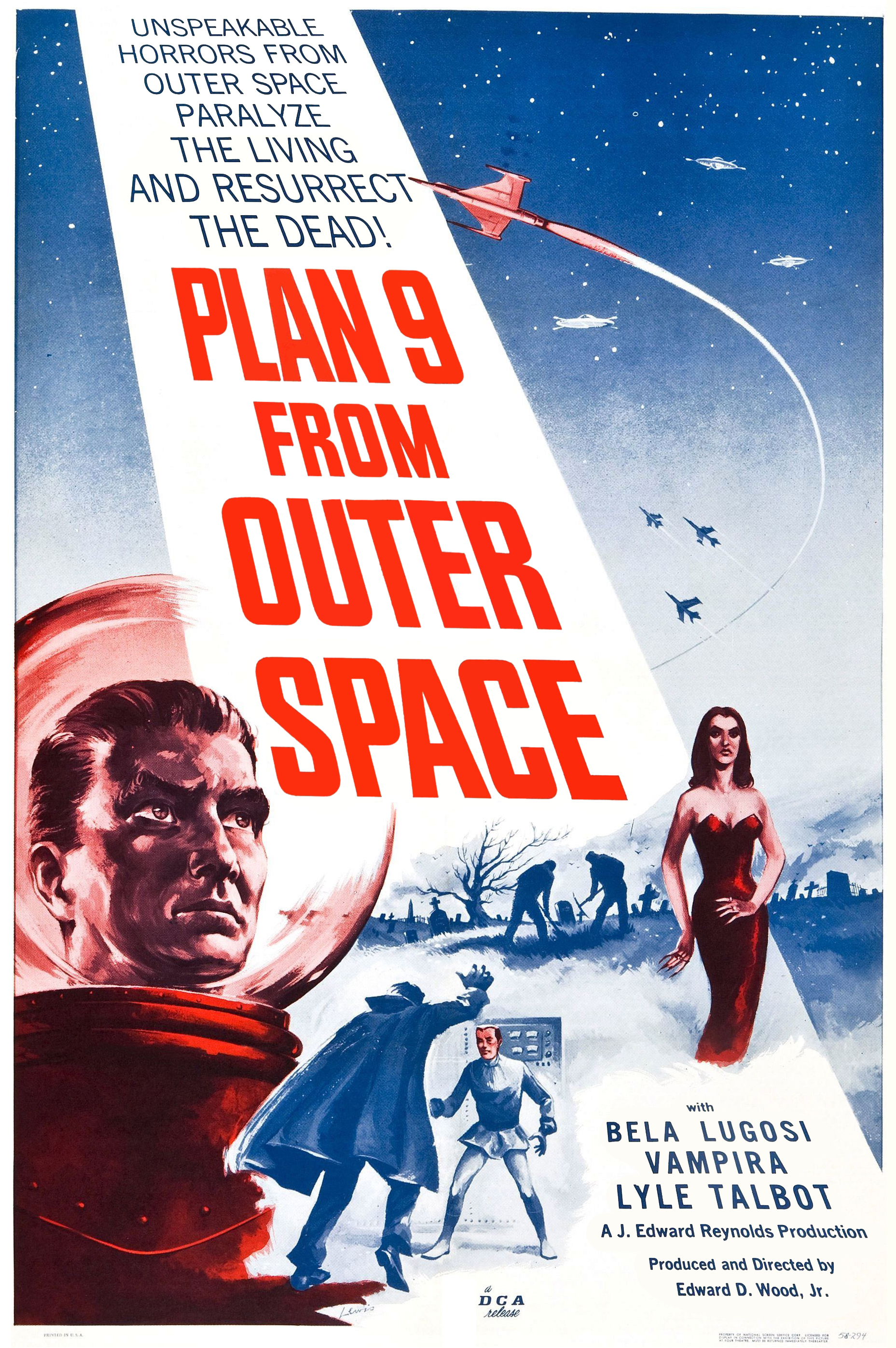
"Plan 9 From Outer Space" (1959)
There are likely much more disastrous and ill-conceived films than Plan 9 From Outer Space, but in the conversation about the "worst movie ever made" -- an honestly arbitrary label -- Plan 9 is often claimed to be the worst of the worst; sometimes even getting regarded as the "Citizen Kane of Bad Movies" (heck, the DVD back-cover proudly declares it). And to be sure, Plan 9 is a very, very, very bad movies, but we only talk about it being bad because it's since become a staple of classic cult cinema. We watch it because it's bad; because its bad elements ultimately make for a movie that is weirdly entertaining to watch. Plan 9 is one of those movies that helped define the idea of "so bad its good" cinema. This is ineptitude at its endearingly finest. I take a cue from critic Scott Tobias here in his own discussion of bad cinema, "The real 'worst film ever made' isn't anything you would ever want
to watch". Film obsessives often actively seek out works like Ed Wood's stunningly incompetent Plan 9 because they actually have a weird, perverse value to them that a film that was just purely bad would not. Plan 9 is certainly bad but if it were merely just bad and had no, um, redeeming qualities, well, then there would be little reason to partake in watching it. Tobias notes that the film has a sense of narrative ambition. There's clearly a story and, even with its Swiss cheese plot holes, gaps in story beats, and the general questionableness of the narrative, it's not entirely hard to follow. There's definitely times where you'll have to ask yourself, "Wait, what just happened?" But it's more due to poor execution and Wood's terrible script than for wont of a story, even if the story is absolutely wanting. The execution is a huge part of the problem; there's a major gap between Wood's vision and the presentation of that vision. He doesn't have that large of a budget and he doesn't do a great job to work around his budgetary constraints or to hide them. UFO's are very apparently hanging from strings, gravestones get knocked over by actors, it's daytime in one shot and night in the next, boom mics appear in frame, actors are obviously reading from scripts, and stock footage, and footage in general, is reused over and over again. Because of this the story's premise seems even more laughable and ludicrous than it already is. Simply put, aliens are raising an army of zombies to kill humanity. There's more weird, and very unnecessary, quirks and specifics to it but they largely don't matter and discovering them only adds to the fun of the film, watching it struggle to tell a bizarre story that only gets more muddled and self-serving as it goes along. The funniest part to me though is the countless clunky lines of the film, which are equally poorly delivered to hilarious effect. When you open on a line such as, "Greetings, my friend. We are all interested in the future, for that is where you and I are going to spend the rest of our lives. And remember my friend, future events such as these will affect you in the future," and the line is provided with total seriousness and gravitas, well, you know you're in for something. That something is a well-worn contender for the title of the worst movie ever, but whether it is or isn't doesn't matter. There's a lot of amusement to be found in the poorly handled and conceived science fiction turkey.
Subscribe to:
Posts (Atom)