Monday, October 21, 2013

"An American Werewolf in London" (1981)

 
Horror and comedy sit oddly side by side in An American Werewolf in London. It's a delicate balancing act between both, at times hilarious and at others scary -- thanks in part to makeup artist Rick Bakers' great special effects.  The film is framed by its cynicism of human nature. American hitchhikers David (David Naughton) and Jack (Griffin Dunne), backpacking through rural Norther England, stumble upon a small quaint village. The village is the home to a dark conspiratorial secret, that it's safe you probably already guessed is a werewolf problem. The villagers briskly and brusquely send the two young men on their way. However, they soon have a crisis of conscience and attempt to save the Americans from the werewolf, managing only to stop David from dying, but still badly wounded. The town covers up the incident and blames it on a "mad man", which doctors and the police buy with a strange matter of fact ease that almost could only exist in a horror film -- the film at times is parodying the genre it situates itself in. From there the film uses a dark and dry comedy that recognizes the bleakness that inevitably would be part of becoming a werewolf. There is a perverse quirkiness to the film, especially in its treatment of its horror designs. The surviving American David begins having haunting visions, including witnessing the rotting corpse of his dead friend Jack who informs him that until David dies Jack will remain in limbo between life and death, giving David's new lycanthrope form even more troubling consequences than the potential eviscerating of unsuspecting Londoners. This inevitable preying upon innocents happens with total devastation; the werewolf scenes are filled with tons of gore that's simultaneously dismal and rather funny. The film has a visually laidback and deadpan style, fitting for the sarcastic humor underlying the more conventional narrative at hand. But even the cheerier, familiar elements feel like more of the same cynicism -- such as the romance with a British nurse (Jenny Agutter), which, surprisingly for a film about a werewolf, is its most implausible aspect.

Grade: 3/4 ★★★

Sunday, October 20, 2013

"Pierrot Le Fou" (1965)

The criminals in Jean-Luc Godard's Pierrot Le Fou feel as though they've seen a few too many gangster movies, and they're self-consciously adopting the posturing of the wisecracking and hardboiled personalities that inhabit so much of the crime genre. Pierrot Le Fou is not always the playful movie that it's so often described as; it's heavily intellectualized and Godard is sorting through some weird, nagging obsessions that only feel like half-formed ideas. Interspersed between its more typical genre based moments are cuts to, among other things, classical artwork, snippets of incomprehensible journal entries, and fragmentary voice-overs. But even the genre elements are reflexively attempting to undermine our expectations. Jean Paul Belmondo's Ferdinand leaves his stifling marriage and goes on the run with his intriguing and mysterious mistress (Anna Karina). The criminal couple quickly demonstrate an inability to truly function as criminals. They literally burn through their money in a car explosion, trying to fake their death. Their efforts to be inconspicuous only make them all the more visible criminals on the lam. When they go into hiding at a beach cottage, they soon become bored. They're attempting to make their lives match the Hollywood movies and novels that they hold so dear. But there's a slice of life quality to much of their escapades with Godard showing all the tiny details of what actual gangsters on the run would be like. They inevitably are at each other's throats as two people who are only in it for the thrill of it and who miscalculate attraction as true connection. But Godard turns much of this into a piece of comical absurdity (The ending feels like live-action Looney Toons). Stylistically cinematographer Raoul Coutard puts a strong emphasis on making the film brightly stand out like a piece of pop art. And the film is in some ways a piece of pop art in its own right, commenting on society, culture and consumerism with sardonic wit and morbid cynicism. The social and political commentary is strong right out of the gate with Ferdinand getting bored at party where the guest can only find interest in talking about consumer products. And it's possibly even more memorably and bizarrely depicted when the couple dress up like an American soldier and a Vietnamese civilian in a bit of play acting for actual American military personnel. Pierrot Le Fou has an anarchic and sketch-like nature. It comes in fits and starts, and there are just as many moments that ring as weird and questionable -- even highly unnecessary and indulgent -- as there are ones that are hilarious and whimsical.

Roger Ebert wrote about the film back in 1966, "So let this be a warning: You probably won't like 'Pierrot le Fou.' One of Godard's films, seen by itself, can be a frustrating and puzzling experience. But when you begin to get into his universe, when you've seen a lot of Godard, you find yourself liking him more and more. One day something clicks, and Godard comes together. And then, perhaps, you decide that if he is not the greatest living director he is certainly the most audacious, the most experimental, the one who understands best how movies work." Much of this remains true of Godard. His films don't seem nearly as iconoclastic because he, and so many others of the French New Wave, made iconoclasm a more appropriate form of filmmaking and because his iconoclasm feels less fresh in some of his films than it did upon its release. Now that postmodern awareness seems more stilted and at times too temperamental. Pierrot Le Fou tosses around a lot of, sometimes interesting, ideas from an ideologue and now they can feel like the random, caustic mutterings of someone who wasn't entirely certain how to bring together the ideas overflowing from his twisted mind.

Grade: 3/4 ★★★

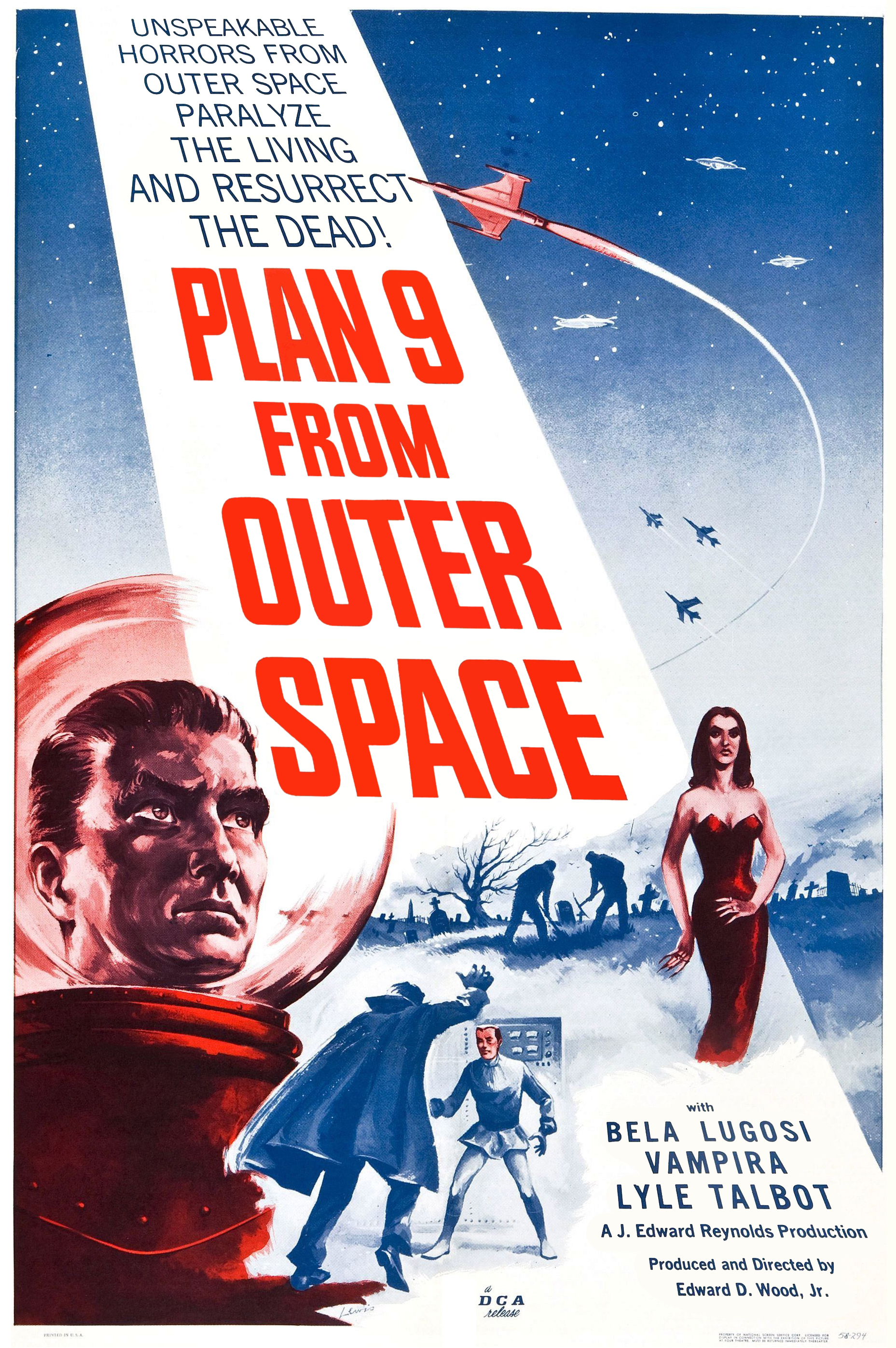
"Plan 9 From Outer Space" (1959)

There are likely much more disastrous and ill-conceived films than Plan 9 From Outer Space, but in the conversation about the "worst movie ever made" -- an honestly arbitrary label -- Plan 9 is often claimed to be the worst of the worst; sometimes even getting regarded as the "Citizen Kane of Bad Movies" (heck, the DVD back-cover proudly declares it). And to be sure, Plan 9 is a very, very, very bad movies, but we only talk about it being bad because it's since become a staple of classic cult cinema. We watch it because it's bad; because its bad elements ultimately make for a movie that is weirdly entertaining to watch. Plan 9 is one of those movies that helped define the idea of "so bad its good" cinema. This is ineptitude at its endearingly finest. I take a cue from critic Scott Tobias here in his own discussion of bad cinema, "The real 'worst film ever made' isn't anything you would ever want to watch". Film obsessives often actively seek out works like Ed Wood's stunningly incompetent Plan 9 because they actually have a weird, perverse value to them that a film that was just purely bad would not. Plan 9 is certainly bad but if it were merely just bad and had no, um, redeeming qualities, well, then there would be little reason to partake in watching it. Tobias notes that the film has a sense of narrative ambition. There's clearly a story and, even with its Swiss cheese plot holes, gaps in story beats, and the general questionableness of the narrative, it's not entirely hard to follow. There's definitely times where you'll have to ask yourself, "Wait, what just happened?" But it's more due to poor execution and Wood's terrible script than for wont of a story, even if the story is absolutely wanting. The execution is a huge part of the problem; there's a major gap between Wood's vision and the presentation of that vision. He doesn't have that large of a budget and he doesn't do a great job to work around his budgetary constraints or to hide them. UFO's are very apparently hanging from strings, gravestones get knocked over by actors, it's daytime in one shot and night in the next, boom mics appear in frame, actors are obviously reading from scripts, and stock footage, and footage in general, is reused over and over again. Because of this the story's premise seems even more laughable and ludicrous than it already is. Simply put, aliens are raising an army of zombies to kill humanity. There's more weird, and very unnecessary, quirks and specifics to it but they largely don't matter and discovering them only adds to the fun of the film, watching it struggle to tell a bizarre story that only gets more muddled and self-serving as it goes along. The funniest part to me though is the countless clunky lines of the film, which are equally poorly delivered to hilarious effect. When you open on a line such as, "Greetings, my friend. We are all interested in the future, for that is where you and I are going to spend the rest of our lives. And remember my friend, future events such as these will affect you in the future," and the line is provided with total seriousness and gravitas, well, you know you're in for something. That something is a well-worn contender for the title of the worst movie ever, but whether it is or isn't doesn't matter. There's a lot of amusement to be found in the poorly handled and conceived science fiction turkey.

Saturday, October 19, 2013

"Apollo 18" (2011)

Apollo 18 is as conceptually ill-thought out as it is poorly executed. The film is a found footage film about a conspiratorial cover up of a botched, secret NASA lunar space launch. Not only is the found footage genre ill-equipped for advancing such a story, but the found footage concept is awfully handled and utilized at nearly every turn. The film is filled with distortions and impossible filmed moments that only pile onto the questionable nature of a story that is already highly implausible to begin with. When the film isn't being utterly ridiculous, it's being surprisingly boring. For a film with a lurid, crazy premise, Apollo 18 is all sorts of not fun. Unevenly paced, and even more problematically plotted, with characters that have no other discernible character traits besides macho and ruggedly heroic, the screenplay is full of gems on not what to do to tell a story. The simplicity of the characters isn't even effectively used for baiting them as victims of the strange extraterrestrial phenomenon occurring on the moon and that provides the film its horror elements. The horror elements are the film's most interesting moments but they're few and far between, ill-timed and haphazardly executed. Apollo 18 is more of a science fiction premise with an underlying horrific suggestion, but the true horror comes from how the astronauts' superior officers back on Earth respond to these inquiries and troubles, signing their death sentences with bureaucratic and covert self-preservation. It's truly the film's most unsettling moment but the film has already long since given up on any semblance of depth so it hardly matters.

Grade: .5/4 

Thursday, October 17, 2013

"Martin" (1977)

Martin is writer-director George A. Romero's modern re-imagination of the vampire story. Romero's first decision to move away from the romanticism and myth is to strip the vampirism down to its most basic components: blood lust and agelessness. What remains is a self-loathing, awkward loner -- potentially literally as Romero leaves it ambiguous as to whether Martin is actually a vampire or if it's all in his head. Troubled teen Martin (John Amplas) says he's 84 years old but his urges are familiar for anyone just on the cusp of adulthood -- his sexual confusion is both pubescent and psychotic. Romero takes the underlying sexuality always inherent to vampires and emphasizes it to its extreme. Martin's desire for blood is highly sexualized, even eroticized. The first scene of the film gives us a good sense of both Martin's tactics and his lust. Martin hasn't entirely accepted drawing blood from people or the cost of human life it entails. He injects his victims with a drug that knocks them unconscious so they don't feel any pain. It's a humane act but everything else about the scene uncomfortably reads as an act of sexual violence. There's a date rape connotation underneath giving the drug -- an idea that gains greater plausibility when you factor in the fact that Martin only pursues female victims. As if the sexual undercurrents weren't already strong enough, Martin outright acknowledges his weird associations of his vampiric acts with his sexual uncertainty and impotence. He has trouble having actual sex and so drawing blood stands in for actual sexual gratification. Romero goes further to establish Martin as a film indebted to vampire lore while also reinterpreting it. Black and white flashbacks to Martin's first vampiric attack re-call older vampire cinema, especially Dracula (a disc-jockey mockingly calls Martin "Count" on a late night horror-fest program), and the juxtaposition with the present shows how distant from those types of narratives Martin is. Romero wants to complicate what the realities of being an immortal being with such desires would be like, as well as to update them to a modern setting, in this case the decaying city of Pittsburgh (As to be expected from Romero, there's some minor social commentary about the 1970's going on here). In a painful scene, Martin botches a job, failing to account for the appearance of other people, and the scene turns into a drawn-out, protracted home invasion where Martin has to violate his own skewed moral code to survive. Romero pulls us back and forth on our sympathies; Martin is well-meaning and naive even as he's violent and sociopathic. But what else would you expect from a guy who's been living as a teen for nearly a century?

Grade: 3.5/4 ★★★

Wednesday, October 16, 2013

"Meatballs" (1979)

There's an argument to be made that Meatballs is the quintessential camp movie. When you watch it now, it feels like you've seen all this before. Kids stuck at a woodsy, summer sleepaway camp with minimal supervision; it's a familiar premise that flourished in the 1980's and Meatballs was one of the first to do it, and competently under the steadied guidance of writer Harold Ramis and director Ivan Reitman -- in the first of what would prove to be a series of comedic team ups with star Bill Murray. Much of the plot is lumpy and loose, but Reitman keeps the story humming along so you never have a chance to really pull it apart. It's simple and contrived but it's also fun and charming if not a little too lightweight. These characters feel like archetypes, and, true enough, they never get fleshed out, but they serve their necessary purpose; the nerd; the chubby kid; the hot chick; the jock; the misunderstood kid. There are multiple stories that get played out but most of them are forgettable, entertaining in the moment but not especially memorable. There's a number of romances and courtships that we keep popping in on. A number of pranks are played, largely on the camp director Morty. There's an underdog competition with the pompous upscale Camp Mohawk just on the opposite side of the lake which, of course, ends with a win being rallied for. The best part of the film is Murray, in his first starring role, as goofball counselor Tripper. It's a great meeting of material and performance; Murray's personality and mannerisms are so well-suited for the role that it's hard to imagine anyone else in it. He's clearly improvising dialogue here and it makes for the right dose of anarchy added into the mix of the routine story. Tripper has a really sweet relationship with a camper (Chris Makepeace) who he takes under his wing and helps comes out of his shell. Meatballs has an odd sincerity though. There's a nostalgia for this environment and this time in people's lives, and it gets the summer camp vibe down just about perfectly.

Grade: 2.5/4 ★★

Tuesday, October 15, 2013

How I Met Your Mother: "The Poker Game"

Well, that was more like it. This wasn't a perfect episode but the B-plot of "The Poker Game" about Ted forgetting a wedding gift for Marshall and Lily was classic How I Met Your Mother. The show has always been good at one particular joke: time jumping, telling a story once before re-telling that story from a different perspective to see the story in a different context. When Ted recounts his side of the story and we revisit events, it felt like the kind of jokes the series was managing at its peak capacity.

The main plot about Barney, his family and Robin was more problematic. If you're still invested in Barney and Robin perhaps this story would be meaningful to you, but otherwise this felt like more of the same we've already seen from them without actually learning anything new or worthwhile. It's not an entirely dead story. In fact, the episode's funniest moment comes due to it when the many poker players pop out from various corners of the hotel room after Barney leaves. That was the goofy side of HIMYM at its finest, turning farcical theatricality into its advantage. Even the reappearance of Frances Conroy as Barney's mother Loretta was a welcome sight and she got in some wicked jokes.

HIMYM has so much history to draw upon at this point and I want it to use what we know about its characters and their lives, and by the same token what we don't know, to make both meaningful commentary, poignant juxtapositions and humorous callbacks and jokes (Note the little wonderful details in the flashbacks such as Lily's changing hairstyles or the appearance of the Slutty Pumpkin in the background. Continuity nerds should be very pleased). HIMYM has that power at its disposal. It has always done the previously stated things since its very beginning and it should be able to do it with even stronger emotional meaning and acuity. That it hasn't recently is one of the show's biggest shortcomings. Here was the an example of that opportunity. It's not even necessarily a matter of time jumping. Having Ranjit, William Zabka and Loretta be present and signifiers of the little world the show has built up over its eight plus seasons is a nice way to really make the weight of the show's history be felt. And HIMYM as a show about history, storytelling and growing up should be making those acknowledgements of its history; and it doesn't all have to be serious as the hilarity of "The Poker Game" demonstrated.

Grade: B+