Tuesday, October 15, 2013

The Walking Dead: "30 Days Without Accident"

Critic A.A. Dowd recently said, "I get that it's not exactly the best show on TV, but I'm happy THE WALKING DEAD is back." And that pretty much sums up my feelings about the series; I have a strong love-hate relationship that fluctuates constantly, much as the series fluctuates from promising and addicting to muddled and unsatisfying. Still there's something oddly comforting about The Walking Dead that makes me keep returning to it. Part of it is certainly a desire to see new and innovative ways that zombie scares and kills can be doled out but there's also something about this world and this atmosphere that sucks you in time and again.

Initially I found the decision to stay at the prison a poor decision that went against what the third season had been about (much in the same way that keeping the Governor alive felt contradictory to the season's aims), but now it feels like a more appropriate decision. The Walking Dead is a television show and television shows need some level of stasis both more budgetary and narrative reasons. Eventually the show needed to settle into a comfortable rhythm and this appears to be it -- for now at least, as the cliffhanger at episode end suggests. On the other hand, the last time the show went into deadlock focus on one location was season two at the farm and that produced a dreadfully uneven, and far too often boring, stretch of episodes. The prison is a more interesting central location and the show is further along so that hopefully we see less of that.

And yet still not much of anything happens in this premiere. Things are far too cheery for their own good, which of course means things are going to go south quickly soon. But not much is done to advance the story. Little amusing details are thrown at us about what's happened in the interim -- including an adorable kid's story time/knife lesson (Good on you Carole!) -- but really: what's actually happened? Rick meets a woman in the woods who turns out be crazy and kills herself. A run for supplies ends up going, not all that unexpectedly, really badly (which, admittedly, was pretty entertaining). If the show weren't serialized may be it could get away with little weird side stories but think about it: what's the story for this season? The third season had some major problems but it was obvious that the central story was the Governor and Woodbury versus Rick and the prison. And before it was that it was: oh, here's a prison that needs to be made habitable.

Or put it another way. It's sort of nice just to hang out and kick back with this group of people who we've come to know and, in some instances, like. But it's also the essential antithesis of what makes The Walking Dead work and dramatically satisfying. The best stretch of episodes the show had was the first half of season three in which there was a relentlessly paced series of action sequences that were intense and exciting. The Walking Dead is at its best when something, anything happens. The moment it slows down it gets stuck. It gets stuck because this is miserable fucking world. There is nothing to look forward to or be happy for. Even bringing life into this world -- as Glen and Maggie discuss -- is kind of pointless and heartbreaking because you're sentencing new human life to a shitty existence. Any time the show takes a breather is a time where it forces us the viewer to consider we're just watching shitty things happen to people for our own enjoyment. And when it's not something thrilling such as zombie killing, it's just people mourning the loss of civilization, and most, if not all of, their friends and family, and coming to terms with living in a post-apocalyptic world. When you actually stop to consider that's what you're watching, it's kind of depressing and empty.

But, hey, look on the brightside, some nonentity character just turned into a zombie inside the prison. That should make for a fun time, right?

Grade: B+ 

"House of 1000 Corpses" (2003)

House of a 1000 Corpses is almost a challenge of bad taste. There's nothing especially entertaining about it. Even its perverse sense of humor wears its welcome rather early on; the film's black humor is never entirely reconciled with its violent excesses. The plot becomes increasingly convoluted and the story eventually becomes less scary than numbing. And yet I found myself fascinated by the film even as I was sickened by it. Director Rob Zombie has an uncanny ability to create images that are striking even as they're deeply disturbing.

But perhaps no one has stated Rob Zombie's film visions more succinctly than critic Keith Phipps, "Let’s float a notion: Rob Zombie is the greatest horror-movie director never to make a great movie. Zombie has a gift for horrifically beautiful compositions and a feel for atmosphere and character, letting quirks and background details suggest history and depth. He speaks the language of classic horror films, but his taste for the extreme puts him at home in an era in which Saw sequels have become institutions."

And yet Zombie's work is more startling, unsettling and interesting than any Saw sequel or knockoff. Phipps is right. The atmosphere in 1000 Corpses is beautiful in a get-under-your-skin gruesome and fuck-with-your-mind sort of way. The characters -- a disgusting, sadistic backwoods family murdering off personality-less teens -- are well-realized even as they're insane and intolerable.

Still 1000 Corpses is not really all that good. Even as I can recognize its merits -- where many still would dismiss it as pure, undignified torture porn -- I still don't think it's a good movie; interesting and unique but ultimately a little hollow.

Grade: 2/4 ★★

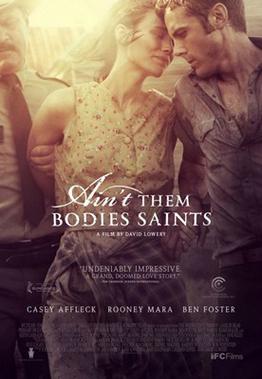
"Ain't Them Bodies Saints" (2013)

If Bonnie and Clyde weren't a romanticized vision of outlaws, it might look something like Ain't Them Bodies Saints. The writers and director (Both David Lowery) aren't the ones doing the romanticizing here, it's the characters themselves who keep telling themselves stories about the greatness of their crimes and their status. Bob (Casey Affleck) is constantly telling Ruth (Rooney Mara) about their future; he's mythologizing before there's anything to be mythologized about and he's draws her into a life of reckless criminality. Ruth hasn't completely bought into Bob's way with words or his swagger. We first see her stubborn and strong-willed, trying to walk away from the whole relationship. She's pregnant though and so she gets drawn into the outlaw lifestyle. The film moves past this quickly. Their outlaw career goes south fast and Bob convinces Ruth to feign taking part in the robbery under duress. Bob gets a five year to life sentence and though he writes letters to Ruth touting how wonderful their life will be once he's freed, we can tell things have changed. The beauty of Ain't Them Bodies Saints is its sly reinterpretation of so many crime movies. "This happened in Texas," the film dryly informs us at the start of the film. The film is mocking the taglines of so many movies claiming they're based on a true story. This isn't a trumped up tale; matter of factly things happen -- told in a clipped, elliptical style -- and they happen realistically, tragically and painfully. Bradford Young's cinematography acknowledges the disconnect between Bob's perception of events and reality. Gorgeous, naturalistic imagery -- reminiscent of Terrence Malick -- with an understated pastel design is used throughout the film. The film looks romantic even as its story is romantic only to the couple yearning for things to be as easy and simple as they imagined when they made a pact to start a new life with each other.

Grade: 3.5/4★★★

Monday, October 14, 2013

"The Blair Witch Project" (1999)

It's hard to appreciate how fresh and unaffected The Blair Witch Project was upon its release. The film and its ideas have been so heavily parodied, re-purposed and remade that it can be difficult to recognize how not only influential the film was but also how good it continues to be. The film didn't invent the found footage genre but it certainly popularized it with an unexpectedly hugely successful turn at the box office catalyzed by a viral Internet marketing campaign that was one of the first of its kind. While recent found footage concepts such as the Paranormal Activity series have aped its ideas, few of the films since feel as inspired or as legitimately scary as Blair Witch. Its not just its shoddy, shaky cam VHS-look that Blair Witch gets right but utilizing that stylistic choice not for gimmick but for verisimilitude. The film is psychologically nuanced. The scares aren't from being startled but from watching the three Gen-X, would-be film students (Heather Donahue, Joshua Leonard, and Michael C. Williams) slowly unravel. Blair Witch also has an initial concept that nicely determines how the film plays out. The three characters are investigating a local legend, one they don't actually buy into. It's a simple framing device but its highly effective; the characters start out as skeptics but as they get lost in the woods and strange things happen they realize that they've tempted fate by failing to tread lightly. The film is also exemplary for how to stretch a shoestring budget. Blair Witch is convincing because it focuses on its characters and their fraying relationship, and it does this because it has so little else to rely on. The film goes for big scares once, in its final moments, and that painfully demonstrates the limitations of the budget to the point where it can feel disappointing. The most frightening moments are when the frailty of human nature is on full display -- perhaps seen best in the film's most remarkable moment where Donahue makes a chilling confession straight to the camera. For a long time there's simply the possibility that there's nothing supernatural afoot just madness sinking in as they get more deeply, irrevocably lost in the woods.

Grade: 3.5/4 ★★★

Sunday, October 13, 2013

"Escape From Tomorrow" (2013)

For many, going to Disney World is the ultimate dream. Escape From Tomorrow turns that dream into a nightmare. Shot DIY, under the radar of Disney's restriction of filming at the theme park, the film plays off Disney's sunny, innocent facade by suggesting something more sinister and evil lies underneath the surface of the amusements and rides. A family goes to the park and the father Jim White (Roy Abramsohn) starts slowly losing his grip on reality. In one sense, the film is about a father whose frustrated by losing the life he had now that he's married and has children (Writer-director Randy Moore claims the film is based on his own experiences with his father when his parents were getting divorced). He stops caring about his children and his spouse, predatorily stalks two nubile French teens, and begins seeing inexplicable, disturbing things creeping into the background. The faces of the people in It's a Small World start looking like demons hiding in plain sight. A single mother becomes an enchantress who bends reality. In short, nothing is quite what it appears to be and that works well for playing against expectations of what the happiest place on Earth ought to be like. The black and white look of the film feeds into this; there's a trippy, darkly alluring quality to the film. It slowly draws you in by being both highly mundane and yet uncannily surreal. The film really is only able to manage this feat for so long. The last third of the film gets a little too bonkers for its own good and the film loses some of its dark seductive appeal in the process. This last third wholly embraces the craziness that has only been suggested up to that point (for much of the first two thirds, there's hints that this might all be inside the head of the father). Still, Escape From Tomorrow largely succeeds at being unsettling and entrancing by taking something familiar and flipping it on its head in ways that feel a little too close to reality for comfort, even as it seems otherworldly.

Grade: 3/4 ★★★

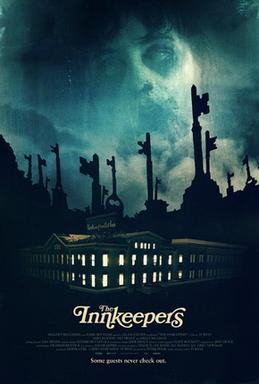
"The Innkeepers" (2011)

The Innkeepers is a movie that buys into the potential virtue of seemingly nothing happening. It's a horror movie that doesn't obsess with getting right to the scares, and in the process it becomes a well-crafted piece of dread inducing cinema. The longer nothing happens, nothing even remotely frightening, the more we wonder when something might happen. Director Ti West used this same notion to even better effect in his terrific House of the Devil. In some ways, the film is indebted to horror movies such as The Shining where the story and imagery get to us in our gut by being unsettling and surreal rather than from startling us. Set in a creepy old hotel on its last weekend in business, the film largely focuses on the two employees overseeing the building in its last days. They split time between dealing with their residents -- utilized primarily for comic effect -- and investigating the paranormal phenomenon allegedly haunting the place. Luke (Pat Healy) clearly has a crush on Claire (Sara Paxton) and he's using the ghost talk as a chance to woo her. She's completely oblivious to this even as it's obvious to us, taking the talk about spirits as a welcome distraction from the humdrum minimum wage job. However, in time, Claire becomes more invested in the ghost hunting than Luke and the film focuses on her. The Innerkeepers has many virtues, chief among them is its sharp characterization. Claire is one of the better female character horror has written in recent memory; strong and curious yet unmistakably nervous and doubtful. The interplay between Luke and Claire is also especially strong and speaks to the film's small doses of humor and playfulness. West is great at composition. He uses the early going of the film to establish the lay out of the hotel and its winding corridors, and to develop characters. The Innkeepers is a throwback to older horror movies where the story rather than the scares was the top priority. The film weaves a simple but deliberately told story that isn't worried about being a little slower going in the early proceedings, building a creeping sense of paranoia. Although it ultimately isn't able to stick the landing, with an ending that feels like an unintentional anticlimax, everything that comes before is a confidently told with visual panache.

Grade: 3/4 ★★★

Saturday, October 12, 2013

New Grading Policy

I've always found the letter grading system slightly problematic for grading movies. The significance between grades becomes somewhat arbitrary in some instances. What's the real difference between a "B" and a "B-"? I couldn't really tell you in all honesty. Grading comes from the gut and it becomes even more instinctive and guess-work based the more flow within the grading system there is. That's why I've decided to move to a more solid and dependable grading system: the four star system.

Yes, in actuality, grading altogether is pretty arbitrary but it's in some ways a necessary evil. The letter grading will likely remain for television reviews I do but the star system is going to be applied to film reviews, at least for a little while on a experimental basis.