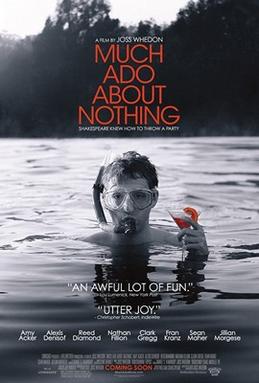
Much Ado About Nothing is a curiosity. A swanky, chic, wine-drenched (seriously, alcohol seems to be getting consumed in nearly every scene) black & white adaptation of Shakespeare's play transposed to the present day by writer-director Joss Whedon. The film features a host of Whedon regulars from past film and television work, including Amy Ackler and Alexis Denisoff in the lead roles as quarreling, barbed witted sparring partners Beatrice and Benedick, who are tricked by their friends into falling in love with one another. Much has been noted about the circumstances under which Whedon filmed the movie; filmed entirely at his Santa Monica, Californian home, a Tuscan villa styled house, over the course of 12 days, the movie at times feels like a bunch of friends casually putting on a home-theater production of the bard's work. At other times it feels like we're getting a glimpse into a very private and well-acquainted group of friends putting together a movie for their own amusement. The juxtaposition of Shakespeare's dialogue and the present day setting is at times jarring -- although it eventually settles into a pleasing rhythm -- and setting it all in one location at times noticeably limits the options for the ways the story can be told. (Locations keep getting re-used over and over and the low budget becomes painfully obvious in certain instances). Jay Hunter's cinematography is gorgeous and intoxicating; it's dazzling and energetic at points. These performers clearly have a lot of chemistry and there is, perhaps not surprisingly being based on a Shakespearean comedy, plenty of funny moments, particularly parallel moments of dedicated slapstick from Ackler and Denisoff and the winning appearance of Nathan Fillion as bumbling police officer Dogbert. However, Much Ado feels far too indulgent. Too often there's the sense we're on the outside of some joke that only those involved in the production quite get. Still this is good, charming performers wonderfully reciting Shakespeare's impeccable writing and having a great deal of fun doing it.
Grade: 3/4 ★★★
Saturday, October 12, 2013
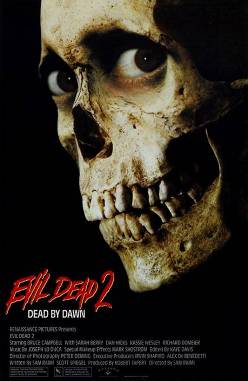
"Evil Dead 2: Dead By Dawn" (1987)
Evil Dead 2 is one of the most purely fun films. This is a film brimming with ideas, imagination, ambition and style to spare. By the time our ever faithful protagonist Ash lands himself back in medieval Europe we have gone through an exhausting amount of plot, furiously burned through with savage delight. That ending is unimaginable when initially Ash appears with his girlfriend in a beaten down old yellow sports car. But writer-director Sam Raimi and co-writer Scott Spiegel go for broke testing out every last weird, interesting and wonderful idea they can come up with. Evil Dead 2 isn't so much a story so much as it's a series of stolen moments. The first third especially is fragmentary moments that only loosely connect to one another. Let me foolhardily attempt to describe it briefly: Ash arrives at the abandoned cabin, his girlfriend is taken over by evil spirits, beheaded and buried, Ash is possessed, saved by the break of daylight, drives away only to find the bridge home destroyed, chased by spirits, and goes raving mad, his possessed girlfriend rises from the grave and he kills her with a chainsaw, and finally he fends off his turned-demonic hand. Mind you that the film is only an hour and twenty-four minutes long, but it moves along with a measured clip and packs so many inventive and fun things into that brief time. The film is ostensibly a sequel to the original Evil Dead and in another sense a remake. The film borrows the basic horror premise of the original but it only uses it as a jumping off point. Evil Dead 2 diverges tremendously from its predecessor; make no mistake: Evil Dead 2 is not a horror movie. It's a comedy. For much of its runtime, it's essentially a one man show for Bruce Campbell. Campbell is a huge part of the film's appeal. He does some fantastic Three Stooges slapstick. But it's also in the expressions and microemotions that Campbell conveys that really sell the film. There are moments that are so funny and endearing merely because the chiseled face of Campbell pauses to give a goofy grin or shoot off a one-liner. Then there's the glorious amounts of blood spewed out from the walls and evil spirits; it's so over-the-top and so clearly not real blood that its excesses become hilarious. The special effects are some excellent designs. Some superb low-budget technical craftsmanship is on display; a homage to old B-horror movies and Ray Harryhausen.
Grade: A-
Grade: A-
Friday, October 11, 2013
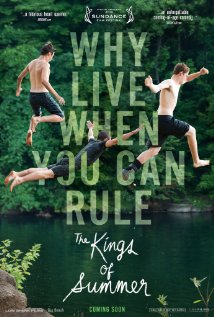
"The Kings of Summer" (2013)
The Kings of Summer is one of those light coming of age stories that keeps getting made in recent years, particularly on the indie scene. I say light because it too often glosses over the real pains of the time, place and age that it deals with. Like The Way, Way Back, there's a charm and wit about The Kings of Summer that makes it entertaining and fleet -- although it drags in the last third. Also like Way Back, it has a lot of good performers elevating material that is a bit too familiar and, at times, simple. Nick Offerman as one of the fathers gives nuance to the part by just the ways he delivers his lines in unexpected and bitingly funny ways. All the young performers are charismatic if not especially memorable; Moises Arias as the kooky member of the trio of boys Biaggio gives a quirky and committed performance that stands out, and it's a nice meeting of writing and acting that really works well. The other two boys Joe and Patrick (Nick Robinson and Gabriel Basso) are resentful of their parents and longing to get out from under their thumb. In the course of events they inevitably learn to grudgingly respect and even love their parents. They go out deep in the woods, build a make shift home, and suddenly believe themselves to finally be "real men" (adults!). The cinematography is at points rather lovely; there's a beautiful naturalistic feel that highlights the forested locales and contrasts the drab suburban settings the guys are escaping from with the their new nature-hideaway. One unfortunate story point involves a girl that Joe pines for; she dates a douchey guy for a brief stint and Joe then thinks he has a chance with her. He invites her to the forest retreat where she falls for Patrick thus leading to the inevitable falling out between the two friends. The Kings of Summer never rises above its cliches or its simplicity; there's something more painful and bitter under the surface but it always seems to avoid it whenever it comes too close.
Grade: B-
Grade: B-
"Child's Play" (1988)
There is an absurdity inherent to the premise of Child's Play that in its most entertaining moments the film embraces whole-heartedly. The notion of a serial killer transferring his soul into a child's doll has a built in level of incredulity to it. At first the film tries to take its premise seriously and be a more straightforward horror movie but the closer the film gets to inevitable reveal, the more it seems to recognize that there is a comedic goldmine to be had in a cute little cherub-faced toy doing things that clash with that cute, innocent sensibility. So when Chucky stops pretending to be just a child's plaything and begins spitting out offensive epitaphs, it's more funny than scary; the moment is made all the more hilarious by the fact that the actress, Catherine Hicks, is clearly at points acting with a doll that she's shaking around for effect. The film's action sequences increasingly accept this campy, comic tone. Initially they're shot from the point-of-view of the doll but once they cease to and we just get a Chucky outright attacking his victims with a knife these moments are simultaneously thrilling, creepy and rather funny. This isn't to say Child's Play isn't scary; there's a menacing quality to the film but it's always mixed with or undercut by a humorous tinge. Whether this is intentional or not, it makes for a fun time all the same.
Grade: B
Grade: B
Wednesday, October 9, 2013
"Three Colors: Blue" (1993)
I'm not entirely sure I understand what I saw in Three Colors: Blue but I'm also certain that I wasn't supposed to, and I'm okay with that. The film is about a woman Julie (Juliette Binoche, in a beautifully understated performance) who survives a car accident but loses her husband and daughter in the incident. It's a film that feels impenetrable and abstract at times because the story is exploring Julie's fractured psyche in the aftermath of the incident. She grows erratic, closed off and disconnected. She sells her home and hides away from all people she formally knew. Tiny things happen to her that are never made clear. At one point she befriends a prostitute; she listens to a flute player whose music she finds intoxicating; she goes swimming -- perhaps to feel something; anything. Julie was married to a great composer. It's suggested at one point that she actually wrote his music. It's never revealed whether this is true but she does seem to have knack for music. She hears her husband's old music at every turn; it haunts her mind like old ghosts, coming at her like micro-flashes of lightning. Director Krzystzof Kieslowski shoots the film is a gloomy, mysterious and alluring style -- and, perhaps to be expected, it's bathed in blue tones of every shade and variety. The film doesn't make a fine point about what certain imagery means but some images are so haunting and transcendent that it really doesn't matter; they're hypnotic and seductive and can be appreciated for their own sake. The story has the quality of a symphony; sumptuous, lavish; high emotions and somber low-points. At once, deeply felt and yet distant and hard to pin down. It's an elegant, gorgeous and challenging mood piece.
Grade: A-
Grade: A-
Tuesday, October 8, 2013
"Trans" (2012)
Trans is an important documentary with a good message. The film is about what it means to be transgender and the struggles and lives of transgendered individuals. But even more so it's about getting people who aren't aware or feel uneasy about the issue to come to accept transgendered people. It's a worthwhile, considerate message; one presented through compassionate and sensitive interviews with individuals who are transgender. It shows how they're just like anyone else.
I'm not quite sure how it conveys that message is always one that works though. Trans forgoes recounting the history and terminology of its subject in order to dive us in head first into an emotional identification with the individuals who live with being transgendered. At times it feels emotionally manipulative -- and I say this as someone who agrees with and supports the message of the film. But ultimately the film's message is strong enough and presented with such humanity and warmth that it doesn't matter.
Grade: B
Monday, October 7, 2013
How I Met Your Mother: "The Broken Code"
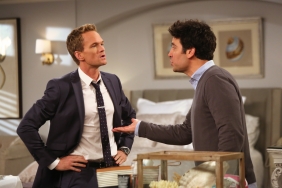
Unlike last week's episode, "Last Time in New York", this week's episode, "The Broken Code" felt like it actually had a story that was worth telling and that needed to be told. There's nothing wrong with sitcom antics and it's expected that they'll have diminishing returns in later seasons, but How I Met Your Mother's central conceit forces it to give the burden of proof in order to feel truly well and satisfying. I don't find Barney and Robin that interesting of a couple and so my opinions of their storyline avoiding their elderly relatives -- on top of the fact that that joke about old people felt very one-note and uninspired -- was bound to be meh.
Here though the main story about Barney being uncomfortable about Ted's still lingering feelings and Ted attempting to deny them felt like it had some weight to it that the last episode didn't really have. Most importantly there felt like there were actual stakes; Barney and Ted' friendship very well could have been seriously compromised and no doubt will be on an uncertain footing going forward -- and that's all for the better. This season needs to throw out complications to make it have a sense of purpose, conviction and, most importantly, energy. Weddings tend to be fraught with complications and thus far the complications have been too light and disposable (Thankfully we got that old people joke out early and lets hope there's nothing quite as bland as it going forward).
But even the less meaty subplot between Lily and Robin felt as though as it wasn't completely a throwaway story. The story ultimately moved past the weird tics and insecurities of Robin in regards to her inability to make female friends and onto reaffirming the relationship she has with Lily. HIMYM has always been a show grounded in relationships and character dynamics and in recent seasons it has been at its best when it examines those relationships and assesses what they mean to these characters. Inevitably the commentary is thin here but it elevates a story that while amusing felt needless.
Like I said, a tv show doesn't have to make such purposeful statements all the time; if it's funny and energetic enough then we can roll with it even if it's not suggesting something meaningful (although inevitably they'll be some statement no matter what). But the central conceit of the series and the show's general emphasis on its relationships has unfortunately played against the stories it can meaningfully tell and that are actually satisfying.
Final seasons are statements of what the writers believed the show was about. To me it has always been about these characters, but I'm just a viewer not the author of this work and therefore what I felt this show was about and what it actually will end up being could be very different. I doubt the gap between those two perceptions will be that far apart, but it's still frustrating nonetheless when it loses track of these characters.
This was a good episode that made me feel as though the wedding weekend structure could actually work (and oddly enough it had little to actually to do with the wedding). We could do with more of this and less of what we got last week.
Grade: B
Here though the main story about Barney being uncomfortable about Ted's still lingering feelings and Ted attempting to deny them felt like it had some weight to it that the last episode didn't really have. Most importantly there felt like there were actual stakes; Barney and Ted' friendship very well could have been seriously compromised and no doubt will be on an uncertain footing going forward -- and that's all for the better. This season needs to throw out complications to make it have a sense of purpose, conviction and, most importantly, energy. Weddings tend to be fraught with complications and thus far the complications have been too light and disposable (Thankfully we got that old people joke out early and lets hope there's nothing quite as bland as it going forward).
But even the less meaty subplot between Lily and Robin felt as though as it wasn't completely a throwaway story. The story ultimately moved past the weird tics and insecurities of Robin in regards to her inability to make female friends and onto reaffirming the relationship she has with Lily. HIMYM has always been a show grounded in relationships and character dynamics and in recent seasons it has been at its best when it examines those relationships and assesses what they mean to these characters. Inevitably the commentary is thin here but it elevates a story that while amusing felt needless.
Like I said, a tv show doesn't have to make such purposeful statements all the time; if it's funny and energetic enough then we can roll with it even if it's not suggesting something meaningful (although inevitably they'll be some statement no matter what). But the central conceit of the series and the show's general emphasis on its relationships has unfortunately played against the stories it can meaningfully tell and that are actually satisfying.
Final seasons are statements of what the writers believed the show was about. To me it has always been about these characters, but I'm just a viewer not the author of this work and therefore what I felt this show was about and what it actually will end up being could be very different. I doubt the gap between those two perceptions will be that far apart, but it's still frustrating nonetheless when it loses track of these characters.
This was a good episode that made me feel as though the wedding weekend structure could actually work (and oddly enough it had little to actually to do with the wedding). We could do with more of this and less of what we got last week.
Grade: B
Subscribe to:
Posts (Atom)