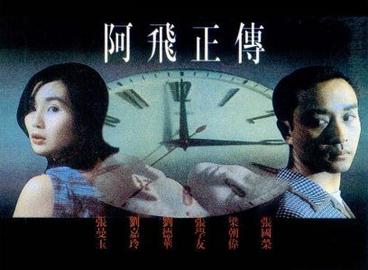
Days of Being Wild has two modes of storytelling: melancholic contemplation and uncontrolled passion. The film mostly sticks to the former, but at times bursts into fits of fiery intensity. Everyone in its small cast of characters is yearning after something. In the moment that seems to be romance or affection, but it's also often something more soulful and primordial, something they lost long ago that they can't attain, that they're searching after. The look and feel of the film is quite lovely at conveying this; director Wong Kar Wai is wonderful at composing imagery that's evocative and gorgeous yet very understated. The film's story is also part and parcel with this minimalism often being elliptical and brief (There are random inner monologues that seem to come out of nowhere and nearly everyone gets at least one detailing massive amounts of information in tiny clips of time). But the the information put across in these small windows is rich, moody and at times thoroughly erotic. Set in the 1960's Hong Kong -- mostly to align with the sexual revolution -- Yuddy (Leslie Cheung) is a young, frustrated man who has unbridled passions that he unleashes on two very different unsuspecting women (Maggie Cheung, Carina Lau) -- both of whom he's withholding towards even as he clearly has feelings for them. Meanwhile he's confronting the discovery that the woman that raised him isn't actually his biological mother -- an irascible, hard to please spinster -- which only serves to make his outbursts all the more unpredictable and explosive.
Grade: A-
Sunday, September 29, 2013
Friday, September 27, 2013
My "Insidious: Chapter 2" Review
Once again I was fortunate enough to get the chance to write a review for my school's newspaper The Lafayette. Not sure this review is quite as well written as my previous one but I'm still really grateful for the opportunity, and hopefully you' ll read and enjoy it (Also, I did not come up with the headline for this one. Although I'm not entirely sure I could have come up with anything much better).
I also wrote an article for last week's edition previewing a recent film festival, but that's merely for those who really want, for some odd reason, to read everything by me, which isn't at times even me.
Wednesday, September 25, 2013
"The Celebration" (1998)
The first thing you're likely to notice while watching The Celebration is its look. It's a film of stark minimalism; the lighting and camera quality is very low budget; the cameras are handheld and shaky and besides a handful of scenes there's not a whole lot of incredibly technically impressive shots beyond the fact that it's kind of impressive that anything got filmed under such limited circumstances. This is all deliberate though; writer-director Tomas Vinterberg was a founding member of Dogme 95, a Danish film collective that wanted to make movies that stayed away from Hollywood conventions of filmmaking. The emphasis was character, theme, etc. and all that good stuff that special effects and big studio budgets had increasingly been diluting movies of. The Celebration could easily be told without sticking to the rules of Dogme 95 but the style of the film feeds into the story. It's shot with a claustrophobic intimacy that only makes the revelations at the 60th birthday of Helge Kligenfeldt all the more unbearable and relentless to witness. Helge's son Christian proposes a toast during the festivities -- except it's not your typical toast -- he says he and his recently deceased twin sister, who committed suicide, were sexually abused by their father -- and the confession suddenly starts making everyone more combustible and surreally, unpleasantly in denial. Christian, and the family in general, has to keep pushing forward to crush the denial and to come to terms with what has happened.
Grade: B+
Grade: B+
"Bride of Frankenstein" (1935)
The Bride of Frankenstein picks up right where Frankenstein left off but you could get away with not seeing the first film as the connection between the two is tenuous beyond a handful of characters. The Bride of Frankenstein assumes you know who Frankenstein and his monster are and proceeds on to becoming weirdly soulful and lyrical. Frankenstein had made the monster (Boris Karloff returning to the iconic role) a sympathetic, misunderstood outcast but Bride really goes out of its way to underline this point. Everyone is hunting him down or running away at the sight of him until he comes across a blind man who sees the inner beauty of the monster; they both lack a sense (sight and the ability to speak respectively). The blind man teaches the monster some words and shows him kindness only for the hunters to catchup once again and ruin it. If nothing else, it strengthens the monster's resolve to finally make a friend and start asking deep questions, like whether it was best he was never brought to life in the first place. This dovetails with Frankenstein's mentor Dr. Pretorius's (a wonderfully campy Ernst Thesiger) plan to create a female monster to marry off to the poor misunderstood guy. But the Bride (a fantastic bit of costuming and makeup design) rejects the monster as well and he accepts that he's not meant for this world, in a poetic and deeply sorrowful ending. The film is filled with a moody vibe, from its wonderfully atmospheric lighting to its Gothic sets, and expands nicely upon the themes from the first film.
Grade: A
Grade: A
Tuesday, September 24, 2013
"Kiss Me Deadly" (1955)
Kiss Me Deadly is quite unlike any other film noir. Where most noir hint at deadliness and brutality, Kiss Me Deadly hits first and asks questions later. There's a strange, pleasant subversiveness to the film where the film increasingly embraces the inherent implausibility, density, and darkness of its narrative, leading to one of the most bizarre and awesome endings in all of cinema (one that influenced Quentin Tarantino's Pulp Fiction). It's a B-movie but it's fine embracing its low budget, pulpy thrills, which makes it on the surface a little abrasive and rough -- as well as ahead of its time. But though Kiss Me Deadly functions on its own as noir, it's also a commentary on noirs. Everyone gets told they're in over their heads in noirs but few times has it been so totally accurate; the conspiracy in the film is so broad reaching and cynical that it somewhat becomes a critique of the genre. And Ralph Meeker's hard-boiled detective Mike Hammer -- a character who's barely likable or charming -- is so obsessed with the case almost to the point of nihilistic self-destruction that it's simultaneously suggestive of Cold War paranoia as well as the singular obsessions that abound in noirs.
Grade: A
Grade: A
Monday, September 23, 2013
How I Met Your Mother: "The Locket"/"Coming Back"
"The Locket" and "Coming Back" play out much like the last mid-season finale "The Final Page". The hour has a longer story it's telling but the two halves have enough stand-alone narrative that they could function as their own episode.
At times it feels as though the writers don't really know what to do with this extra time and "Coming Back" is the stronger of the portions of the episode on the whole as story elements begin to snap into focus. But the extra time allows the writers to drop in smaller moments that I don't know they would have otherwise, for good and for ilk. Much like the extended appearance of Seth Green in "Final Page", things in the first half get a little too goofy and needlessly unfocused for their own good.
The freshest moments are those that feature Cristin Milioti. The series, not surprisingly, highlights her brief moments. Not only that but they have a creative spark to them. In those moments, it doesn't feel like the show is dragging its feet and spinning in circles. In fact, it likely should have made these moments really stick and have some breathing room (When Future Ted says, "And that's how Lily met your Mother", the show passes over it far too quickly). It's something completely new and different, as well as something we've been dying to witness for over 8 years.
There's stuff that doesn't work. Marshall has the weakest of the stories, especially in the first half. His story highlights the series biggest problem at the moment: the characters are far too fragmented in their interactions at the moment. Though Sherri Shepherd gets some good fodder out of her lines and is a suitable match for Jason Segel, it can't help but feel like the writers are just killing time in Marshall's part of the story.
Critic Todd VanderWerff once described the power of television as accumulation. Movies can have more texture and they can have less loose ends but television has staying power. You don't just watch a tv show; you live through it. And so though there's a bit too much excess in this hour, the moments that need to stick and are intended to really get you in the gut do. Take the final moments of the episode where future Ted, now with the mother, recalls sitting at the same table a year earlier. What's so powerful about that moment, and moments elsewhere like it the series has pulled off, is how achingly real it is. The facade of sitcom antics fades away for a brief moment where the show rewards our investment and reassures us that it has been and will continue to be worth it.
I laughed for sure at the premiere, although not as consistently as I did when the show was at the top of its game. But the show can still be daggers. And ultimately it's just nice to be in this world for an hour or a half, to revisit some old friends and start to say good bye. Whatever complaints I may have had, it's been a lot of fun How I Met Your Mother.
Stray Thoughts:
-Thus far the weird structure for the season, letting it unfold over just the wedding weekend, is proving to be a fruitful device -- especially for relating to us the mother's role in it -- but we'll wait and see how long they can sustain it. The more they get out of the discussion of fate and fateful coincidences the more I will be able to ignore it (As I eat that stuff up). If they get into too much minutiae about weddings though, it could start getting rough.
-Though Marshall's story was the weakest -- in part because it feels like there's a lot of the show's ill-advised stall tactics and narrative contrivance -- his mother's attempts to take down the Facebook photo, for me at least, provided some of the most solid laughs.
-Marshall's story was the overall weakest but, for the most part, I also could have done without the "Barney and Robin might be cousins" story; left to their own storytelling devices in recent years these two characters can get a little too sickeningly cute and too over the top.
-Christin Millan and Josh Radnor have some killer chemistry as demonstrated by that brief flash forward scene and that makes me absurdly pleased after waiting and wondering for so long what that might be like.
-“King Joffrey’s parents were brother and sister, and he was a fair and wise leader.”
Grade: B+
At times it feels as though the writers don't really know what to do with this extra time and "Coming Back" is the stronger of the portions of the episode on the whole as story elements begin to snap into focus. But the extra time allows the writers to drop in smaller moments that I don't know they would have otherwise, for good and for ilk. Much like the extended appearance of Seth Green in "Final Page", things in the first half get a little too goofy and needlessly unfocused for their own good.
The freshest moments are those that feature Cristin Milioti. The series, not surprisingly, highlights her brief moments. Not only that but they have a creative spark to them. In those moments, it doesn't feel like the show is dragging its feet and spinning in circles. In fact, it likely should have made these moments really stick and have some breathing room (When Future Ted says, "And that's how Lily met your Mother", the show passes over it far too quickly). It's something completely new and different, as well as something we've been dying to witness for over 8 years.
There's stuff that doesn't work. Marshall has the weakest of the stories, especially in the first half. His story highlights the series biggest problem at the moment: the characters are far too fragmented in their interactions at the moment. Though Sherri Shepherd gets some good fodder out of her lines and is a suitable match for Jason Segel, it can't help but feel like the writers are just killing time in Marshall's part of the story.
Critic Todd VanderWerff once described the power of television as accumulation. Movies can have more texture and they can have less loose ends but television has staying power. You don't just watch a tv show; you live through it. And so though there's a bit too much excess in this hour, the moments that need to stick and are intended to really get you in the gut do. Take the final moments of the episode where future Ted, now with the mother, recalls sitting at the same table a year earlier. What's so powerful about that moment, and moments elsewhere like it the series has pulled off, is how achingly real it is. The facade of sitcom antics fades away for a brief moment where the show rewards our investment and reassures us that it has been and will continue to be worth it.
I laughed for sure at the premiere, although not as consistently as I did when the show was at the top of its game. But the show can still be daggers. And ultimately it's just nice to be in this world for an hour or a half, to revisit some old friends and start to say good bye. Whatever complaints I may have had, it's been a lot of fun How I Met Your Mother.
Stray Thoughts:
-Thus far the weird structure for the season, letting it unfold over just the wedding weekend, is proving to be a fruitful device -- especially for relating to us the mother's role in it -- but we'll wait and see how long they can sustain it. The more they get out of the discussion of fate and fateful coincidences the more I will be able to ignore it (As I eat that stuff up). If they get into too much minutiae about weddings though, it could start getting rough.
-Though Marshall's story was the weakest -- in part because it feels like there's a lot of the show's ill-advised stall tactics and narrative contrivance -- his mother's attempts to take down the Facebook photo, for me at least, provided some of the most solid laughs.
-Marshall's story was the overall weakest but, for the most part, I also could have done without the "Barney and Robin might be cousins" story; left to their own storytelling devices in recent years these two characters can get a little too sickeningly cute and too over the top.
-Christin Millan and Josh Radnor have some killer chemistry as demonstrated by that brief flash forward scene and that makes me absurdly pleased after waiting and wondering for so long what that might be like.
-“King Joffrey’s parents were brother and sister, and he was a fair and wise leader.”
Grade: B+
"Wet Hot American Summer" (2001)
Wet Hot American Summer is a weird, silly movie filled with a scatter-shot of every last goofy joke it come up with. It's a send up of every 80's movie cliche the film can think up, chewing up and spitting back them to see what comes back up. Some of these jokes don't land or go on for far too long but the smorgasbord style of joke telling allows for the film to move past the gags that fall flat and onto something funnier. In its mid stretch the film is moving so rapidly from one shenanigan to the next that it doesn't quite matter that the film is fairly inconsistent. By embracing the awfulness of the cliches of late-70's and early 80's movies (particularly summer camp movies but really everything and anything to the point of off-putting specificity to anyone outside the know) the film occasionally makes the same mistakes those movies do. The film is perhaps most interesting for its large number of then largely unknown actors and comedians that would blow up in a few years time, including a scene stealing Amy Poehler, Paul Rudd, Bradley Cooper, and Elizabeth Banks. This is a movie throwing everything it has at us to try to make us laugh, and thus it's fitfully funny -- though it too often fails, those moments where it is funny are pretty hysterical and inspired.
Grade: B-
Grade: B-
Subscribe to:
Posts (Atom)


