The Cabinet of Dr. Caligari is been considered by many as the exemplar of German Expressionism, a 1920's film movement that emphasized haunting atmosphere through stylized designs and macabre narratives. In terms of artistry the film still holds up surprisingly well. The movie is filmed on sets and stages designed with a jagged and angular look; created by designer Hermann Warm and painters Walter Reimann and Walter Rohrig. The sets stand out as unreal and make Caligari an unsettling and surreal film experience. Caligari uses a comatose sleepwalker, or somnambulist, Cesare, to do his bidding, killing off townspeople -- given a greater dose of paranoid unease by the film's twist ending which calls into question much of what we have seen. The look of the film feeds into the dark, psychological story and vice versa. What sets the film apart though is its atmosphere. No film quite looks or feels like Caligari. The unrealness is heightened and emphasized and it was this look that went on to influence countless movies from film noirs to later horror films. Few movies continue to seem so original and unique all these years since its release.
Grade: A
Friday, September 6, 2013
"White Heat" is One of the Best Classic Gangster Flicks
In White Heat, James Cagney's Cody Jarret is perhaps cinema's earliest psychopath, a man flitting between rage and childish simplicity. Cagney got type-casted as the gangster in a number of movies but few variants were quite as soulful as Cody Jarret in White Heat. In Cagney's hands Cody is oddly relatable and likable; Ivan Goff and Ben Roberts' script turns Cody into a bit of tragic figure, albeit a slightly demented one. Cody isn't the film hero (he's more of an anti-hero) -- no that would be Edmond O' Brien's undercover cop -- but the story wants us to like the guy -- he is, after all, the film's protagonist -- and when Cagney bears that crooked smile of his, it's hard not to be won over. Cody has some major mommy issues and a family history of insanity, so his violent outbursts (all with absolute remorse and twisted glee) aren't totally inexplicable. And there are few better endings where a character gets exactly what they want only for it to be the total opposite of what they need than Cody's exclamations of, "Made it Ma! Top of the world!"
Grade: A-
Grade: A-
Thursday, September 5, 2013
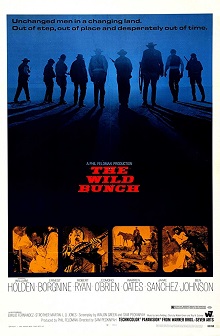
"The Wild Bunch" Has Brutal, Majestic Violence to Spare
Bandits walk into a Texan town disguised as soldiers and rob a bank. They're unaware that men are in the town pursuing them for bounties on their head. Once inside though, the bandits realize they are cornered and a gunfight ensues. And within the span of a few minutes, everything goes wrong. A Temperance Movement march just happens to be passing by and gets caught in the crossfire. Civilian casualties become higher than the death toll of the criminals being shot down or their attackers. This is the breathless action sequence that starts the western The Wild Bunch and it is highly intense and fun. In another film this would be the climax, but director Sam Peckinpah is just getting started with one of a number of heavily stylized -- filled with quick cuts, multiple angles, and slow motion over moments of violence -- and brutal action scenes that are the best moments of the film. Peckinpah is pushing to the limits the acceptable amount of violence and blood spilt out, and each gunfight turns deadlier than the last. And if The Wild Bunch is slow to the draw, than it makes up for it with its action. The film meanders and chews on plot strands, and its slow operatics occasionally make it flabby and inelegant. The gruff, no nonsense tone -- cruder than anything that had come before it -- of the film is best demonstrated by the film's most thematically rich plot about aging outlaw Pike Bishop (William Holden)'s world weary, deeply regretful outlook on what has become of his life. The crew is all aging outlaw save for one wide-eyed and strong-headed young Mexican named Angel (Jaimie Sanchez). Pike wants out; one more big scheme and he'll retire. Or so he says, but deep down he knows there is no way he leaves this career -- alive at least anyway -- especially not with Pike's bitter former partner Deke Thornton (Robert Ryan) hot in pursuit to bring him to justice. "They'll be waiting for us," his trusted partner Dutch Engstrom (Ernest Borgnine) informs him. "I wouldn't have it any other way," Pike replies.
Grade: B+
Grade: B+
Wednesday, September 4, 2013
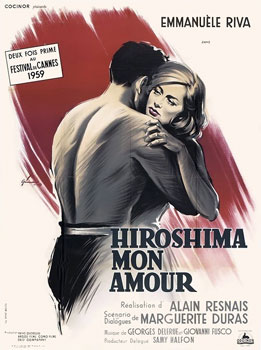
The Love Affair of "Hiroshima Mon Amour" Collapses in on Itself
Hiroshima Mon Amour is a dreamy, hazy film about histories, both personal and literal, complicating people's lives and coming to to term with those histories. The biggest history factoring in here is World War II, and specifically the nuclear bombing of the city of Hiroshima.14 years later lovers, one French (Emmanuelle Riva) and one Japanese (Eiji Okada), have an affair, at Hiroshima, in which the past weighs heavily on their tenuous affair.
The film, on a descriptive level, is essentially a straightforward narrative about lovers who have less than a day left to determine if they continue with their affair. But in the hands of director Alain Resnais there's all sorts of excessive arthouse touches, some gorgeous -- there are some stunning shots of the city itself and some haunting flashback scenes in France -- and some unnecessary. While at the time, as part of the French New Wave, the film's stylistic and narrative choices -- non-linearity, flashbacks -- were groundbreaking, now they feel slightly pretentious and overdone. While the romance is paradoxically both over and under explained in ways that make the whole ordeal seem unreal and strange.
Grade: B-
Tuesday, September 3, 2013
"Pather Panchali" is a Remarkably Beautiful, Human Tale
Satjayit Ray's Pather Panchali is about a small family struggling to get by in the countryside of Bengali. But really it is a film about what it means to be human; to live, to laugh and cry, to suffer, to not get what you want, to bond with your siblings, to fight with your parents, to watch those around you grow up and grow old and even die. It is a film of deep humanity that spends most of its time observing unintrusively into the lives of Indir (Chunibala Devi), Harihar (Kanu Banerjee), Sarbajaya (Karuna Banerjee), and most importantly Apu (Subir Banerjee), and Durga (as a child Runki Banerjee and as a teenager Uma Dasgupta). It is a movie of small triumphs -- the film's most exuberant scene features Durga and Apu seeing a train for the first time in their life -- and big losses -- more than one death occurs in the film. The film is a convincing and honest glimpse into village life in a small, remote place. The Ray family live in their ancestral home, a place in dire need of repairs, repairs they simply do not have the money for. Harihar keeps reassuring that one day they will move away when they can save up enough money; that day is pushed further and further away until it feels like a pleasant dream. The film is one about changing times and generational divides. We see Durga steal fruit from an orchard in the film's first scene to help feed her family; she is scolded by her mother, but though she grows older, and becomes a role model to her newly born brother, she is still the same mischievous girl at heart. The film is shot in a simple, sparse style; it is naturalistic and docu-realistic (featuring mostly amateur actors), capturing quietly stolen moments. Some of these moments are so striking, evocative and emotionally rich that they feel poetic. Pather Panchali takes its time; it rambles but, if given a chance, most certainly rewards.
Grade: A
Grade: A
Monday, September 2, 2013
"Broadcast News" is as Sharp About Relationships as It is About the News
With the help of a sharp script by writer-director Albert Brooks, Broadcast News moves past its broad satirical jabs at the television news industry and moves on to become a nuanced character piece. While its satirical bite provides the film with some of its funniest and strongest moments, the film becomes more satisfying as it just lets its well-shaded characters talk and unload. The performances of the three leads, Brooks, William Hurt and Holly Hunter, carry the film and give characters of potentially one-dimensional nuttiness and romantic entanglement an earnest lived-in quality. Hunter slowly turns in the film's best performance, in time becoming the film's lead (and most interesting, compelling) role and giving so much damage and uncertainty to the type A television producer Jane Craig. Brooks is essentially playing himself as camera shy, snobbish news reporter Aaron Altman but that still makes for a very funny character, and the film's "flopsweat" scene is arguably its funniest. Hurt turns news anchor Tom Grunick into more than the dumb hunk and gives the character enough charisma that we can buy his success. But it is still Hunter's film; relatable yet frustrating; affable yet selfish. She gives such richness to the working woman torn between her inner turmoil, and her personal and professional uncertainties; I feel as if I've met this person and know her in my own life.
Grade: B+
Grade: B+
"Broken Blossums" is Still Devastating Despite Being Dated
We watch Broken Blossoms more for its artistry and historical significance than for its entertainment value. And true enough, watching a movie made pre-1920's can feel more like a chore than a good time and Broken Blossoms is at times incredibly hammy. But the way director D.W. Griffith makes the story come together in the final moments is still devastating. It's one part morality play and one part social commentary, and in order to sell home both, everything that could possibly go wrong does so spectacularly. Move past the blatant racism made apparent in details such as naming the Chinese character "The Yellow Man" and there's a surprisingly sympathetic portrait of an Asian character (even though played by a Caucasian, Richard Bathelmess) in a time when Asian hostility was huge. A character only marginally less sympathetic than the other tragic figure of Lucy (played by the wonderfully expressive Lilian Gish) who the Yellow Man takes in to care for after her abusive father (Donald Crisp) goes too far. It's mawkish and sentimental but there's a surprisingly good message about tolerance and the film's stylistic touches -- notably a mist effect -- stop its staged quality from feeling totally dry.
Grade: A
Grade: A
Subscribe to:
Posts (Atom)