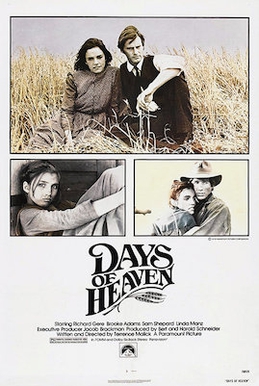
There's a farm. It seems to exist outside time and space. There's not a sign of civilization for miles and miles, just fields of wheat. The only people are the workers who work in the fields. It's a lonely, isolated existence with the only pleasure being the natural beauty of the surrounding. Migrant workers arrive for the harvest, amongst them Bill (Richard Gere), his girlfriend Abby (Brooke Adams), and his kid sister Linda (Linda Manz).
Linda serves as the narrator in Days of Heaven. She doesn't provide exposition though; she gives us flavor. She speaks as if reciting quickly scribbled down poetry (all in one of the thickest New York accents you'll ever hear). For the most part the film is not her story though. She observes, she comments, and she is affected, but the plot revolves mostly around her brother, his girlfriend, and the man who owns the farm.
Bill kills the boss in a factory he's working and is forced to flee. His quick temper will get him a number of problematic situations throughout the film. Writer-director Terrence Malick lets the film unfold with a languorous casualness. Occasionally it bursts into violence and destruction, but for the most part the film is content to provide a sense of place. There's some gorgeous cinematography by Nestor Almendros and Haskell Wexler -- which won an Oscar -- of the vast landscape (the film takes time for cutaway shots of plants, animals, etc. that provide the film with texture and atmosphere).
The film is a period piece set primarily in the late 19th century Texas panhandle. Industrialization is starting to take over, but the little, sleepy farm has yet to be fully integrated. Railroad tracks are laid out nearby but are rarely used. A car is used every now and again. There are a handful of mechanized tools. But otherwise this feels like a picturesque place; unspoiled, uncorrupted.
Bill tells everyone that Abby is his sister. Why he does this is never clear (perhaps because it's easier to keep her under his protection and control). Bill discovers the farm owner (Sam Shepard) is deathly ill and will pass within the year. He comes up with a scheme to take his money. The owner has an interest in Abby and Bill suggests she skid into these feelings; feelings, in time, she unexpectedly starts to feel back for him.
We're given a sense early on that none of this can end well. The first scene is of Bill arguing with his boss and then hitting him over the head with a led pipe. Violence is an inevitability. Ennio Morricone's score sounds like a chilling nightmare. There's a wistful, dream-like quality to it, but there's also a sense of underlying menace. Malick makes so much of the film have an innocence despite how cruel and vicious it often is. Part of this is the perspective of Linda, but it's also the naturalness of the film. Nature appears innocent and unassuming until it swallows you up. The characters are specks on this wide, sprawling plain.
Grade: A
Sunday, August 18, 2013
Saturday, August 17, 2013
"Prince Avalanche"'s Winsome Blend of Existential Musings and Amusing Character-Based Comedy
Prince Avalanche plays like a two man existential play. Two men, Alvin and Lance (Paul Rudd and Emile Hirsch), painting the yellow dividing lines on a long stretch of rural, rustic road in 1980's Bastrop, Texas, get on each other's nerves and stave off boredom. Their task is tedious, repetitive and seemingly with no end in sight (as all existential nightmares tend to be).
Alvin and Lance are as mismatched as any two people could be (in an inspired bit of costuming, the two are dressed like Mario and Luigi from the Super Mario Bros. video games). Alvin is uptight and self-serious; Lance is lazy and caustic. Alvin runs the operation. He's only hired Lance because he's the younger brother of his girlfriend. Without this connection the two would doubtless be at the other's throat in an instance (and in deed they come close to sparring on more than one occasion). They bicker, fight, and bother the other to no end (again: existential nightmare).
The film is bleak and melancholy. The characters are placed against empty, infinite roads or barren, hauntingly beautiful forests. They camp out in the woods in between painting and putting stakes in the ground. Alvin takes pleasure in the zen possibilities of isolation while Lance starts to lose it a little.
This sounds like this would be slightly depressing and down film, but it's often a very funny one. Rudd and Hirsch are exceptionally well paired and play off each other well. The languors of the film provide the context for the great bursts where Alvin and Lance argue and blow up. As the two grow increasingly angry at the other and come to understand the other, it becomes even funnier and more fulfilling.
There's a continual quirkiness and arthouse-ness about the film, starting with the premise itself. Some of this doesn't entirely work (including some lovely, Malickian shots of the natural environment). The existential tinge leads to some philosophizing (especially about a massive fire that occurred in the area their working) that feels incredibly forced. But overall the film's black comedy, loose contemplativeness, and solid characterization make it worthwhile.
Grade: B
Friday, August 16, 2013
The Mesmerizing Poetic Realism of "L' Atalante"
Jean Vigo's sole feature length film, L' Atalante, is one of the most influential films of all time. Released in 1934, the film looks forward to much of the future of European arthouse film-making, including the French New Wave. L' Atalante is deeply naturalistic. There's a roughshod simplicity to it. A man and a woman get married, Jean and Juliette (Jean Daste and Dita Parlo), spend their honeymoon on the titular boat -- captained by Jean -- and get into a fight that leads to them briefly splitting. There are really only four characters, the other two being the two crew-mates to the tiny, sea-worn vessel; one a hardened veteran, Père Jules (Michel Simon), who's seen it all and one who's young and inexperienced.
Vigo masterfully tells their story with intimacy, warmth and humanity. Whimsey abounds in the film with the surreal and spine-tingling mingling with the earthy and the everyday (in this way, Vigo shares a lineage with Federico Fellini) -- including two fantastic dream sequences that portray the couple's longing for each other (One, a feigned suicide attempt into the water by Jean where he imagines Juliette is there, which is still every bit as technically astounding today).
The film in fleet -- at just 85 minutes long -- but it forms such richness in this little time. The couple clearly is in love with eachother. They flirt, they tease, and they fight. They are in honeymoon bliss, kissing and holding each other at every chance they can get. But the initial euphoria caves in; Jean begins to grow jealous, insecure and overbearing. He fears he's undeserving and that Juliette is straying. Juliette wants to explore Paris when they dock, but Jean is not trusting enough. She sneaks out in the middle of the night, and Jean abandons her. They both grow morose and out of sorts without one another. And so, not surprisingly, they are inevitably reunited and wordlessly make-up, collapsing giddy into each other's arms.
The film finds sweetness in its humanism. There's a gruffness to the setting, almost always on the boat; foggy, dark, tough, at times tedious and unpleasant. But this is put into contrast with the depths of humanity that abound on the boat. There's the newlyweds of course, but there's also the first mate, who's a man of simple pleasures; a jolly man who's past his prime, but content with his lot in life.
Ultimately the film's power comes from how heightened the examination of its events are. There's a poetic quality to the way Vigo observes the mundanity in the narrative. There's a realism to it but also an ethereal quality.
Grade: A
Wednesday, August 14, 2013
This Week in Film (8/12/13 - 8/17/13)
Worried you might have missed out on all the substandard reviewing that I have to question why you're reading over the reviews of some legitimate film site? Well, fear no more! Here is the latest Master Post for the week that collects all the writings from the blog. I go a little deeper than I have in the past few weeks digging into some older films, but there's also newer releases as well to balance things out for those of you who aren't the would-be cinephile I am. Let's tally it up:
Breaking Bad: "Blood Money" - The midseason premiere to the final season of this acclaimed television drama picks up after the shocking cliffhanger of "Gliding Over All", and doesn't waste any time to kick things into high gear. An assured, thrilling start to the last stretch of episodes.
Roman Holiday (1953) - Audrey Hepburn's debut performance is an exercise in how to charm the pants off of everyone. The all time classic romantic comedy has a lot of silliness, as rom coms so often do, but you have to be a robot to not be laughing, and generally finding yourself delighted, at Roman Holiday's screwy princess out of water premise.
Elysium (2013) - Neill Blomkamp's follow up to his excellent sci-fi allegory District 9 amps up the metaphors with insulting heavy handedness. The action is entertaining and packs a gritty punch, but it's surrounded by incredibly unsubtle storytelling and ideas it seems to have no real interest in exploring.
The Bank Dick (1940) - There's no good way to describe this W.C. Field film which is pure anarchy and a lot of fun if you give it a chance. Field's essentially plays himself, as he did in so many of his films, a drunken, mumbling hedonist who quips and bumbles his way through one scene after another.
L' Atalante (1934) - Jean Vigo's only feature film is the naturalistic and lyrical story of honeymooners living on a barge. Its glimpse into the everyday is deeply humanistic and warm, and filled with minor flights of fancy that are entrancing. It's a gorgeous, rich little film.
Prince Avalanche (2013) - Joseph Gordon Green's latest film moves past his recent stoner comedy efforts and back to his indie roots, blending buddy comedy and existential contemplation with pleasing results. Paul Rudd and Emile Hirsch play opposite each other as mismatched road-workers painting the yellow lines on a long stretch of Texas road and generally getting on each other's nerves in equal parts melancholy and funny.
Days of Heaven (1978) - Terrence Mallick's second film carries much of the narration, naturalness, and cinematographic beauty of his debut Badlands (1973), but is even more concerned with the vastness and resplendence of nature. The story, seen through the eyes of a kid, is stripped back in favor of a voice-over that is haunting, poetic and lacks the full understanding of the implications of the devastating love triangle she witnesses when no one realizes she has.
The Inspired, Sketchy Anarchy of W.C. Field's "The Bank Dick"
W.C. Fields seems to be aware at times that he's starring in a movie throughout The Bank Dick. He's so mannered that he stands in stark contrast to every actor around him. While everyone is a prim and proper 1940's, Leave It To Beaver type, Field's Egbert Sousé makes good on his name (well the mispronounced version of it anyway) by constantly getting himself good and drunk. He mumbles nearly every line and makes quips that seem to be solely for the enjoyment of himself (and the audience). Fields, who got his start during the silent era, (and the film in general) is taking so many cues from vaudeville (In this way, he's part of the same generation as the Marx brothers). He bumbles his way through one loosely sketched scene and sight gag after another with the hope of making us laugh as much as possible. At times the film feels like a live-action cartoon (complete with a sound track that has heightened sound effects that could have appeared in an old Looney Tunes short).
It's not really worth getting into the plot into much detail as it falls apart if you think too much on it. Field's accidentally lands himself a job as a bank guard (a "bank dick"). He proceeds to get drunk and well-intentioned-ly embezzles money for an outside investment. The bank inspector, of course, appears to make this simple plan become a complicated mess of slapstick and desperate acts of cover up and misdirect.
It's a thinly put together thing that would be a curio if it weren't for Field's outstanding performance -- one that recalls many earlier, well-established performances of Field's as a drunken, henpecked husband. Field's would never be able to get away with his anarchic caricature in a later era of film, but that's what makes it so entertaining. It's not a film so much as every idea floating around Field's head at that time. It's a mess, but a very fun one.
Grade: B
The Heavy Handed, Dull Sci-Fi Spectacle and Allegory of "Elysium"
Director Neill Blomkamp sure does love metaphors and symbolism. District 9 is a not all that subtle critique of apartheid. But where District 9 had enough story to stand on its own beyond the underlying message, Elysium, Blomkamp's second film, falters far more in attempting its allegory (actually it's more like ALLEGORY). The film is set over a hundred years into the future where a ravaged, diseased Earth has caused the wealthiest of mankind to flee to a magical, all-purpose space station called Elysium; meanwhile those less fortunate other 98% struggle to get by on an Earth that has become all but a giant cesspool slum. Blomkamp (who also wrote the film) appears to be someone who believes that there really is a class warfare at present. The members of Elysium are one-dimensional villains (including Jodie Foster playing a bizarrely accented -- though somehow not the worst fake accent, that would be rogue mercenary Sharlto Copley's-- Secretary of Defense who attempts to stage a coupe in order to increase her own power) who only care about protecting their own interests and making money. A caste system is in place where the people of Earth serve at the bidding of those from Elysium.
Matt Damon plays Max, a guy who's end ended up on the wrong side of the tracks (which means little as everyone on Earth is consumed by poverty). There's a mushy intro about Max and his childhood friend/sweetheart Frey (played as an adult by Alice Braga) making plans to one day make it up to Elysium (Frey, of course, appears later, a now distant figure removed from Max's life who he attempts to win back over). If you're questioning if Max will end up going to Elysium than you're hoping for a far more complex film. Elysium is direct and on the nose about nearly everything it does.
The action is gritty and visceral but meanders and rambles on at times (Both in terms of staging and placement within the story). The film draws out certain story points out for unnecessary lengths. It seems to take the film an unorthodox amount of time to get our hero on a direct course for Elysium. Max's crappy, parole mandated job gets him in an accident that leaves him with radiation poison that gives him but 5 days to live; so he wants to get to Elysium to use their magic insta-healers. But before he can do that he has to get fake ID's and transportation from Spider (Wagner Moura), a former criminal partner. But Spider has a task for Max to complete before he can head up to Elysium. And this is only the start of a series of plots that side track the film, including a plot about Max stealing data information from the brain of his former boss, only to get caught up in the middle of the Secretary of Defense's coupe plot. None of the side tracking makes any sense when it's so very obvious where the film intends to end up. And even that ending somehow falls apart in messy, convoluted and head-scratching ways.
In the micro, Elysium ably distracts us from its implausibility issues but in the macro (seemingly the thing it should be nailing due to the allegory angle) it's best you don't ponder it over too much. Avatar took a similar allegorical angle and had equivalent problems; too much schematizing, too many sketchy, underdeveloped characters. But at least with Avatar I felt like I knew the world that was Pandora; it was a vast, rich, gorgeously depicted world that felt worth exploring. This far flung future Earth gives me so little to go on as to what makes this world worth being invested in (It's futuristic, sure. But what about this world makes it unique and different from any other future, sci-fi society? It's built up extensively and yet I feel as though I know so little about it). And that's the problem with allegories, if the themes and ideas and grandness aren't constantly huge and don't constantly push towards proving the argument the film's making than at times it feels hollow and overly simplistic. Or if there's not enough the film can give us beyond its allegory than the film rests on how compelling the subtext is, which in the case of Elysium is dull and heavy handed.
The film stacks the deck so heavily against us liking the citizens of Elysium. The Earthlings have less than nothing and counting. The people of Elysium have everything (and are absolute assholes). That's not a very interesting conflict; the potential for tension has mostly been sapped out. I enjoyed parts of Elysium but I was taking them in at arms length; the film rarely engrossed me its world. That's a shame. Sci-fi is about possibilities; transporting us to a time and place. I never felt there were many possibilities, just one, and this time and place was not interesting or detailed enough to make me feel like I was there.
Grade: C
The Thoroughly Charming "Roman Holiday"
I really ought to only have to say one thing about Roman Holiday and that should be enough: Audrey Hepburn -- in her debut performance. (There, this review can end there).
Hepburn is so well-suited for the role of the princess (she even looks like a princess) who flees her stuffy position of royalty in order to have a world wind day on the town with news reporter Gregory Peck that it's hard to imagine anyone else in the role. She makes her excitement at everything she's never been able to experience have so much sincerity. Peck is probably not the best actor to place opposite her (he's a little too old) but he does fine. But it's Hepburn's film. She's that rare sort of actress who immediately makes a film more charming and memorable (like Marilyn Monroe and Maryl Streep). Of course, she's sophisticated, well-spoken, and sweet, but Hepburn is also very funny. The film is filled with moments where her doe-eyed lack of understanding is not only incredibly cute but hysterical as well.
Sure, Roman Holiday is screwy, but it also seems to really believe in the romance underlying its premise. Paired with the city of Rome, taking in the beautiful sights of the city (shot beautifully on location in black and white), the romance has the right setting for its exceedingly improbable premise. The film also benefits from how "un-Hollywood" it so often is. Peck's character is a lot more of a greedy opportunist than we might expect a romantic male lead typically to be. The ending is also is far more grounded and bittersweet than the usual romantic comedy, taking stock of the realities of this spectacular meet cute.
It's a funny, sweet little film. Silly at times, but charming and fun all the same. Ultimately it's hard not to be delighted by it.
Grade: A-
Subscribe to:
Posts (Atom)