Monday, July 22, 2013

"Pacific Rim" Is As Cool As It Is Entertaining

Pacific Rim is a film of exceptions amongst the big tentpole blockblusters released this summer. Where so many films featured big, dumb action that wasn't all that interesting or fun, Pacific Rim has plenty of action that is exciting and fun. Where so many films are dark and brooding, Pacific Rim is lighthearted.

Pacific Rim is a film that has a primary objective of giving us all the cool, awesome giant robots fighting giant monsters that our ten year old selves are clamoring for. And boy does it ever succeed! This action is sleek, cleanly shot and tremendously pleasing. It's easy to follow, brightly lit, clamoring with bright, eye popping colors. The monsters and robots are lovingly crafted and the action shines with great deal of affection.

The storytelling of the film harkens back to a simpler form of narrative. At times the story is archetypical; the characters largely fill certain roles: the rebellious hero, the vengeful romantic interest, the stern commander, the scatterbrained scientist. This is a simple tale of good versus evil. The alien monsters (called "kaiju" -- a reference to the genre of films that in part inspired the film) appear through a rift in the tectonic plates, a portal between worlds. A prologue quickly informs us of what's happened in the years since their arrival, and the film ensues almost entirely in the middle of a war where the appearance of the monsters is a matter-of-fact occurrence. The world has joined together to fund a program for giant robots (called "jaegers") to combat them, but the program is soon to be shut down. The commander (Idris Elba being stoically badass like few people can) attempts one last kamikazi run with the last four remaining jaegers to try to shut the portal for good.

The pleasure of the film stems mostly from how it finds so much nifty, merry, imaginative visual entertainment. While this feels like it ought not be an intelligent film, it's so lovingly and intelligently crafted that it rises above its cliches and its shortcomings. This is a film that revels in being fun and cool, and does it with such pride that you can't help but have a good time.

Grade: B+

"Spring, Summer, Fall, Winter ... And Spring" Is As Profound As It Is Visually Stunning

Spring, Summer, Fall, Winter ... And Spring is about a monk and his apprentice. They live on a floating Buddhist temple out on the middle of a lake. The film plays out like a series of vignettes connotating not just a change in season but significant passages of time; the titles represent the literal seasons we watch the story take place during but also the figurative time in the life of the protagonist, the apprentice. We watch him as a petulant child, a reckless teenager, an angry young man, a sobered middle aged man, and finally as the very master he had such a complicated and contentious relationship with.

The film is one of accumulation. The story gains heft and resonance the further it passes along. It asks us to witness the life of a person (At times the film is marking time; letting us really sense the passage of time). He's not always a good person but his master sees something in him. There's also a sense of aging and maturity that most people have as they grow up, forced to own up to the things they've done.

There's a sereneness to the film that often contrasts with its frequently painful and sad subject matter. The film takes advantage of its gorgeous scenery. The monastery is surrounded by beautiful, pristine landscapes. There's a lovely sense of the finiteness of man in the vastness of nature. The temple is a speck, and the people on it are less than a speck.

The film, as its title suggests, is concerned with the cyclicality of life, ending on a beautiful, poignant, and appropriately melancholy note. The film is a generally melancholy one; the master keeps trying to instill wisdom upon his tutelage and keeps failing. But he keeps persevering and the boy, later a man, eventually starts to embrace the teachings. But it's a slow process. The film's first segment finds the boy tying rocks to animals, torturing them. The master ties a rock to the boy while he's sleeping and has him untie the rocks while the large stone clings to his back. He tells the boy that if any of them are dead by the time he finds them he will have a stone forever weighing on his heart. This weight is continually felt throughout and it only gets heavier as the story progresses.

Quietly contemplative and repeatedly profound Spring, Summer, Fall, Winter ... And Spring is an elegant, elegiac film.

Grade: A

Sunday, July 21, 2013

The Beautiful Child-Like Whimsy of "Spirited Away"

Children are the protagonists in the films of Hayao Miyazaki. We see the world through their eyes. There's a a sense of wonder that pervades his films; it's a child-like wonder about the possibilities the world holds.

The films often start similarly. A family heads to a remote location, a new, unfamiliar place. They're moving into a new home. The distant place reveals itself to hold mysterious and fantastical things. It's the possibility of anything hiding, something awesome, just around the corner, just inside that forest or beyond that wall.

Kids are the heroes in these stories. It's childhood that is the unstated theme of the films. In Spirited Away, Chihiro is a ten year old girl; fearful of abandonment, worried no one will listen to her, that no one will understand her, that she'll lose those she cares most deeply about.

The animation of Studio Ghibli is unique. It's hand-drawn, lush, and soft. Simply drawn but filled with rich detail. The animation is infatuated with nature but also with spiritual, surreal and otherwordly things.

Chihiro and her parents stumble upon a fantastical other world filled with spirits and creatures. Her parents begin eating food randomly laid out, while Chihiro hesitates (Another Miyazaki trademark: children seeing the truth where adults cannot or will not). Her parents, eating like pigs, soon turn into giant pigs and mysterious, strange things start coming of the woodwork. 

Much of Spirited Away is storybook. Miyazaki is not really concerned with plot but with mood and atmosphere. The film is whimsical. The visions that the story comes up with are fanciful and splendid. The whimsy is also present in the story; Chihiro is befriended by a boy with magical powers, Haku, and turned into a work-slave by an evil witch. She's made to work at a bathhouse inhabited by anthromorphic animals, walking-talking vegetables, and other incredible sights (unlike those of any other film). Her love for her parents and Haku, and her faith in the goodness of those around her save the day.

Spirited Away is often considered to be Miyazaki's best film, his most representative (It's certainly one of his two or three best). It's a film with a lot of imagination and inventiveness. This is a film that's just a pleasure to spend time in its world; we enter following the tale of a child and leave feeling giddy like a kid again.

Grade: A

Tuesday, July 16, 2013

"Evil Dead" - Film Review

Being a remake, Evil Dead is likely to draw comparisons to the films that came before it. And it's important to say up front that while the film bears a passing resemblance to the original The Evil Dead, it's a very different film. The original was comedy in horror drag while this new film goes more for a horror vibe.

The film were given has call backs to the older series, the iconography and the famous scenes. But it's really not much more than an average horror film. Five people go to a cabin, creepy stuff starts happening and people get possessed.

There's still the original's penchant for raining down blood (at one point literally). But it's a more serious and moody film. This is at times to the film's detriment. Much of the excess needs to be played for laugh otherwise it feels unnecessary or glib.

There's also few actors in the film that have the charm and humor of Bruce Campbell. Jane Levy (being much darker than her work as Tessa Altman on Suburgatory might suggest) comes the closest but gets sidelined for an inordinate amount of time.

I appreciate the film's attempts to set itself apart from its source material, even if it doesn't entirely work. The film tells the story of a drug addict (Levy) heading to a cabin with friends and family to go cold turkey. The film, in a way, becomes an odd metaphor for overcoming addiction.

The drug angle allows the film to make excuses for the characters to initially keep avoiding the truth of the situation they're in. But it's also never really given enough room to breathe. The characters could have been there for any number of reasons and the film never entirely justifies this idea.

While the film has its problems, it's pacing and tonal shifts are pretty bad, it has an extraneous introduction, and it tries too hard to provide explanations to its horror, there's still a pretty good sense of atmosphere, a few decent horror setpieces (though never really all that scary - but with a couple good twists), and a final sequence (the film's best and scariest -  and also most absurd) that almost redeems the film. It's duller than it ought to be and less scary than it could potentially be, but it's not entirely a disservice to the far more inspired original.

Grade: C+

Monday, July 15, 2013

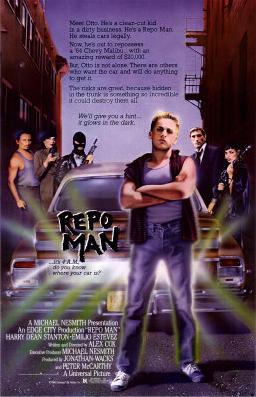
"Repo Man" - Film Review

Repo Man is tonally and structurally one of the most bizarre films I've seen. It never comfortably figures out what exactly it wants to be. It's funny, with a satirical bent at times (mocking consumerism and conformity), but it's also very dark, weird, and offputting. And It's constructed with such looseness and aimlessness that it's hard to know what we're supposed to take away from the film.

Emilo Estevez plays Otto, a would-be slacker who decides to start repossessing cars when his parents blow their money on donations to one of those television churches. Most of the film is watching him learn the ropes of the repo life, but there's a story playing out in the background about aliens whose remains have been smuggled out of Area 51. These extraterrestrial remains are in the trunk of a Chevy Malibu with a high repo bounty on it, and so in time Otto's path crosses with it.

It's as weird as it sounds and never compromises to be normal or predictable. It's also pulpy; mixing the seedy, the trashy, and the visually lucid. And for some its strange, punk, anarchic sensibility will surely ring true for them, but for myself, I'm still a little uncertain.

Grade: B-

Saturday, July 13, 2013

"As Tears Go By" - Film Review

As Tears Go By is an odd mishmash of deadpan humor, melodrama, romance, crime drama, and vivid imagery. And I'm not entirely sure it succeeds.

The film is about a criminal who attempts to help out a deadbeat criminal partner while wooing over a cousin he just discovered existed. 

There's plenty to like in the film. The meet-up between Wah (Andy Lau) and Ngor (Maggie Cheung) plays out like a more serious version of Stranger Than Paradise. These early scenes are simultaneously very funny and also tantalizing.  

The romantic elements are deeply erotic and even swooning. There's an epic sweeping scene set to Berlin's "Take My Breath Away" where the lovers run and embrace after having previously avoided acting on their feelings. This is every bit as affecting as the film intends it to be and exquisitely stylish to boot.

There's also a significant amount of brutal violence that at times is strangely elegant in how its shot by director Wong Kar Wai. The violence is twisted enough that though its entertaining its also almost never allows us to entirely be in the moment. Much of the romance is also dark and neurotic enough that it never becomes entirely cliched.

The film has sentimentality to it which is perhaps best seen in the relationship between Wah and Fly (Jacky Cheung) which is brotherly. Wah keeps bailing out Fly from his botched criminal activities and debts that increasingly put both in harms way. Wah would be better off without him but he can't escape the codependency.

But a lot of these elements while interesting on their own feel disconnected from one another, as if this is three or so different concepts for films pushed together. While Kar Wai certainly knows how to shoot things so their far more engaging and artistically interesting than the material might suggest, it still doesn't stop the film from feeling incomplete.

Grade: B

"Sansho the Bailiff" - Film Review

Lots and lots of miserable things happen across the course of Sansho the Bailiff's run-time. It's a sad, moving fable about doing the right thing in the face of the tragedies and difficulties of life. And yet despite the fact it puts us through the wringer with one devastating turn of events after another, the film is powerfully uplifting and hopeful.

The story it most reminds me of is Les Miserables. It has the same sort of scope and weight. In both narratives impossibly terrible things happen to people over the course of many years, but rather than feeling emotionally manipulative, it all feels totally earned. Both richly draw their characters and the situations they're put in, and then elevate the story to one of lofty but great themes about hope, redemption and loss.

On its face, Sansho the Bailiff appears simple, even in its direction by Kenji Mizoguchi which is continually reserved. But it slowly draws us into its story engrossing us as it moves along with a sense of patience and purpose. There's a seamlessness to the pacing and flow of the story.

The film is a period piece set in the Heian period of feudal Japan. It is about a family and their struggles. Their first misfortune occurs when the father, the official of a district, refuses to follow orders that would harm his people. Formerly aristocrats, their fates are left uncertain. As his wife and children travel to visit him in exile years later, they are kidnapped and made into slaves. The children are separated from their mother. The kids bide their time hoping that their parents are still alive and that they might one day escape. They are under the possession of the ruthless Sansho, who brands the face of anyone who falls out of line. Zushio grows bitter and loses faith in escaping or changing his life, while his sister Anju keeps hope.

The film has the fullness in its look at the lives of its character. We see Zushio and Anju as children and later as adults. We watch as the burdens and sacrifices that life forces upon us shape them. The film poses to us how we keep faith in the face of dire circumstances that should make us despair and crush us. Zushio breaks in the labor camp, becomes Sansho's trusted servant, hates himself for it, and then is forced to confront what he has done.

Its construction it is so carefully calculated. Its storytelling is something so profound and poetic that its hard to put it into words. And between its exceptional craft and deep story, it is a thing of beauty.

Grade: A