Tuesday, July 16, 2013

"Evil Dead" - Film Review

Being a remake, Evil Dead is likely to draw comparisons to the films that came before it. And it's important to say up front that while the film bears a passing resemblance to the original The Evil Dead, it's a very different film. The original was comedy in horror drag while this new film goes more for a horror vibe.

The film were given has call backs to the older series, the iconography and the famous scenes. But it's really not much more than an average horror film. Five people go to a cabin, creepy stuff starts happening and people get possessed.

There's still the original's penchant for raining down blood (at one point literally). But it's a more serious and moody film. This is at times to the film's detriment. Much of the excess needs to be played for laugh otherwise it feels unnecessary or glib.

There's also few actors in the film that have the charm and humor of Bruce Campbell. Jane Levy (being much darker than her work as Tessa Altman on Suburgatory might suggest) comes the closest but gets sidelined for an inordinate amount of time.

I appreciate the film's attempts to set itself apart from its source material, even if it doesn't entirely work. The film tells the story of a drug addict (Levy) heading to a cabin with friends and family to go cold turkey. The film, in a way, becomes an odd metaphor for overcoming addiction.

The drug angle allows the film to make excuses for the characters to initially keep avoiding the truth of the situation they're in. But it's also never really given enough room to breathe. The characters could have been there for any number of reasons and the film never entirely justifies this idea.

While the film has its problems, it's pacing and tonal shifts are pretty bad, it has an extraneous introduction, and it tries too hard to provide explanations to its horror, there's still a pretty good sense of atmosphere, a few decent horror setpieces (though never really all that scary - but with a couple good twists), and a final sequence (the film's best and scariest -  and also most absurd) that almost redeems the film. It's duller than it ought to be and less scary than it could potentially be, but it's not entirely a disservice to the far more inspired original.

Grade: C+

Monday, July 15, 2013

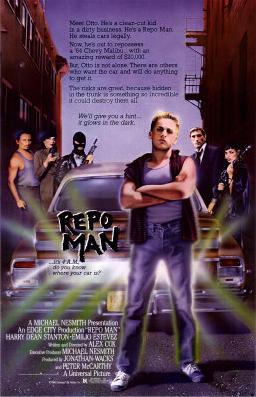
"Repo Man" - Film Review

Repo Man is tonally and structurally one of the most bizarre films I've seen. It never comfortably figures out what exactly it wants to be. It's funny, with a satirical bent at times (mocking consumerism and conformity), but it's also very dark, weird, and offputting. And It's constructed with such looseness and aimlessness that it's hard to know what we're supposed to take away from the film.

Emilo Estevez plays Otto, a would-be slacker who decides to start repossessing cars when his parents blow their money on donations to one of those television churches. Most of the film is watching him learn the ropes of the repo life, but there's a story playing out in the background about aliens whose remains have been smuggled out of Area 51. These extraterrestrial remains are in the trunk of a Chevy Malibu with a high repo bounty on it, and so in time Otto's path crosses with it.

It's as weird as it sounds and never compromises to be normal or predictable. It's also pulpy; mixing the seedy, the trashy, and the visually lucid. And for some its strange, punk, anarchic sensibility will surely ring true for them, but for myself, I'm still a little uncertain.

Grade: B-

Saturday, July 13, 2013

"As Tears Go By" - Film Review

As Tears Go By is an odd mishmash of deadpan humor, melodrama, romance, crime drama, and vivid imagery. And I'm not entirely sure it succeeds.

The film is about a criminal who attempts to help out a deadbeat criminal partner while wooing over a cousin he just discovered existed. 

There's plenty to like in the film. The meet-up between Wah (Andy Lau) and Ngor (Maggie Cheung) plays out like a more serious version of Stranger Than Paradise. These early scenes are simultaneously very funny and also tantalizing.  

The romantic elements are deeply erotic and even swooning. There's an epic sweeping scene set to Berlin's "Take My Breath Away" where the lovers run and embrace after having previously avoided acting on their feelings. This is every bit as affecting as the film intends it to be and exquisitely stylish to boot.

There's also a significant amount of brutal violence that at times is strangely elegant in how its shot by director Wong Kar Wai. The violence is twisted enough that though its entertaining its also almost never allows us to entirely be in the moment. Much of the romance is also dark and neurotic enough that it never becomes entirely cliched.

The film has sentimentality to it which is perhaps best seen in the relationship between Wah and Fly (Jacky Cheung) which is brotherly. Wah keeps bailing out Fly from his botched criminal activities and debts that increasingly put both in harms way. Wah would be better off without him but he can't escape the codependency.

But a lot of these elements while interesting on their own feel disconnected from one another, as if this is three or so different concepts for films pushed together. While Kar Wai certainly knows how to shoot things so their far more engaging and artistically interesting than the material might suggest, it still doesn't stop the film from feeling incomplete.

Grade: B

"Sansho the Bailiff" - Film Review

Lots and lots of miserable things happen across the course of Sansho the Bailiff's run-time. It's a sad, moving fable about doing the right thing in the face of the tragedies and difficulties of life. And yet despite the fact it puts us through the wringer with one devastating turn of events after another, the film is powerfully uplifting and hopeful.

The story it most reminds me of is Les Miserables. It has the same sort of scope and weight. In both narratives impossibly terrible things happen to people over the course of many years, but rather than feeling emotionally manipulative, it all feels totally earned. Both richly draw their characters and the situations they're put in, and then elevate the story to one of lofty but great themes about hope, redemption and loss.

On its face, Sansho the Bailiff appears simple, even in its direction by Kenji Mizoguchi which is continually reserved. But it slowly draws us into its story engrossing us as it moves along with a sense of patience and purpose. There's a seamlessness to the pacing and flow of the story.

The film is a period piece set in the Heian period of feudal Japan. It is about a family and their struggles. Their first misfortune occurs when the father, the official of a district, refuses to follow orders that would harm his people. Formerly aristocrats, their fates are left uncertain. As his wife and children travel to visit him in exile years later, they are kidnapped and made into slaves. The children are separated from their mother. The kids bide their time hoping that their parents are still alive and that they might one day escape. They are under the possession of the ruthless Sansho, who brands the face of anyone who falls out of line. Zushio grows bitter and loses faith in escaping or changing his life, while his sister Anju keeps hope.

The film has the fullness in its look at the lives of its character. We see Zushio and Anju as children and later as adults. We watch as the burdens and sacrifices that life forces upon us shape them. The film poses to us how we keep faith in the face of dire circumstances that should make us despair and crush us. Zushio breaks in the labor camp, becomes Sansho's trusted servant, hates himself for it, and then is forced to confront what he has done.

Its construction it is so carefully calculated. Its storytelling is something so profound and poetic that its hard to put it into words. And between its exceptional craft and deep story, it is a thing of beauty.

Grade: A

Friday, July 12, 2013

"My Darling Clementine" - Film Review

My Darling Clementine could very easily have been a revenge narrative or about two leading community figures butting heads, but instead it chooses to spend a lot of time just hanging around an Old Western town called Tombstone. Those first two storylines are pushed to the background of the film, and we get to see the lives of people living in this lawless, isolated Old West town.

There's a grit to the film. The town is filled with booze, prostitutes, gambling and individuals of questionable trustworthiness. Even our protagonist Wyatt Earp (Henry Fonda) is selfish and vindictive. The paragon of the community Doc Holliday (Vic Mature) is a controlling and bitter man. The kindest indvidual is the titular Clementine (Cathy Downs), a spurned lover of Holliday, whose a prim and proper middle class figure from back East. And she's hardly the focus of the film, despite the title's suggestion.

But the title is fitting because it's a film where no one gets what they want (She never gets to be anymore than a mere "darling"). Earp and his brothers are cow wranglers who go into Tombstone as a respite from their travels, only to return to find the brother they left behind has been murdered and their cattle is gone. He takes up the job offering as the town marshal, which puts him at odds with Holliday and a bunch of shady cow wranglers called the Clantons. Holliday rejects Clementine, who keeps loving him despite his treatment of her, and he's equally terrible towards prostitute Chihuahua (Linda Darnell) who he's promised to marry (and never does, nor seems to really be committed to it). Earp clearly has feelings for Clementine but finds it best not to act on them, thus never ending up with her. And the price of the justice for Earp's brother proves to be incredibly costly, leading to the death of many people from the town.

This is not the most romantic of Westerns. It's moody, especially in its shots of nighttime. There's a longing, loneliness and isolation about the film. The most exciting things that happen to the town are the appearance of a Shakespeare performer and the completion of a church. There is little in the way of civilizations for many, many miles (though it starts to make its appearance over the course of the film). Tombstone is just a speck on the horizon of Monument Valley, but there's a lot of life in there. There's a lot of hope bubbling underneath all that melancholy, and it's embodied in the glimpses the film gives us of the town and the people who inhabit it.

The film is technically about the infamous gunfight at the O.K. Corral, which we witness towards film's end. But it's one of the least important parts of the film. This isn't a film about Wyatt Earp, and Fonda plays him rather unassumingly. It's about the idea of the Old West, and director John Ford explored that from countless angles throughout his career, but few as effectively as this.  
 
Grade: A 

Thursday, July 11, 2013

The Scandalous Thing About "Scandal" Season 1 is That It Might Be Good

Our seemingly sensible selves tell us that Scandal is not something we should watch by choice other than begrudgingly and in hushed tones so no one is aware we're watching something with so many crazy twists and turns. Scandal, especially early on, feels like its going to be a guilty pleasure. It seemingly a series that is good at indulging in our baser instincts of what we expect from television in fast-talking, soapy fashion. Our sensible selves tell us: there's good stuff in there but its all so clouded over by its more, well, scandalous elements.

And certainly, there are ideas that feel half-baked on the show, and it definitely has a little more leg work to go in order to relieve itself of the label "guilty pleasure". But Scandal is a show that isn't half-bad at what it does, even if what it mostly does is lightly skewer the current political environment with potshots at both the Left and the Right and everyone in between (There's an episode where the case-of-the-week features a South American dictator, and it's every bit as "Um, okay then ..." as you might expect).

Tethered by the awesome central performance of Kerry Washington as super lawyer Olivia Pope who has gone from former White House adviser to political fixer, the series primarily focuses on procedural cases, gradually tying in a larger story connected to some illicit activities involving the President. Creator Shonda Rhimes makes the dialogue snap out of her characters like they're hopped up on five-hour energy, and the dialogue is the kind that often sounds cooler said at a whiplash pace than it might actually be delivered any other way. Some of it is a little too cute or neat (There's a running joke about "wearing a white hat" that borders on trite).

Pope runs an agency filled with lawyers that she's plucked out from the Island of Misfit Toys. The company takes on the cases of whomever walks in their door, fixing their client's problems without judging them. Slowly the supporting characters are revealed to be more than do-gooders and deliverers of exposition, and though the different cases vary in quality, what they slowly reveal about the operations of the company are suggestive of a really cool set-up that you'd only ever witness on television. Pope is steely and seemingly totally in control which means, of course, she's got her own baggage that slowly reveals itself.   

Scandal is a plot heavy series, which means a shortened seven episode season never really allows the show to find its footing. The pilot features a newbie being hired by the company and we begin to see the rest of the characters primarily through her eyes. But the series never even really gets to develop this angle, cliched as it is. Too many little plot threads are hinted at but never get to take form and that's what the problem is; Scandal is attempting too many things at once, and some of it is interesting but some (okay a lot) of it falls flat.

But between the performances of a cast that is at times more convincing than the material provided and an affection for giving its audience a delectably fun time (at times a little too predictably and plainly so), Scandal does exactly what you'd expect. And that's not a bad thing. The real scandal of Scandal is that this might just have the potential to grow into a very good drama. And it's doing it by giving us what we want; that's not a guilty pleasure, that's just a pleasure. I could see this show working out the kinks; developing the under-serviced supporting players more and turning the cases of the week into something with more teeth.

I'm not saying you should expect wonders from the first season, but it's okay to embrace the pleasure part of that guilty pleasure you're experiencing.         

"The Treasure of the Sierra Madre" - Film Review

The Treasure of the Sierra Madre is the tale of three men who go seeking gold in the mountains of Mexico and discover gold, yes, but something much bleaker as well. It's a story that becomes more compelling and darkly philosophical as it moves further along. Built on themes about greed, madness, and betrayal, Sierra Madre is a deliberately paced film that explores some of the darker elements about isolation and money-seeking.

The film has the quality of film's like Apocalypse Now. There's a journey that unfolds slowly, at times surreally. We have an idea of where this is going but the story keeps unfolding with a feverish intensity. There's a exceptional character study at the heart of the film, particularly of Humphrey Bogart's Fred C. Dobbs. Events conspire to pull at the frayed strands of Dobbs' psyche.  

The film is carried by the sharp dialogue of John Huston's script and the great performances of the three leads, including Tim Holt, Walter Huston (John Huston's father), and, most memorably, Bogart. Bogart as Dobbs, the most paranoid and desperate of the three, was born to speak this dialogue which crackles with his pronunciations, even as it also starts to sicken. Huston is also great as Howard, the old-time prospector whose seen it all, and acts as foil to Dobbs.

The film is fantastic at conveying the overwhelming sense of inevitability of the events that occur, which play out like a morbid Greek tragedy. Dobbs claims early on that he'd get a little bit of gold and get out before the desire for more overcame him, and in that moment we can foresee where this is all headed.

On one level, the whole film is a giant morality tale. A number of scenes are clearly staged on studio sets and there's a studio vibe to it at times (Much was filmed on location, though the night scenes weren't) - especially Howard's time spent in an Indian paradise. But it's also surprisingly dark for a studio film of this time.

Director John Huston does a phenomenal job of pacing and structuring this, and filling it with a keen attention to detail (The gold mining takes place a fair amount of time in after we've gotten to know the characters and see just how desperate they are). Blackly funny, adventurous, and wonderfully melancholy, The Treasure of the Sierra Madre is a classic.

Grade: A