My Darling Clementine could very easily have been a revenge narrative or about two leading community figures butting heads, but instead it chooses to spend a lot of time just hanging around an Old Western town called Tombstone. Those first two storylines are pushed to the background of the film, and we get to see the lives of people living in this lawless, isolated Old West town.
There's a grit to the film. The town is filled with booze, prostitutes, gambling and individuals of questionable trustworthiness. Even our protagonist Wyatt Earp (Henry Fonda) is selfish and vindictive. The paragon of the community Doc Holliday (Vic Mature) is a controlling and bitter man. The kindest indvidual is the titular Clementine (Cathy Downs), a spurned lover of Holliday, whose a prim and proper middle class figure from back East. And she's hardly the focus of the film, despite the title's suggestion.
But the title is fitting because it's a film where no one gets what they want (She never gets to be anymore than a mere "darling"). Earp and his brothers are cow wranglers who go into Tombstone as a respite from their travels, only to return to find the brother they left behind has been murdered and their cattle is gone. He takes up the job offering as the town marshal, which puts him at odds with Holliday and a bunch of shady cow wranglers called the Clantons. Holliday rejects Clementine, who keeps loving him despite his treatment of her, and he's equally terrible towards prostitute Chihuahua (Linda Darnell) who he's promised to marry (and never does, nor seems to really be committed to it). Earp clearly has feelings for Clementine but finds it best not to act on them, thus never ending up with her. And the price of the justice for Earp's brother proves to be incredibly costly, leading to the death of many people from the town.
This is not the most romantic of Westerns. It's moody, especially in its shots of nighttime. There's a longing, loneliness and isolation about the film. The most exciting things that happen to the town are the appearance of a Shakespeare performer and the completion of a church. There is little in the way of civilizations for many, many miles (though it starts to make its appearance over the course of the film). Tombstone is just a speck on the horizon of Monument Valley, but there's a lot of life in there. There's a lot of hope bubbling underneath all that melancholy, and it's embodied in the glimpses the film gives us of the town and the people who inhabit it.
The film is technically about the infamous gunfight at the O.K. Corral, which we witness towards film's end. But it's one of the least important parts of the film. This isn't a film about Wyatt Earp, and Fonda plays him rather unassumingly. It's about the idea of the Old West, and director John Ford explored that from countless angles throughout his career, but few as effectively as this.
Grade: A
Friday, July 12, 2013
Thursday, July 11, 2013
The Scandalous Thing About "Scandal" Season 1 is That It Might Be Good
Our seemingly sensible selves tell us that Scandal is not something we should watch by choice other than begrudgingly and in hushed tones so no one is aware we're watching something with so many crazy twists and turns. Scandal, especially early on, feels like its going to be a guilty pleasure. It seemingly a series that is good at indulging in our baser instincts of what we expect from television in fast-talking, soapy fashion. Our sensible selves tell us: there's good stuff in there but its all so clouded over by its more, well, scandalous elements.
And certainly, there are ideas that feel half-baked on the show, and it definitely has a little more leg work to go in order to relieve itself of the label "guilty pleasure". But Scandal is a show that isn't half-bad at what it does, even if what it mostly does is lightly skewer the current political environment with potshots at both the Left and the Right and everyone in between (There's an episode where the case-of-the-week features a South American dictator, and it's every bit as "Um, okay then ..." as you might expect).
Tethered by the awesome central performance of Kerry Washington as super lawyer Olivia Pope who has gone from former White House adviser to political fixer, the series primarily focuses on procedural cases, gradually tying in a larger story connected to some illicit activities involving the President. Creator Shonda Rhimes makes the dialogue snap out of her characters like they're hopped up on five-hour energy, and the dialogue is the kind that often sounds cooler said at a whiplash pace than it might actually be delivered any other way. Some of it is a little too cute or neat (There's a running joke about "wearing a white hat" that borders on trite).
Pope runs an agency filled with lawyers that she's plucked out from the Island of Misfit Toys. The company takes on the cases of whomever walks in their door, fixing their client's problems without judging them. Slowly the supporting characters are revealed to be more than do-gooders and deliverers of exposition, and though the different cases vary in quality, what they slowly reveal about the operations of the company are suggestive of a really cool set-up that you'd only ever witness on television. Pope is steely and seemingly totally in control which means, of course, she's got her own baggage that slowly reveals itself.
Scandal is a plot heavy series, which means a shortened seven episode season never really allows the show to find its footing. The pilot features a newbie being hired by the company and we begin to see the rest of the characters primarily through her eyes. But the series never even really gets to develop this angle, cliched as it is. Too many little plot threads are hinted at but never get to take form and that's what the problem is; Scandal is attempting too many things at once, and some of it is interesting but some (okay a lot) of it falls flat.
But between the performances of a cast that is at times more convincing than the material provided and an affection for giving its audience a delectably fun time (at times a little too predictably and plainly so), Scandal does exactly what you'd expect. And that's not a bad thing. The real scandal of Scandal is that this might just have the potential to grow into a very good drama. And it's doing it by giving us what we want; that's not a guilty pleasure, that's just a pleasure. I could see this show working out the kinks; developing the under-serviced supporting players more and turning the cases of the week into something with more teeth.
I'm not saying you should expect wonders from the first season, but it's okay to embrace the pleasure part of that guilty pleasure you're experiencing.
"The Treasure of the Sierra Madre" - Film Review
The Treasure of the Sierra Madre is the tale of three men who go seeking gold in the mountains of Mexico and discover gold, yes, but something much bleaker as well. It's a story that becomes more compelling and darkly philosophical as it moves further along. Built on themes about greed, madness, and betrayal, Sierra Madre is a deliberately paced film that explores some of the darker elements about isolation and money-seeking.
The film has the quality of film's like Apocalypse Now. There's a journey that unfolds slowly, at times surreally. We have an idea of where this is going but the story keeps unfolding with a feverish intensity. There's a exceptional character study at the heart of the film, particularly of Humphrey Bogart's Fred C. Dobbs. Events conspire to pull at the frayed strands of Dobbs' psyche.
The film is carried by the sharp dialogue of John Huston's script and the great performances of the three leads, including Tim Holt, Walter Huston (John Huston's father), and, most memorably, Bogart. Bogart as Dobbs, the most paranoid and desperate of the three, was born to speak this dialogue which crackles with his pronunciations, even as it also starts to sicken. Huston is also great as Howard, the old-time prospector whose seen it all, and acts as foil to Dobbs.
The film is fantastic at conveying the overwhelming sense of inevitability of the events that occur, which play out like a morbid Greek tragedy. Dobbs claims early on that he'd get a little bit of gold and get out before the desire for more overcame him, and in that moment we can foresee where this is all headed.
On one level, the whole film is a giant morality tale. A number of scenes are clearly staged on studio sets and there's a studio vibe to it at times (Much was filmed on location, though the night scenes weren't) - especially Howard's time spent in an Indian paradise. But it's also surprisingly dark for a studio film of this time.
Director John Huston does a phenomenal job of pacing and structuring this, and filling it with a keen attention to detail (The gold mining takes place a fair amount of time in after we've gotten to know the characters and see just how desperate they are). Blackly funny, adventurous, and wonderfully melancholy, The Treasure of the Sierra Madre is a classic.
Grade: A
Wednesday, July 10, 2013
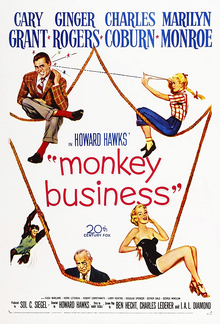
"Monkey Business" - Film Review
Monkey Business is a delightfully screwy comedy. A boring, absent minded scientist (Carey Grant) is working on a formula for a youth serum and testing it on monkeys. When one of the monkeys solves the formula before the scientist, he slips the mixture into the water cooler and soon has the scientist convinced he's figured out the answer to the fountain of youth. This in turns leads to lots and lots of shenanigans.
This is unquestionably a silly film but so much of it is pitch-perfectly zany that it doesn't matter how much of a stretch so much of it is or how ridiculous so many of the plot turns are. Grant and Ginger Rogers, as his wife, commit to the transformations caused by the serum and it leads to some predictable but hilarious scenes where they act first like they're in their twenties and then as if they're in pre-school. Grant gets a new hair cut, a new suit and a new car; crashes the car, and takes Marylin Monroe, the secretary of his boss - really just Monroe playing Monroe as she did in so many films and always pleasingly so - out on the town. Rogers pulls pranks on Grant's boss, before attempting to recreate their honeymoon night, which, of course, ends up disastrously. A fight gets out of hand, Rogers kicks out Grant, and calls up her lawyer to work on the divorce papers.
In the vein of screwball comedies (including director Howard Hawks' great Bringing Up Baby), this is a woozy escalation of events. The earlier comedy sequences seem quaint when compared to the ones towards the end (which really are testing credulity). Grant paints his face as an Indian and with the help of some neighborhood kids scalps the lawyer. Meanwhile, Rogers mistakes a baby for Grant, assuming the formula has gone terribly wrong and de-aged him too far.
There's no questioning this is a little dumb and a little goofy, but Hawks keeps the film humming along. The film never really takes a breather, continually pushing forward with one joke after another. And it's all so charming and funny that it doesn't matter that this is a little absurd. The film's enjoyment comes through its embracement of its absurdity.
The star power and the direction here turn what could very easily have been something bad into something with impeccable comedic timing.
Grade: A-
Tuesday, July 9, 2013
"Bad Taste" - Film Review
Bad Taste is straight up with its aims; it's right there in the title. It's a trashy, schlocky film that revels in "bad tastiness".
The film is perhaps best known as the debut effort of director Peter Jackson. In the film we can see a lot of what would make up his later films, particularly those of his splatter film period. Though the story is dearly in need of more substance, the craft here is great. The special effects are inspired, and gloriously, often hilariously, over-the-top. Jackson is clearly working with a limited budget (he plays two different parts, along with writing, producing, making effects, doing make up, and directing the film) and out of that he comes up with some inventive ways for action, tension and humor (at some points disgustingly so).
Jackson keeps the story simple. A secret, small government agency is assigned to contain an extraterrestrial attack upon a small, isolated New Zealand town. The aliens have possessed the bodies of some of their victims and seek to eat any human that comes in their way. The aliens are harvesting human bodies to be used as part of a fast food franchise.
Jackson slowly builds up the story, starting out with smaller horror and action setpieces before building to a series of slightly indulgent, awesome and a bit tacky fight scenes where guns go a blazing.
Underlying all of this is a dry humor. There are a number of throwaway lines that are wonderfully biting and satirical without drawing attention to themselves. The film's humor is what drives it. The storytelling is constantly aware that this is a little trashy and has fun with its crazy, silly premise.
Through the film such a high level of affection comes across that even at its low points, it's a little giddy.
The storytelling is lacking a little too much, especially early on. But there's some good splatter effects and it's interesting to see where Jackson got his start.
Grade: B-
Monday, July 8, 2013
"The Queen of Versailles" - Film Review
Lauren Greenfield's Queen of Versailles finds a unique lens for exploring issues surrounding the economic state of the United States. The film tells the story of one of the nation's wealthiest families, the Siegels, pre and post 2008 economic collapse. And in the lavishness of their lifestyle and in the conflict it comes into when confronted with economic problems, the film finds a sad, darkly funny tale of excessive consumption and materialism with much greater implications for the larger U.S.
David Siegel made his fortune by founding the world's largest time share company, Westgate Resorts. So assured of his success and a workaholic, he put all his time and energy into the company. Nearly all of his family's money is tied up in the company. His wife Jackie dropped out from an engineering job at IBM to pursue a career as a model, which she was successful at for some time before marrying David. Now she lives out her days in their massive home with dozens of dogs and her seven kids. But this is not enough; she convinced her husband to build a full scale replica of France's Versailles Palace (the largest single family home in the U.S.), a house that remains incomplete.
In the miniature Versailles, Greenfield finds a near perfect unintentional symbol for her subject matter. The Versailles on the outside is near complete; it's luxurious, extravagant, and, to the right eye, gorgeous. But the inside is unfinished with scaffolding still in place. Greenfield started out the film before the 2008 and continues the story with a new direction in the face of the Siegel's new found struggles. The Siegels seem baffled in the face of their new economic challenges; they don't even speak the language of this downgraded lifestyle. The Siegels have to make sacrifices (sacrifices that Jackie never really takes to heart). Versailles has to go on the market (but who the hell is going to buy it?).
Greenfield is cynical about her subject matter. There are times where she's clearly taken aback by how ungrateful and ignorant the family so constantly is, particularly Jackie, a former Miss America contestant whose slowly becoming a plastically calcified version of her former self. Greenfield has an eye for images that consummately encapsulate everything that's happening and that she wants to get across. For example, at one point, there's a wonderful, hilarious shot of a stretch limo going through a McDonald's drive thru.
It would be all to easy to villainize the Siegels (and Greenfield's opinion seems to sit with more bemused discontent). But the film does a really great job of showing the fullness of the world its exploring by branching out to do interviews with the children and employees of the Siegels. In the employees, the film nicely demonstrates the extreme contrast between the Siegel's life and those living more typical and difficult American lives. The Siegels aren't completely terrible people; they're just people who've known too little of any other life for far too long. Both David and Jackie grew up in low income families, but though they mention this, it's hard to imagine it.
It's a surprisingly sympathetic portrait but it's also one that doesn't hold back its punches, allowing us to take a strange pleasure in the near demise of this frustrating and selfish family.
Grade: A
Sunday, July 7, 2013
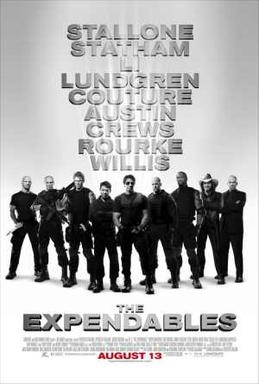
"The Expendables" - Film Review
The Expendables is a film all about massive wish-fulfillment. It seeks to answer what diehard action fans have surely pondered to themselves for ages: what would happen if you took the biggest action stars and put them all into one film? You'd apparently get The Expendables which features a cast that includes Sylvester Stallone (who also directed), Jason Statham, Jet Li, Terry Crews, Mickey Rourke, Randy Couture, and Dolph Lundgren teaming up to do badass action-y things.
We get the loosest of plots about an extra-paramilitary force (called The Expendables) that runs covert missions for private gain. There's a mission about taking down a South American dictator and the American business man he's gotten into bed with, but it really doesn't matter. This is a film that isn't concerned all that much with a plot and is more concerned with hyper-masculine, over-the-top action. And in that regard it's rather successful.
The film's most obvious shortcoming is failing to take advantage of its cast. Arnold Schwarzenegger and Bruce Willis make cameos but it feels like a throwaway. Besides Stallone, Statham and Li, most of the other actors are sidelined.
Going into a film like this, you're aware you're not getting a film with a spectacular story or depth, but that's okay if you're interested in some well-choreographed, explosive fight scenes. The action is at times so excessive that it's hard not to laugh in the face of its extreme self-indulgence.
This is a dumb film but it's never one that pretends to be smart. If you're willing to overlook some glaring storytelling problems, there's some high-octane entertainment to be found in The Expendables.
Grade: C
Subscribe to:
Posts (Atom)