Sunday, July 7, 2013

"Spring Breakers" - Film Review

Harmony Korine is a provocateur. He's a writer and director known for his films that try to shock us.

His first attempt to provoke us in Spring Breakers is in the casting. There's definitely an element of stunt-casting to having Selena Gomez and Vanessa Hudgens appear in Spring Breakers. The film is playing against their perceived family friendly, Disney personas. Of course these are personas that have been built up over many years, and the film is concerned with appearances, particularly manufactured ones. 

The story of Spring Breakers is a simple one. Four nubile college females (Gomez, Hudgens, Ashley Benson, Rachel Korine) are obsessed with going to Florida for spring break but don't have to money to do so. So three of them decide to rob a chicken joint to gain them the necessary funds to stay down in the Sunshine State. They seem almost unconcerned by the violence they've used to acquire the money; in fact, they almost revel in the rush of the experience. But this fits in with what much of the film argues. The film makes the case about the emptiness and vapidness that underlies so much of this partying-obsessed lifestyle.

The film's lighting is bright and its editing style is frequently filled with quick cuts. It's like the film is on ADHD. The vibe the film gave off to me was like a dance club, but it's more like coming down from a high and realizing the club is little seedier than you first realized. The color scheme for the film is a bright and super saturated; everything pops but it's lots of neon colors which almost becomes hard to visually take. The music choices similarly blare out; it's lots of techno, house and dance music.

The film is often one that's more concerned with its ideas than its story. The film ends abruptly and little actually happens in the course of getting there. We see the girls do lots of bad things, and be blind and ignorant to the damage their causing. This is at times property damage or physical harm, but there's also lots of psychological harm being wrought throughout.   

There's not much distinction between the four girls, but perhaps that's the point. They're stand-ins for all the people like this. Gomez plays the ostensibly "good girl" whose religious, and at one point super ironically comments on the spiritual awakening the trip has lent her. But besides that there's little done to give us a sense of what has led these people to this point in their life.

James Franco arguably gives the most memorable performance in the film. He plays a criminal who bails out the girls after they end up in jail midway through the film. The performance is ridiculously, almost unbelievably, hammy.

The film gets it message across at its best when its showing subtler contradictions. There are moments in the film that in the hands of another director would be erotic or sexy or tantalizing, but here are sad, pathetic, and even disgusting. There's plenty of nudity throughout and Korine lingers on the images of naked bodies. The objectification is magnified times ten to the point where it's not sexy or interesting, but just a matter of fact. What initially might have seemed like an exploitative film is much more contemplative and venemously indicative.

Grade: B+ 

Saturday, July 6, 2013

Bidding Farewell to "Happy Endings"

Not too long ago it was announced that Happy Endings was canceled. I only just recently finished up the last three episodes that had piled up in my queue (not that my watching in real time would have saved the series with the abysmal ratings it had), and so I now feel the need to share some thoughts on the series.

Initially Happy Endings held little promise in its midseason run first season, which felt too familiar and too uninspired to amount to much. But in time the show grew into something much better and much funnier. The show grew into a hyper-aware sitcom, skewering the very conventions it was playing around with. Happy Endings was a flopsweat of countless jokes, scripts brimmed with joke upon joke.

Happy Endings was a show that was hyper-literate and versed in pop culture. At nearly every turn it would throw in a spoof, homage, or just a sly joke puncturing genres. The characters on the show seemed to know, on some level, that they were sitcom characters, and the show played around with this to some fun results. This was a great cast filled with delightful performances. If nothing else, the show made us take notice of Adam Pally who I would say was the series' highlight if it weren't for the miraculous utilization of Elisha Cuthbert as Alex. 

Above all else the series was hilarious. If one joke didn't land, there would be a dozen immediately following it that would be sure to get you. The speed of delivery and the types of jokes Happy Endings was telling set it apart from so many shows, but it also made it a perpetually low-rated series. When ABC pulled it before clunking it down on the death-knell of Friday nights, burning off episodes two at a times, well, the end was spelled out.

The cancellation is a shame. Happy Ending was a messy show but often an ingenious one. It was a show best simply enjoyed for its wacky, glorious antics. And now we shall get no more of them. 

"Les Enfants Terribles" - Film Review

Les Enfants Terribles is about a sickly codependent brother-sister relationship. At first, it seems like any ordinary sibling contentious affection and rivalry, but it soon reveals itself to be something much more complicated (potentially incestuous).

Elisabeth takes care of her brother Paul after he becomes injured in a snowball fight. They soon become inseparable, spending all their time together. But the relationship becomes strained as both branch out.  

The film starts out as something more naturalistic and grows into something more theatrical and philosophical. The early naturalism is continually undercut by the voice over from an omniscient narrator who provides the events with a darkly whimsical and metaphysical quality (The narration is a bit excessive and gets into flights of fancy). The film is even playful in the early going, showing a loving but slightly self-destructive relationship between Elisabeth (Nicole Stephane) and Paul (Edouard Dermit). Stephane gives a fantastic performance, especially towards the film's end.

The film is a bit jumbled, filled more with vignettes than a complete throughline of a narrative. But the sibling relationship remains throughout and is fascinating. So much of the film contains such a sense of atmosphere that even minor scenes are interesting, and then this cinematography becomes ever more heightened in the film's third act. It becomes gloomy, dream-like, foreboding.

Not all of this works. Certain turns in the plot and character motivations/actions come out of nowhere. But the film at its best is wonderfully dreamy.        

Grade: B

"World War Z" - Film Review

World War Z is about a man doing everything he can to protect his family. Gerry Lane (Brad Pitt), a former U.N. employee, is called in to look into the cause of the viral spread that led to humanity’s crisis. The military will only allow his family to remain on an offshore naval base if he makes himself useful. And so despite how little interest he has in this, he sets out to try to find Patient Zero, the first person to have been infected. This takes him first to South Korea and then Israel and finally Wales. The film is a somewhat globetrotting one, but the film never overstays its welcome in any one location; it stays long enough for it to get in the story it needs without making us lose interest before moving on.

The film is somewhat uneven. The transitions from one part of the story to the next are poorly handled. As is, World War Z feels like a number of different stories mashed together. These different vignettes are all pretty fun in of themselves but they don't always add up to the most cohesive of films.

Not all of the action and horror in World War Z is successful. There’s a scene where zombies form a ladder and climb up over a defensive wall, and it not only stretches plausibility but isn’t all that interesting (it doesn’t help that the CGI here is pretty crappy). But much of it is rather effective and occasionally pleasingly inventive. There’s a great scene midway through upon an airplane that is one of the single best uses of zombies I’ve seen in a long time. There’s an even better scene at film’s end that is super intense and suspenseful where our hero has to grab medical supplies from a sealed off portion of a research facility. The film draws this out with engrossing and thrilling results.  

What I was most struck about World War Z was how effectively it found a story within what was at times huge zombie action taking place. The film focuses in on a few people and it makes the drama and our investment based in these handful of people, and it does this well. We start the film in the home of Gerry with his family. The story follows them out into traffic, where they get caught in the middle of a zombie invasion into Philadelphia. And we keep following these people, seeing the drama through their eyes. In this way the action never becomes all-consuming or distracting, like say in Man of Steel. Though a number of these characters never really get developed enough, Brad Pitt gives an assured performance as Lane. 

There are weaker and more questionable moments, and it's uneven in places, but World War Z is largely entertaining.  

Grade: B-

Friday, July 5, 2013

"Starship Troopers" - Film Review

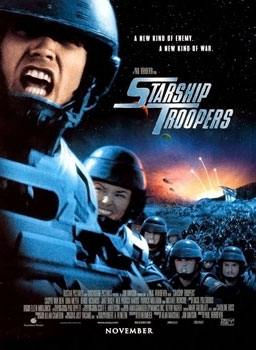
Starship Troopers is a film that’s often hard to read. It’s intended as a satire but it’s satirical in a genre, sci-fi, that rubs up against this tone in strange ways. The film is so often peppy and upbeat in the face of its carnage and its macho action. This makes it sometimes hard to wonder whether you’re supposed to be simply be bemused or actually laugh at things. Enough content is played straight that it could be mistaken as serious. But it becomes clear from the strange interspersed “television clips” from the programs played in this far flung futuristic society (these are some of the film’s most hilarious moments).

Like other films by director Paul Verhoeven, such as Robocop, Starship Troopers is having fun at the expense of its excessive violence. The blood, guts and goo is played up for some delightful excess. The troopers find themselves fighting some villainous insect aliens. The film’s other excesses come in the form of society’s military complex which has come to engulf everything (fascistically so). Jingoism runs amok in the Starship Troopers universe. 

The film drags in spots, especially towards the end which repeats a number of earlier ideas to diminishing returns. But on the whole Starship Trooper’s satire is thoroughly unique and consistently funny. The production design is filled with intentionally chintzy and silly elements that add up to a sort of campy, lovable charm. Though because of how Verhoeven plays so much of the material, it’s often hard to know what to make of what we’re seeing, it’s at least never boring.   

Grade: B

"Beyond the Valley of the Dolls" - Film Review

Director Russ Meyer was the King of Sexploitation in the 60's and 70's. When he teamed up with Roger Ebert to make Beyond the Valley of the Dolls, he created one of his best remembered films.

Beyond the Valley of the Dolls is a weird, goofy, trashy film that went on to become a cult classic. Sexploitation, the genre of film-making Meyer's worked in, called for lots of violence and nudity, and there's plenty of both on display here. The film is sexy, displaying ample amounts of objectification (of both men and women - but mostly women). Much of the film is allowing attractive people to simply be attractive.

Despite how trashy and exploitative the film is, it's also smarter than that. Meyer and Ebert's script provides the film with a fair amount of satire and social commentary, and though some of it isn't entirely graciously handled, it gives even the sillier and limper moments a sense of purpose they otherwise might not have had. The film is very much of the time in which it was made. Made in 1970, the film is clothed in the vibe and style of the swinging 1960's that had just come to pass (at times laughably and awkwardly so), and much of the commentary looks forward to the conflicted 1970's America.

Though whatever greater messages about corruption, exploitation and understanding in the film might have devolved, especially in the surreal and silly ending, and are too frequently undercut by the film's sensibilities, the film is at times pretty fun. This is occasionally merely due to a camp factor. But there are still aspects that hold up. Plus there's splatter effects and hot bods.

The film's story of a girl rock group's rise to fame and the cost that comes at remains to be, in the words of the characters, groovy. Even if it is frequently for reasons not necessarily intended by the film. This a trashy, schlocky, at times pretty bad film, but it's also one where a lot of real affection shines through and it remains entertaining even if it's due to just how strange and poorly handled it so often is.   

Grade: B-

Wednesday, July 3, 2013

"Despicable Me 2" - Film Review

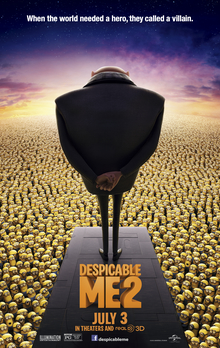
Despicable Me 2 is a film that is very much like its predecessor. This is both its blessing and its curse. This is still a rather fun and entertaining family movie. But it’s also a film that plays so many of the same cards that the first film played. The film has a familiarity that is never entirely played against or that the film tries to elevate itself above.

The studio realized that much of the success of the first film came from the adorable, scene stealing sidekicks to Gru (Steve Carell) called the Minions. The tiny, fuzzy, yellow, intelligible creatures are given even more screen time than the last outing, and it’s a decision that isn’t entirely ill chosen. The Minions remain to be the funniest and most adorable aspects of the film, even if the film does lean a little too heavily on them. Some of this material doesn’t land, but the film also uses them in unexpectedly new ways that honestly the film could have used more of.

After the last film, what story is there left to tell about Gru? There really isn’t much. It’s cute to see Gru fumble in his attempts to raise his adopted daughters. But there’s only so much story to be mined from this, and the writers seem to know this. A plot is added at the center that turns Gru into a spy working for the government, attempting to take down a villain. Then Gru falls for the partner assigned to help him and the romantic subplot is used to show a surprisingly vulnerable side to the character.

Despite that there’s little reason to tell more story here and despite how very jumbled the storytelling is, the film remains to be fun. I laughed a lot (and that’s saying a lot from me – I’m a robot). The film disappointingly lacks the depth of the first film, and this sequel is far less emotional and cleverly told. But as a kid sitting in the row ahead of me shouted as the Minions appeared on screen, “This is the funny part!”  And there enough of those moments, funny, fun and sweet, that it largely doesn’t matter that this isn’t as strong of an outing. This is some fine animation and some solid family friendly entertainment   

Grade: B-