Tuesday, July 2, 2013

"The Kid With A Bike" - Film Review

The Kid With A Bike is about a kid who wants his dad, and instead ends up with a bike.  

Cyril Catoul (Thomas Doret) is living in a group home. His father Guy (Jeremie Renier) put him in one, claiming it would be for only a month. A month has passed though, and Cyril is now upset. He thinks the home is trying to keep him away from his father. He’s idealized the man, but the man is not how Cyril imagines him to be. He’s a deadbeat who wants nothing to do with his son. 

Cyril spends much of the film searching for fathers or father-figures. The one person who seems to have actual interest in him is kindly hairdresser Samantha (Cecile de France) who takes in the boy on weekends after meeting him by chance. She’s trying her best to get through to Cyril who is quietly stewing, frustrated, unresponsive and confused. But we can tell Cyril’s antics are beginning  to wear on her; she’s becoming exasperated.

Cyril is too young to truly understand the opportunity he’s stumbled upon in this woman. She’s a working woman, struggling to make due, and yet she can't help but help this kid. She doesn’t know the boy but she sees from their first meeting that this is a sweet kid deep down, simply troubled and distrusting.

The boy rides around on a bike constantly throughout the film. It’s the one thing in life he seems to get any enjoyment from. The bike keeps getting stolen and Cyril has to get it back. He tracks down the bike in one instance to a youth gang, where the leader recognizes an easy target and manipulates Cyril. He plays the father-figure that Cyril so desperately desires. He’s giving Cyril all the attention and responses he thinks he wants and deserves, rather than the sterner love Samantha provides him. 

The film takes a starkly realistic approach to its subject matter. There’s little romanticism to be found here. The most sentimental scenes are in quietly stolen moments between Samantha and Cyril. The film even finds some oddly metaphysical material to work with when Cyril coincidentally runs into two people he attacked as part of a crime with the gang leader. But on the whole the film tells its story with confounding simplicity.   

The film discovers quiet tragedy and emotional devastation in its realistically drawn story. Cyril is doggedly resolved upon finding his father, despite his father’s absolute disinterest in having anything to do with him. When he finally discovers him, after he avoids a meeting Samantha set up, Guy quickly dismisses his son before telling Samantha he doesn’t want to see him. Samantha can’t bring herself to tell Cyril and makes the man tell his son the truth. Cyril is quiet on the car ride home, and then he snaps. All Samantha can do is hold him.

When we first meet Cyril, he's running away from the group home. Throughout the film we keep witnessing him running away. He's distancing himself from his problems and avoiding hard truths. As the film starts, he doesn't have the bike, his father has sold it away (They must have stole it from him, Cyril says). Even as Samantha buys it back for him, he can't accept that it was sold away. Even when he does accept things, he learns that life is never that easy or that fair.

Grade: A-

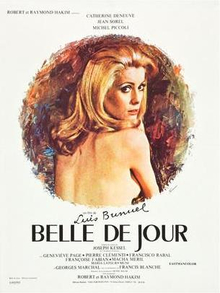
"Belle De Jour" - Film Review

Catherine Deneuve is good at playing impenetrable. It’s difficult to play blankness; it can come off as bad acting rather than ambiguity. It helps that Deneuve is young and incredibly attractive. She’s classically beautiful and the film plays against expectations

Deneuve plays a woman, Severine Serizy, who’s adrift, and sexually frustrated. She’s no longer sleeping with her husband Pierre (Jean Sorel). And she inexplicably decides to become a high class prostitute after learning about a whorehouse. She spends her afternoons when her husband is at work working a brothel.

When we first meet her in the film’s opening scene, we see her in what we learn is a dream, and a very twisted one. It’s more nightmare or dark fantasy than a typical dream. Director Luis Buñuel is setting the tone and the mood with the scene. Bunuel was notorious for his films that attempted to startle and unsettle with their imagery. (Think of Un Chien Andalou). Here we see a quaint carriage ride that quickly turns into a twisted bondage, rape fantasy. 

Severine clearly has a troubled mind. The film keeps cutting away to dreams, daydreams, fantasies, memories. Eventually it’s hard to tell what these visions are. We see her as a child, where she is molested, and participating in the Eucharist. She’s been sexually repressed, but her longing leads her to Madame Ansais’ (Genevieve Page) brothel, given information for the apartment’s location by a family friend Henri Husson (Michel Piccoli - a man who keeps making advances on her that she denies and yet appears in her fantasy, dreams, and memories). 

At the whorehouse she participates in and witnesses a number of disturbing sexual rituals and fantasies played out. There’s a professor with a messed up sense of role playing. She drives out to a man’s home where she’s not asked for sexual favors but to act like the corpse of the man’s dead wife.

And yet despite how strange this all is, she seems to be taking pleasure out of it. This is especially true after she foolishly falls for and leads on a criminal, Marcel (Pierre Clementi), who attends the brothel. The guy is unstable and violent, but she longs for him. 

Eventually this all ends badly. She’s from a comfortable, reasonably well-off middle class lifestyle, and she has little business being here. The other prostitutes are there because they need money and the pay is good. She is there to fill some need within herself that even she can’t quite explain. A client ends up being Henri and he threatens to tell her husband. Marcel becomes obsessive, and she leaves the business to avoid contact with him. But he shows up at her home and then shoots her husband. 

The film ends with Severine's husband, essentially a vegetable now, sprung back to life at the discovery of the information from Henri. The soundtrack plays strange sounds, including the sound of the bells from the carriage. And then we cut to a shot of the carriage from the beginning and it's now empty. Has Severine changed? What does it all mean? Bunuel may not necessarily be concerned with meaning. He wants us to react to his surreal and absurd imagery and contemplate what it all means. But the imagery is as alluring (and disturbing) as the erotica that Deneuve participates in. Bunuel skillfully balances the surreal imagery with a fascinating character study about bourgeois repression.    

Grade: B+           

Monday, July 1, 2013

Thoughts on Season 2 of "Awkward."

 Spoilers Below:

Awkward.’s second season was more insular than its first. Its first season felt like it was constantly branching out, testing out the possibilities within its high school, teen drama setting. The second season always seemed like it had been given a lot less leeway for the options of its storytelling. The second season's major plot device was the love triangle between Jenna, Matty, and Jake. This quickly wore its welcome though, especially as we got glimpses of other stories that weren’t being given as much time because of the emphasis on the love triangle.

The strongest story of the second season was between Jenna and her mom Lacey. When Jenna discovered that her mom wrote the letter from last season and then confronted her about it, the emotional material for their scenes became increasingly potent. When Lacey tells Jenna that she’s a terrible mother who doesn’t deserve to be loved, it’s the most devastating, teary-eyed moment that the season pulls off. 

But the Jenna-Lacey scenes took a back seat to Jenna sorting out her conflicted feeling between Jake and Matty. Initially this was interesting but then the story kept repeating the same beats over and over, and it became less compelling. It refreshed itself to a degree when Jake broke up with Jenna after discovering she had been with Matty (and then a little bit after Jenna’s blog went public – which led to some delightful metaness). But I kept wanting to learn more about Ming (a fun but underused character), who had already been sidelined a little too much last season. This was the case with a number of supporting characters. Lissa was barely given screentime and Sadie’s stories (primarily involving her relationship with Ricky Schwartz) felt reductive.  

This isn’t to overstate my frustrations with Awkward.’s second season. The show remained incredibly charming and refreshingly sincere while playing around within this genre. There was never an episode that made me dread watching more; Awkward. is the kind of show that makes you feel delightful just to inhabit its world a little while. These characters are good (occasionally silly and fast talking) people. They mean well, but most of them are teens in high school figuring out the world and navigating the difficult terrain of high school politics and romance.

I think the show missed some opportunities. The fall out over the discovery of the letter’s authorship was passed over a little too quickly and the anonymous blog commenter felt like more of the same plot devicing as the letter from last season. The choice of who Jenna ended up with also occurred off screen which came off like a cop out after being so heavily a concern for this season. But the paths the series went down were true to creator Lauren Iungerich’s vision, even if they weren’t as neatly plotted out as the first season, and remained interesting and entertaining while never entirely losing sight of the characters, even the supporting ones who could use a greater presence. 

"Ben-Hur" - Film Review

The subtitle to Ben-Hur is “A Tale of the Christ”. It’s somewhat of an unusual subheading because Ben-Hur isn’t really at all a story about Jesus Christ. It’s a tale about a man, Juda Ben-Hur (Charlton Heston), who is enslaved, freed, takes vengeance on the man who wronged him and then finds redemption for his vengeance. I once read a television guide description for the film that described it as a film about a man who rides in a chariot race and runs into Jesus. These are certainly the two best remembered (and most memorable) moments in the film, but they’re actually rather small parts.   

The story is at times an alternate history that inserts Juda occasionally into big historical-religious moments, but the story of Jesus largely plays out in the background of the film, at least until its final moments when Juda witnesses Christ die on the cross. The more overtly religious moments aren’t the films strongest elements. It’s entertaining to see Juda barely miss hearing the Sermon on the Mount, but the film is too heavy handedly delivering its messages (At times, it feels like a Bible school lesson). 

The film is at its best when it’s combining the melodrama of Juda’s quest to get back at Messala (Stephen Boyd) with the spectacle of its epic narrative. The chariot race is the best example of this, and is the film’s most memorable scene. The greatness of the scene is how all of it features real people, real horses, and real chariots. This isn’t the special effects of modern filmmaking, and it’s a scene that’s not only rather impressive but also thrilling and exciting. This isn’t the only great action sequence. Earlier in the film, Juda finds himself a slave in a ship’s galley. The ship heads into battle against another fleet of ships. The ship is rammed, split open, and set ablaze. 

Juda barely escapes. He jumps ship and rescues the ship’s captain. The man is so grateful that in time he takes him in as his son. With new found fortune and freedom, Juda heads back to his home of Judea to confront Messala for his betrayal. 

Messala is a little too one-dimensional (as are most of the characters). He’s completely driven by power and greed. But being a friend with Juda who then turns on him gives the story an effective motivating drive. It’s simple, clear, direct. The film works as well as it does because of how direct it is. It’s not a complicated or hard to follow story. There’s far too much of a good and evil split taking place, and Juda is just a little too noble to be believable. But the movie situates itself in a comfortable realm of black and white. 

The most complicated thing the film does is to lead Juda to believe his mother and sister are dead upon his arrival home. He holds Messala responsible. But he has been lied to by his former slave and love interest Esther (Haya Harareet), who has lied to protect him from the truth that they are now lepers. Juda is so infuriated that his anger at Messala sets him on a course to see the man die. Later he discovers that he’s been lied to and it’s the darkest material the film gets into. Though the film quickly falls into sentimentality and glosses over the troubling nature of the discovery. 

Ben-Hur functions at its best as an old fashioned, sandal-and-swords epic. The production design lends itself to a grand scope that the film takes advantage of (The film had the largest budget for a film up to that point). A lot of the emotional material feels a little too pat and easy at times, but the film also does a credible job of establishing relationships so that it’s all easy to understand and follow. The chariot race represents the film at its most compelling. Ben-Hur is essentially a revenge narrative, and it’s one that the film plays out with predictable, but occasionally surprisingly engaging, storytelling. The ending is a little overlong, the film in general really is. But it’s a film of excess. One of big emotions, big action, and big messages. When it finds the right mix of this, it still manages to draw us in. It's uneven and at times boring, but at its best, its epic spectacle still entertains.    

Grade: B+

Sunday, June 30, 2013

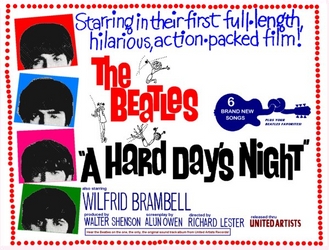
"A Hard Day's Night" - Film Review

Considering it’s on one level just a long ad for The Beatles’ latest album, A Hard Day’s Night is a surprisingly fun movie. This is a film with remove from its release that could feel very dated and artifactual. And to an extent it is that (We get a glimpse into that cultural milieu and the phenomenon of the band). But it’s also a film that stands on its own unexpectedly well.

The film has a number of slighter elements. This is best represented by Wilfred Brambell as Paul’s grandfather. Brambell seems to revel in having the old man do things that seem a little naughty for a man of his age and disposition.

The film is essentially about the bands journey to a studio to film and record a concert. Along the way shenanigans ensue. The band trades some memorable quips in between sets. The film is really cheeky and therefore really funny (There’s some humor here that is very much British from its delivery to its content). The band is having fun at the expense of everyone around them who expects them to be dumb because they’re young and rock stars. In one memorable scene, reporters interview the band mates and they proceed to take the questions incredibly literally to the consternation of their interviewers.    

The film is at its best when it’s playing up the personas of the band members. The band plays themselves and make fun of themselves and perceived conceptions of themselves. The film’s best sequences involve the band getting chased by screaming fans and by beleaguered police officers. 

The film is pretty much an extended music video. The movie plays the songs from the then upcoming album of the same name (a set list of one great song after another). There are a number of points where songs play over scenes or the band plays song, occasionally spontaneously. The film is considered to have widely influenced film musicals and even modern music videos. 

What is perhaps most striking is how young John, Paul, George, and Ringo seem. They’re old enough to be off at college, and as they goof around there’s an easy, youthful, bro-mantic banter to it all. The film works as well as it does because of their youth. There’s physicality to some of this and there’s also a sense of youthful abandon. 

The film has an energy to it, in line with the youthful character. Director Dick Lester appears to have taken cues from the French New Wave, then in full force. There’s a free form, loose quality to the way the film is shot. And this style suits the band’s music and the film’s cheekier sensibility.   

Through the film, The Beatles were trying to reach out to their fanbase and win a greater connection (Not that they needed any more. This was at the height of Beatlemania). Here we see them being down-to-earth, affable, charming and mildly rebellious. They're still rather winning, even if it isn't 1964 anymore. 

Grade: A

"Man of Steel" - Film Review

There’s a series of sequences in the last third of Man of Steel that all sort of blend together. They are a number of action sequences and after while they’re indistinguishable from one another. It’s as if the editor didn’t realize he had about at least thirty minutes of screen time that was absolutely unnecessary to telling the story. And in the middle of this constant, ceaseless action, you could be forgiven if you started to zone out here or there. You could probably fall asleep and wake up some time later and have missed rather little and still manage to follow the plot.

After a while this starts to become draining. This isn’t storytelling. This is CGI gone awry. This is someone yelling, “Hey! Isn’t this cool!”  

There are a lot of other things that take place in Man of Steel but that third act is so frustrating and poorly done that it becomes exemplary of the things that the film gets wrong.  

Man of Steel doesn’t really feel like it’s a Superman movie. There’s rather little that ties it to the comics or the older films. The infamous superhero outfit doesn’t get broken out until rather late in the film and Superman doesn’t work at the Daily Planet disguised as Clark Kent until there's five minutes left. 

The film keeps asking us to accept thing at face value simply because it’s asking it of us. Character’s motivations are rarely explained, and things just seem to happen for the sake of the plot. Take the film’s villain General Zod (Michael Shannon). He tries to destroy Earth to create a new Krypton. That’s his goal … but his reasoning is vague at best. We spend a fair amount of time with the character and yet it only becomes more convoluted as the story advances; the answer seems to be, “Because it must be done!” 

The film has a disjointed quality. It keeps jumping around its narrative but this detracts from its clarity and its pacing. After an unnecessarily lengthy opening sequence where we watch Superman’s father (Russell Crowe) send his son off to Earth and battle for excessive lengths, the film jumps ahead to when Clark is in his thirties, disillusioned and aimless. It’s never entirely explained how Clark got to this point. We get flashbacks to his childhood, but the film does more telling than showing here. We see Clark get bullied, but it’s never entirely clear why except for plot convenience. And the explanations by Clark’s adoptive father (Kevin Costner – in one of the more memorable parts of the film) always come off as didactic. 

The flashbacks are bad storytelling. It’s putting the cart before the horse, giving us questions than answering them after the fact (which wouldn’t be a problem except for these questions aren’t really a mystery so much as defining character traits of the protagonist). But since we don’t see Clark grow up in real time, the film treats his childhood as a less important part of the story despite the fact it holds the very answers to why we should be invested in his character. It doesn’t help that Clark in the present day (Henry Cavill) is a barely audible, gloomy and lurking figure. He’s more of a hovering presence than an actual person.

I said earlier that this film almost could act largely as a film that isn’t a Superman movie. In fact, it often comes off as a science fiction film done by someone who wasn’t aware that they were making a science fiction movie. An alien comes to Earth, befriends humans and defends them against other aliens. That’s science fiction (without the comic book origin story stuff happening elsewhere).  But instead of treating the film like sci-fi, the film treats the story like it’s an action movie. The action sequences feel like something out of a big action film. There’s a scope to it all, and there’s many, many explosions. But it also feels like a disaster movie. Countless people die and the destruction waged upon the planet is devastating. Superman weirdly enough seems to take little interest in how much destruction he and Zod wrack up in the course of their fighting. But the film has got none of the careful visual composition of the best science fiction or action movies. The special effects in these scenes are less about being part of the overall story but rather exist as attention grabbing sights. It keeps returning to these visuals but they’re not all that interesting to watch, especially since they’re so poorly edited (jumping around shakily a lot). And there’s simply not enough stakes behind what is taking place to care. We don’t know enough about either Superman or Zod’s motivations to be all that interested in what they’re doing or the property damage they’re accumulating.    

Director Zach Snyder is taking a cue from Christopher Nolan’s Batman trilogy (Nolan is a producer of Man of Steel). Nolan’s films brought a gritty, dark take to that franchise, and Snyder is clearly enamored by that approach. But Snyder fails to understand what made those films work. It’s like how so many television series copied the sex and violence of The Sopranos in the wake of its success but failed to understand that there was more to it than these elements. There was good, thoughtful storytelling there as well. Nolan’s films were more about using Batman as a lens for sorting through whatever philosophical and ideological questions were floating around his head. It gave the films a depth that went beyond the blockbuster bluster. Man of Steel is all the sheen and none of the luster of the Batman films.  

Weirdly enough the film I kept coming back to as I watched Man of Steel was 2001: A Space Odyssey.  Not because they have anything remotely in common and not because I wished I was watching it instead (though I did), but because 2001, besides being a great movie and sci-fi, is a film where it’s so easy to see Stanley Kubrick’s vision coming through every single scene, every single shot. You may not like it, you may find it weird or boring, but it’s shot by someone who knows exactly what they want to say and how to say it. Kubrick has such a command of visuals in 2001. Zach Snyder does not in Man of Steel.  

Snyder’s previous efforts show someone who’s more enamored with style than substance. Suckerpunch is a self-indulgent mess of someone letting their obsession with stylistic excess run amuck. 300 is so over-the-top that it almost transcends how dumb and loud it is. There are moments in Man of Steel that feel like someone who watched The Dark Knight or Tarantino movies or European arthouse (or all of those things) and failed to understand all the things that make those types of films work. There are all these little flourishes that seem so unnecessary and they become distracting. And this is made all the more problematic because the film is in a fight between its formalistic touches and the fact it’s a big action movie. It never really reconciles the two. When it does settle for one in its third act, it just becomes messier than ever (make of that what you will).  

By film’s end, we’ve been so heavily pummeled by confusing, repetitive and uninteresting action that it becomes mind-numbing. The film overstays its welcome, and then overstays it ten times over (It's an overlong slog at times). Man of Steel is not enough fun to make up for its poor storytelling and bad characterization.  

Grade: D+

Friday, June 28, 2013

"Gomorrah" - Film Review

The Comorra is one of the world’s largest criminal organizations based in Italy. Based on true events, the film Gomorrah shows the poisonous influence the criminal outfit has on everything around it. An early sequence shows a man distributing money. Every experience in every home he goes into is rather casual. They offer him food and they exchange pleasantries. This is par for the course. Everyone is used to it.

This is why it’s not all that surprising when one the film’s protagonists, a young boy, is drawn into the criminal proceedings. We want to yell out, “Don’t do it!” But he’s participating in initiations rituals before we know it. No one can seem to escape the reach of the Comorra. 

The film is more interested in people on the fringes of the criminal operation. We don’t see the bosses all that much. The film’s interests lie with the little people who get caught up in this. There’s the money distributor. There’s the boy initiated into the Comorra. There are two young men acting as would-be gangster, free agents, who foolishly go up against the Comorra. There's a tailor who attempts to work for a competing garment factory.

Much of the film’s story takes place just off camera. There’s a gang war taking place, but we see little of this. We learn about it mainly from word of mouth. The film rarely wants to shift its perspectives from the characters it has its eye on. There are other scenes that contextualize the messes the many protagonists have gotten themselves into, but they’re the least important parts of the film. 

There’s a sense of inevitable tragedy hanging over the film. We know that bad fates are on the horizon for these characters and the film draws out these fates with an increasingly unsettling feeling of dread. It’s a film interested in how no matter how hard you try or how smart you think you are, you can’t escape the reach of the Comorra. It may not be death that awaits you, but you’re sense of self-worth or your innocence or your control over your own life is in the balance. 

The film has a grittiness to it. This is not a film that attempts to make the gangster lifestyle look pretty or appealing. Many of these people are living in poverty or just above the poverty line. A criminal organization such as Comorra can be as successful as it is because it fills a certain role. People living in Naples and Caserta accept the Comorra’s existence because it’s simply become matter of factly part of life and because many of them also benefit from it.      

The film is also interested in depicting the mundanity of much of this. There are long stretches where people are going about their lives. This also plays to the film’s favor. The film wants to cut through the cliches and lies about the gangster lifestyle. These mundane stretches are often broken unexpectedly by excruciating moments of violence. The violence is bubbling just under the surface. It’s inescapable.  

The destruction by the Comorra isn’t just through violence though. The film spends a large amount of time showing how the Comorra dumps toxic waste that will ruin the environment. They’re literally poisoning what they come into contact with. One man working for the waste management company is so disgusted he quits, but the operation keeps going. 

Gomorrah intertwines the many different stories of its characters to build up a mosaic, bleak portrait of the Comorra and their criminal operations. While its grimness, and scathing realism can be unpleasant to sit through at times, the film's exacting look at the toll of the gangster activities and those caught up in it is powerful. It's often times too slow or too impenetrable or too scattered, but the accumulated effect and end result is something that's hard to argue against.

Grade: A-