Friday, May 31, 2013

"Face/Off" - Film Review

Inimitable genre director John Woo doesn’t make movies so much as thinly veiled excuses for action. Face/Off is a great example of this. I could fault the film several times over if its action sequences weren’t so damn entertaining. The film, in general, is very entertaining (sometimes unintentionally so) because it’s so frequently loud, excessive and over-the-top.

So much of your ability to enjoy the film will depend on your ability to just role with it. The film seems to accept everything that takes place at face value. This is perhaps most true of the titular “face-off” wherein the two protagonists FBI agent Sean Archer (John Travolta) and terrorist Castor Troy (Nicholas Cage) have a surgical procedure to switch faces and change their identity. It’s absurd certainly, but the film just keeps pushing forward as if this is completely logical. 

The film takes pleasure in its twisted take on the body swapping. Castor sleeps with John’s wife and creepily flirts with his daughter. Meanwhile John as Castor rots away in a prison where everyone, including the corrupt prison guards, is out to get him. The most fun found in this is how the turn of events allows for both Cage and Travolta to be completely, delightfully hammy. But this excessiveness is in line with the film’s sensibilities.

This excessiveness is best seen in the film’s many elaborate action sequences. They’re so operatic and ostentatious that sometimes you wouldn’t be remissed to be laughing at the brashness. Indeed the film’s exaggerated manner can make it feel like it falls into the realm of self-parody; this is perhaps best exemplified by the film’s final action sequence which has such an intricate Mexican standoff occur that it almost becomes a commentary on the lengths action movies will go to entertain us.  

At times, this excess seems to be at odds with how self-serious the film is. There’s a weird sentimentality to the film that feels like it belongs in a different movie. The emotional undercurrents are obviously there to keep the whole affair thinly strung together. But you never really get invested in the family drama on John’s end of this ordeal. Oh sure, you get unnerved about Castor stepping in and taking advantage of John's daughter and wife, but that’s more likely just because you’re a decent human being than because these are fully formed characters worth caring about. 

Throughout Face/Off I kept thinking to myself how for a film with such an uncliched premise, it’s a pretty clichéd film. Much of this is due to how heavily it relies on the body swapping premise, which plays out fairly predictably. In fact, so much of it plays out in a sort of aw shucks hijinks-y manner that you could potentially see this as a dark, masculine, action-filled spiritual successor to Freaky Friday without all the gooiness and messages about mother-daughter relationships. The moment both characters get to be the other person they go right ahead and take advantage of the new body in ways we could all but have guessed the moment the film began leading us down this rabbit hole. That’s not to suggest the body swapping, in all its predictableness, isn’t fun. There’s actually a surprising amount of entertainment to be gained from Travolta essentially playing an unhinged Nicholas Cage and Travolta seems to delight in his ability to play up every possible moment.  So in essence we get two people playing two different Nicholas Cages. As Film Crit Hulk (who you should all read) pointed out, Nicholas Cage can instantly make any film watchable, not necessarily better but at least interesting and potentially entertaining, and that’s definitely the case here. 

The simple truth of the matter is that parts of this film I liked while others parts I really disliked (at times in equal measure), but at the end of the day I really enjoyed it. I’m a sucker for a film that attempts to get a reaction out of me (not in an exploitative way, of course); film’s that use the spectacle of cinema in such a way where you can’t help but get on its wavelength and go along for the weird, goofy ride. 

It's beautiful to behold, exhilarating in its action and hilarious in its characterization. Its imagery, thrills and humor (sometimes unintentional) are enough to gloss over the absurdities inherent to its premise. 

Grade: B-

How Doctor Who Became So Addicting and Emotionally Resonant

Doctor Who has largely always been an inconsistent series in its revival form. Even in stronger seasons the show has had episodes that are absolute clunkers. Take a stronger season such as the second season, which has such forgettable efforts as “The Idiot’s Lantern” and “Fear Her”. Fan favorite pegged as series best “Blink” is in one of the most erratic seasons of the series (I would argue that Martha isn’t a bad companion but rather she gets stuck in some of the most middling efforts of the series). The first season really should have been an indicator of the patience required of any potential fan of the series. There’s lots of promise in the first season but there’s plenty that makes even the most stouthearted of Doctor Who fans cringe (the less said about the Slitheen the better). There’s some really solid efforts from the series that demonstrate just how adventurous and fun the series could be given time (particularly from future showrunner Steven Moffat in the two-parter “The Empty Child”/“The Doctor Dances”), but you’d be forgiven if you just didn’t have the patience to get through the first season. The show didn’t really figure out the type of show it wanted to be in full until the season one finale which hints at a lot of the type of storytelling that the show would play around with more in later seasons with varying degrees of success. I would argue the only season that is completely consistent is the fifth season which has the most well-thought out and clear vision for the season long narrative while doing plenty of great stand-alone stories that nicely service the characters. But even that season has episodes that I wouldn’t say are memorable (“The Beast Below”, “Vampires of Venice”) so much as the quality never dipped below a certain respectable level.

I bring this up because there’s something devoted fans of the show dare not admit: Doctor Who is a frustrating series (even as it remains one of the most entertaining). When the show is firing on all cylinders it packs a punch that few series can manage. Even when it’s disappointing (which is another thing more often than not fans wouldn't care to admit), it still has an undeniable charm; one that a show so procedurally heavy really ought not to have in such abundance. Amongst its less well-realized outings, the show still sneaks in enough moments that are so indelibly specific to its mythology and its general philosophy that it’s hard not to want to stop in at its worse just for these slivers. 

Some have argued that Doctor Who is a religion. While this may seem like an overstatement, it gets to the heart of the series’ powerful hold over its fanbase. The show certainly creates a religious like fervor in people who follow it. Many people watch the show to be part of something larger than themselves, the engrossing fandom, which turns the show into much more than a television series but a live-in experience shared with other people. 

Even as the show has me wondering if it’s simply run out of steam, I cannot shake my affection for the series. What I began to realize is that Doctor Who uses motif better than just about any other series, and it calculatingly uses it to form some powerful emotional connections between its audience and the show.

The more obvious aspects of this are the symbols the show has encoded from early on. That big blue box the TARDIS is an image we’re taught to recognize very early on and whenever it reappears we’re immediately cued in. Even the outfits of the Doctor are carefully chosen and timeless in that they rarely ever change from episode to episode. Certain villains take on this symbolic function as well, notably the Daleks and the Cybermen. 

The reoccurring imagery doesn’t stop there though. Tumblr gif sets love to juxtapose images from different episodes and while it’s rather amusing it’s actually an incredibly interesting exercise. For example, note how the divide between Rose and Ten in “Doomsday” eerily parallels the divide between Rory and Amy in “The Girl Who Waited”. The show knows when and where to draw its connections and it does it often enough that it seeps into our subconscious. It helps that these connections are typically made during emotionally fraught moments.  

Look to the way the show treats its characters. The introduction of companions almost always takes the same path. An episode takes place where the characters is introduced and peaks the interest of the Doctor. The Doctor invites them along for an adventure and the following episodes, their first adventure, is set in the future, usually on some alien planet. The second adventure is generally more historically based and set on Earth. The series has taught us to expect these things of the characters in their growing relationship with our favorite Time Lord. It’s also taught us to anticipate fairly emotionally devastating exits for companions as they leave the Doctor. 

This reoccurrence structurally, visually, and symbolically emotionally ties us to the series but perhaps most important of all are the themes and philosophy of Doctor Who. The Doctor is a godlike, paternal figure who takes along someone who sees themselves as ordinary and the Doctor, through many misadventures, proves their extraordinary. The Doctor is an altruistic figure who feels the need to right wrongs and save worlds wherever he may go. Though he’s well-intentioned, the Doctor is flawed and frequently making things up as he goes along; this makes victory that much sweeter and noble. The Doctor faces many evils and aliens, but he ultimately believes that people are really good at heart and has a deep abiding love for humanity (Earth has become his second home after he lost his own home planet Gallifrey in the Time Wars). Essentially the Doctor is a god but a very human one. His knowledge and his agelessness make him superior to others but though others look up to him, he squarely places his own faith in us. This is crucial as the companion is almost always a surrogate for the audience. The Doctor isn’t just suggesting that his companions are capable of being “fantastic”, “brilliant”, and “cool”, but that in fact we are too.    

If anything all this adds up to a world view that has religious qualities but is more overtly based in secular humanism than anything else. The Doctor believes in people and doing the right thing, and though he’s often wrong on both accounts, his faith steers him to be better and better those around him. That’s a very hopeful and life-affirming philosophy and the way the show uses it shape our vision of the characters and the narrative makes for a truly unique experience. Not much may happen (and what may happen may just be plain bad – *cough* “The Unicorn and the Wasp” *cough*) but there’s a certain distinct pleasure to watching this worldview in action, not just because it’s very life-affirming but because it feels like a philosophy that’s worth living by (which sounds wishy-washy but the romantic inside me wants to just say, “get off me!”). Not only that, but the series shows that it’s a philosophy with limitations which makes the Doctor’s faith in it and the victories achieved through it that much more palpable and important.  

The variety of ways the show utilizes its motifs bonds its viewers to the show. Though on an intellectual level I know there are better series out there, on an emotional level Doctor Who trumps plenty of other series out there. That emotional bond was a slow, long con that has progressed over the course of seven seasons and has been achieved largely through motifs.  

Thursday, May 30, 2013

"Close-Up" - Film Review

Reality and fiction are blurred throughout Close-Up. Nearly everyone in the film is playing themselves; some parts are re-enactments, others are actual documentary footage. But the real kicker is that it's about a man, Hossain Sabzian, who cons a family into believing that he's a famous film director, Mohsen Makhmalbaf, and that he wants them to star in his latest movie.

The film moves back and forth between the past where he's arrested and dupes the family, and his current trial for fraud. The man claims that he had no intention to harm or steal from the family; he was just merely playing a part. The young film buff never could afford to make his own movies and so he's performing a strangely vicarious form of gaining the experience life never afforded him.

But here's the truly bizarre thing; there's genuinely times where it appears as though the guy actually never meant for the whole ordeal to be taken as fraud. He just liked the experience of it; the attention, people listening to him, and the chance to make a movie. And the film wants us to accept that this is absolutely a potential truth. In fact, the real takeaway is that we'll probably never know the truth of the matter; it's probably much messier than that (and cracks definitely show in the argument  Sabzian puts across).

The really odd thing about the film though is how it treats itself like it's a documentary (mind you, at times it is one). There are moments where obviously this isn't the case. But for the most part, it's like a self-serious mockumentary. But it really works at times; there are totally times where you forget it's not real and become immersed in the fascinating story at hand. Part of this effect is because it is real; there are moments that are actual documentary footage and there are moments that are staged, but even the staged moments come unnervingly close to reality. But even during the documentary footage, it still feels more like a fictional tale than a documentary. Which is to say, one can't help but feel as though director Abbas Kiarostami isn't so much concerned with this story but the nature of it. He's letting the inherent strangeness of this story be the real centerpiece of what we should take away. 

Stray Thoughts:
-In the end the real Makhmalbaf meets with Sabzian to reconcile with the family, which is to say the conflict smooths itself over in an even more unreal fashion.
-The reporter, Hossain Farazmand, is very colorful in the opening scene. I wish we'd seen more of him.
-So apparently directors are pretty much God-like figures over in Iran.
-I think I like the idea of this story more than the story itself.  The transitions between scenes felt kind of clunky, while the individual scenes were largely pretty great.
-The scenes of Sabzian speaking at the trial are thoroughly captivating. 

Consensus: The story is a fascinating and sympathetic look at identity and the fine line between fiction and reality.

Grade: A-

Wednesday, May 29, 2013

"Drunken Angel" - Film Review

Drunken Angel is a film that's all about change, or rather the inability to do so. Matsunaga (Toshiro Mifune) can't escape being a member of the yakuza, and neither he nor Doctor Sanada (Takashi Shimura) can escape their drunken ways. Sanada sees a lot of himself in Matsunaga, which is why he goes so out of his way to try to heal him of his tuberculosis. But Matsunaga keeps refusing his help and his advice and this only makes his illness worse. By the time he wises up and starts cleaning up his act in order to get better, he gets dragged back into the underworld of the yakuza; a yakuza member, Okada (Reisaburo Yamamoto), is released from prison and Matsunaga gets caught up in the welcome home celebration. It's like the scorpion tells the frog, "It's in my nature".

It's also a film about lamenting the past. Sanada blew his chance at having a successful private practice, squandering his youth getting drunk and partying. In Matsunaga, he sees himself at that age. Deep down he's not a half-bad guy, but he's done in by his own violent and drunken ways. We also see this in the local shop-owner who pines for Matsunaga. She long ago came to the city and got stuck there in a rut; she yearns to leave the city, and it's only after Matsunaga is done in by film's end that she can convince herself to get out.

The city is constantly referred to as a corrupting force. It's seen as dirty place that's gone to hell, dragging people down with it. There's a pull and tug between Sanada and the yakuza for the soul of Matsunaga with the yakuza acting as a similarly corrupting influence. For the longest time, it seems like Sanada might just win out. The early going of the film appears to tailor a story where Sanada fixes up Matsunaga and in the process wins a spiritual victory to redeem his woebegone past. The film, however, lands on a more bittersweet ending. Matsunaga learns that the yakuza are using him as a pawn to be given up to a rival gang. At this point Matsunaga confronts Okada and it leads to his demise.

Sanada does get a victory but it's in a more unexpected way. A younger patient with TB tells him that she's been cured of the illness. Perhaps after a certain point in your life, you can't change, but that girl has a chance. And, well, Sanada is going to revel in that at least. There's hope even if it's just a silver lining.

Stray Thoughts:
-Director Akira Kurasawa knows how to set a mood. Those opening night shots are wonderfully evocative. The dancehall scene is another nice, but different, example of this.
-I really like the way the fight between Okada and Matsunaga becomes incredibly messy. The end of it slipping around in paint really gives a darkly comic tinge and adds to the sense of chaos and exhaustion.
-The ending with the girl could have been saccharine but it somehow really works. I think the film just needed some sort of victory at that point.
-Some really fabulous acting from both Takashi Shimura Toshiro Mifune (who would go on to star in many other Kurasawa films).
-Those hairdos man! I know this was 1948, but this has a very 60's feel to it at times.
-The poisonous bog is a great metaphor. It could have been too blunt, but the film never feels the need to underline its meaning and so it works really well.

Consensus: A great, thematically rich film filled with lovely imagery and carried by the impeccable craftsmanship of director Akira Kurasawa and the performances of the two leads.

Grade: A 

Tuesday, May 28, 2013

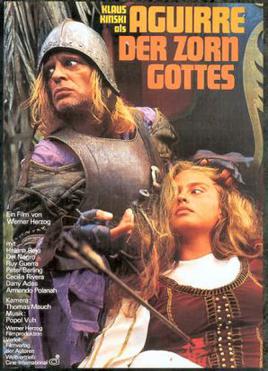
"Aguirre, The Wrath of God" - Film Review

I have to imagine that being part of the production on Aguirre, Wrath of God must not have been a fun experience. Set in the forests of the Amazon and on the river itself; the actors often seemed exhausted because the shooting was itself very exhausting. The film is short in length, at just a little over an hour and thirty minutes; but the film feels so much longer than that. It's languorous and sprawling. Often times it feels like very little in the way of plot is occurring; writer-director Werner Herzog wants to create an atmosphere to the story, and it is not the most inviting of tones he strikes. It's morbid and cynical and sad. Herzog drags his characters through the wringer, and it's clear from very early on that there's no way there's a happy ending to all of this. But a happy ending would be like a cop-out. This is not a happy or pleasant story. It's a story of the corruption of power and the obsession with fame and fortune.

Spanish conquistador Pizarro's journey through the Andes to discover the mythical city of El Dorado hits a roadblock. The tedious, difficult journey winding through the mountains has exhausted them and they've still yet to get any closer to their goal. Pizarro sends out a scouting party to get them resources and figure out their location. The scouting parties efforts quickly go south; they run into rapids and one of the rafts is caught in a whirlpool and all the people on it die. Aguirre seizes the opportunity here, playing off the frustration of the men to stage a mutiny. Another man, Guzman, is voted in as "emperor" but it's clear that the real power resides in Aguirre. But Aguirre's leadership skills prove to be bold, brash and self-destructive.

Everything from this point on goes downhill. The natives constantly attack and kill many; they run out of supplies. They eventually catch fever which only heightens their sense of despair and madness. The film slowly builds up a sinking sense of madness, and exponentially becomes more cerebral and surreal.

The film that bears the most resemblance to Aguirre is Apocalypse Now, which this film would influence and which tells a similar extended story about men heading downstream further and further into untamed, wild territory and continually finding themselves forced to confront their inner demons. They also both lavish in excess, turning their setting into a crucial piece for the mood and the tone of the film, and ultimately the film's power.    

This intention by Herzog is all well and good, but it often makes Aguirre a painful film to sit through. Large stretches feel like they're unnecessary and self-indulgent. The moments that are most effective are the moments where Herzog has the characters take action, and there's a real disturbing beauty to these moments, especially as they so clearly telegraph the growing madness of these people. Of course, these moments only get their teeth because they cut across the deliriously slower, languid stretches.

Stray Thoughts:
-Klaus Kinski is phenomenal in the role of Aguierre, giving the character an intense feral ferocity.
-The religious subtext (well, it's so incredibly overt that it really doesn't even qualify as subtext) is pretty hauntingly beautiful.
-There's some interesting use of minimalism in the film. It's historically based but also seems to be disinterested by this aspect of its story. The minimalism is contrasted with the lushness of the setting.
-That's one doozy of an ending. Whatever my problems with the movie were sort of retroactively sweeped over by that near-perfect end shot with Aguirre on the sinking raft, all his crew dead, and monkeys dancing around. It's chaos; it's death; and it's very fitting for what the rest of the film was attempting.   

Consensus: Aguirre, The Wrath of God is a methodical, sumptuous, dark film that's often powerful, but also slow to reveal itself which plays against its ability to really impact us.

Grade: B+ 

Mad Men - "The Better Half" - Review

Peggy is in a rock and a hard place, as she’s torn between two mentors. One she’s grown disillusioned with, and one who’s not interested in her. The opening scene telegraphs this conflict. Don calls in Peggy to settle an argument between him and Ted, but Peggy refuses to get involved. She’s fed up with Don. This is unfortunate for her current circumstances. She wants to have an affair with Ted, but Ted simply isn’t game for this. On the other hand, if she were to choose Don, he’d more likely be willing to give it a go (he does in fact have an affair this episode). This split between these two men (individuals said to be all but the same people) takes place in an episode filled with duality.

By episode’s end, Peggy finds herself shut out by both her mentors and her boyfriend Abe (though stabbing him might have had something to do with that). Though the episode ends on this excellent moment, all but bound to occur at some point, this isn’t really Peggy’s episode. The big storyline, and the one with the biggest, most memorable turn of events, is Don’s. Well, rather Don’s and Betty’s. Betty gets solicited for an affair by a strange man and while she denies his advance she seems to do it more out of fear of her husband’s wrath than because she’s not taken by the idea. Betty has grown discontent in her marriage to Henry Francis, but she’s too stuck in her old ways to leave the marriage (especially not now that Henry’s political ambitions are on the rise).

Don and Betty happen to coincidentally simultaneously visited little nonentity Bobby Draper. While spending an unexpectedly nice day together where they don’t snipe at eachother, the sexual tensions mount until it becomes clear they’re going to sleep together. And then, yep, they do, and it’s one of those very Mad Men-y twists that feels like it was inevitable even as it comes completely out of nowhere. I like this direction for the series moving forward; it feels like a fresh move for the series to get out of old habits, and an affair with Betty seems like the perfect type of affair to ultimately wreck Don’s marriage to Meghan. Although this affair may never be rekindled again, for all I know (In fact, it's more likely just wishful thinking that it will). 

It helps that the two of them are such different people at this point in their life.  They reminisce about the past, and ponder who Sally is more like. And in that moment, you can see why these two got married in the first place. There was definitely something there at some point, even if it’s all but disappeared by now.  

There’s some nice paralleling here between Meghan and Betty. Meghan is playing twins in the soap opera program she stars in. “I told him I didn’t want to be a cliché,” Meghan says, not realizing the massive irony behind that statement. Meghan is a cliché; she’s Betty 2.0. Alright, personalitywise she’s different, but she’s merely another marriage for Don to fill the hole inside himself that is ultimately unfillable. She’s a twin, a cliché, a repeat. And she’s starting to pick up on this. “I don’t know where you’ve gone. But I’m here,” she tells Don. Unlike Old Betty she admits to her unhappiness in marriage, and Don appears to have accepted the fact that he needs to change something about this arrangement as all he can muster up to say is “I know”. Does he want to try harder? In the moment the answer appears to be yes, but this is Don Draper and so I doubt we’ll see much change on his part. 

While the Don, Betty, and Peggy stories in this episode are great, Roger and Pete’s storylines feel like one plot too many. Pete is considering leaving the company, but it has less to bear on this episode than potentially episodes down the line (although social climber Bob Benson does get him a nurse for his mother, at the suggestion of Joan, no less, who he looks to be cozying up nicely to). Roger continues to be a terrible father figure, failing to babysit his grandson, taking him to the frightening of all frightfests: Planet of the Apes. 

There was moments in this episode that were Mad Men at its best, and especially for this season. But there was also a lot of story that just didn’t feel like it went anywhere. It just seems as though the show could have gotten so much more out of the Betty-Don storyline. Even when we go back to Peggy for the final scene, it takes a moment to snap back into that different mindset of Peggy being torn between Ted and Don. Peggy’s plot has little happen, other than watching her relationship with Abe further deteriorate and having her open up her feelings to Ted (which in part leads to the demise of her relationship with Abe). 

In the end, this episode is very much an episode about the titular "Better Half". It's about relationships and it's about the damage we inflict on those better parts of ourselves. This is most obvious in Don and Betty's stories, which find them cheating on their spouses, but it's also in nearly every storyline. Peggy is frustrated with Abe because she wants to be with Ted, who won't be with her because he himself is married. It's even in Roger's story as he visits Joan, the woman he formerly thought to be his better half and for whom he still occasionally pines for; there's been too much damage done there for him to fix that, and so Joan won't even let him see his son. It doesn't even have to be taken literally; it can be seen as referring to Don and Peggy's relationship, which is a big part of this episode and continues to break down. Don is unfulfilled in his home life and so he trying to get comfort in his work life and he can't get any of the acceptance he needs from the one person, Peggy, who has always seen things similarly to him.    

All and all, a very good episode of Mad Men. It could have been a little less messy, but it nailed things where it needed to and so I was fine with it.

Grade: A-

'Awkward.''s First Season Takes on High School Drama with a Keen and Charming Eye

For the longest time I couldn't even begin to put into words why I liked Awkward.. It's such an unassuming teen comedy that it really is at times hard just to put your finger on why it's so effective. The series is incredibly charming and sweet, that was certainly part of its appeal. But as I get further and further away from high school, I find it somewhat strange how continually drawn I am to narratives about the subject matter. I'm a big defender of Easy A, and a lot of the wiles and tropes that Easy A played around in are front and center in Awkward.. There's a voiceover prompted through a blog that gives us insight into the protagonist's thoughts and the series primarily deals with the protagonist navigating high school, especially relationships, sexuality, and the drama that can come about from both of these things. While these are the types of stories that are so well-worn and played out that it would be hard to imagine some piece of pop culture making them fresh, Awkward. largely succeeds by being incredibly earnest about these topics and making them specific to its characters and the situations they find themselves in.

The show is trafficking in tropes, but it's the way the series so often provides nuance or emotional resonance to a trope it's using that so consistently makes them work. Take queen "bee-atch" (show's word choice, not mine) Sadie, played with delightful despicableness by Molly Tarlov. The series gives just the slightest glimpses to orient us to the reasons for her mean girl sadism that it doesn't fly off into space and become totally unbearable or utterly unrealistic. While the series never feels the need to constantly reiterate what makes Sadie, or any other character for that matter, tick, it's the nudging reminders that nicely relate that there's more to these characters than the wacky antics belies.

The show is often at odds with its broader sitcom-like structuring and its deeply felt emotional authenticity that comes out in smaller doses. The sincerity of the series underlies nearly everything the show attempts, and its undercurrents are sensed in the more goofy, more directly funny moments. But the show still can pull out the stops and stick a solidly emotional moment that feels satisfying, well-earned, and honest.  

So much of what makes Awkward. work is Ashley Rickards' performance as protagonist Jenna Hamilton. The performers in general are really fun, but Rickards command of the central performance is what sells so much of the show. All the hesitation, frustration and longing that comes with being in high school are brought out in Rickards who plays between daring-do moments of lacerating confidence and self-deprecating anxiety as Jenna constantly reinvents herself and accepts her place in the spot-light. It helps that Jenna is never allowed to be a completely sympathetic figure; she's our protagonist and most of the show is seen through her eyes, but Jenna frequently fails to understand where other people are coming from, whether it be her friends, her love interests, or her mother. By allowing the dynamic between characters and within the plot be a bit messier than say a John Hughes movie (which the series even makes reference to at one point), the show becomes a bit more practically relatable. Yes, the kids of The Breakfast Club are relatable, but that's because they're types; they could be anybody. Jenna could be us but she's also very uniquely herself in a way that she's her own fully formed character.    

While much of the show can be much too broad, at times too much so in its characterization, the show at its best moves beyond its tropes. It provides a lovely little lens on the politics of everyday life in high school. This is most clearly apparent in the show's handling of the love triangle that drives much of the season, but it also plays out nicely in the ways in which Jenna is forced to confront the attention thrown at her at many different turns.

The series has this great ability to be rather dirty and yet lose none of its sincerity in a way only a handful of other series can pull of (may be New Girl and Bob's Burgers are as up to the task). Few series would consider taking pinkeye and turning it into an storyline that restates major character tenets in sweet and hilarious fashion. The show is very open about sex, alcohol, etc. and demonstrates the heightened, charged overemphasis these things have in people's lives at this age.

But therein lies the thing to most take home about Awkward.. The series captures that wonderfully delicate state of being so peculiar to being in high school. The sense of self where you imagine that every bit of drama will be the end of the world, but where you could "disappear and no one would even notice". The twinfold burden of believing everything is the end-all be-all that will send the world crashing in on itself, but deep down knowing that not much will probably come of any of this drama. The series never looks down upon this outlook or the behaviors that stem from it, but accepts it as the norm of being in high school.

Awkward. doesn't reinvent the wheel, but it's a fun, smart, and emotionally resonant series with a lot of charm and heart.