Monday, March 25, 2013

"The Master" - Film Review

I don’t believe I’ve ever seen a movie quite like The Master.

On a technical level it’s near flawless. Every shot is impeccably, immaculately conceived and rendered. But this is to be expected from writer-director Paul Thomas Anderson. He’s a filmmaker’s filmmaker. 

Anderson has never shied away from tackling subject matter that’s … well, different. His breakout film was 1997’s Boogie Nights, a film about a porn patriarch.

The Master tells the story of Freddie Quell (Joaquin Phoenix), a disturbed WWII veteran, who’s won over by the charismatic Lancaster Dodd (Phillip Seymour Hoffman), frequently called the Master.

Freddie is leading an aimless life after returning home from the war and finding it hard to adjust to post-war society. Bored at work, sexually frustrated, and taking pleasure in nothing but making and drinking alcohol, he’s always on the verge of bursting out in fits of rage. 

Lancaster, a magnetic orator, sees how easily manipulated Freddie can be and converts him to his following. At least, that’s one interpretation. The Master’s son Val (Jesse Plemons – in some spot on casting) believes that the man is making it up as he goes along and doesn’t actually believe in anything he’s saying; something that he tells Freddie, which deeply unsettles him. One skeptic describes Dodd's religious movement, “The Cause”, as a cult, and it does bear a resemblance to a cult at times.

But perhaps the Master does believe in the seeming pseudo-science of spirits time traveling (Though I personally didn’t interpret the film that way). 

Whatever the case may be, Dodd immediately takes a liking to Freddie, who he claims to see something in (what exactly that might be is never made completely clear). Or maybe he simply feels bad for Freddie, who’s mentally unsound and not the brightest of the bunch to boot. 

In either instance, Freddie’s drinking problems become untenable. He makes his own drinks filled with odd concoctions such as paint thinner (he accidentally kills a person at one point). The Master’s wife (Amy Adams) becomes fearful of the situation. He keeps attacking people who question Dodd’s work and teachings. The members of “The Cause” try to rehabilitate Freddie, but it doesn’t work, and soon after they’re forced to cut ties. 

Whether you find this too strange to enjoy, there’s no denying the film is filled with great performances. Joaquin Phoenix is completely unhinged as Freddie, perpetually crooked smiled, mumbling most of what he says in a low growl . Phillip Seymour Hoffman is a sight to behold as Lancaster; he’s so calm and charismatic that at times it’s hard not to buy into his philosophical propositions, no matter how unfounded.

On top of this, the film is beautifully shot and visually striking, which often makes up for how its plotting is occasionally haphazard, leaving something to be desired.

A challenging, dense, enigmatic movie that's certainly not for everyone.

Grade: B+    

The Walking Dead - "This Sorrowful Life" - Review

One of the underappreciated aspects of television is editing. The best tv series use their editing to add to the tension, humor, etc. But above all else, the editing prevents a show from being boring. The Walking Dead is a terrible offender of having swaths of dead air time. There are such large gaps of time where nothing happens, to the point where it’s distracting. Silence isn’t a bad thing for a show, but that silence needs to be used for a purposeful effect.  But on The Walking Dead, the time where there’s neither action nor people talking isn’t used for any other purpose than as transitions between scenes.

It’s annoying because the show should just jump from one scene to the next but instead it’ll cut to a new location and nothing’s happening yet. And the feel from such a visual choice is that the writers aren’t quite sure what they want to do and so they’re filling up air time with these transitionary breathing periods. The writers on The Walking Dead have never been quite certain as to what they’re doing either in the large scheme of things or in the individual moments, but it’s in these moments where nothing is happening that it becomes apparent that they really don’t have a full conception of what they want to do. They’re just filling up episodic time with this location establishment/dead air time because they were a few minutes shy on a script’s adaptation to the screen. That’s how it comes off. 

It’s a shame they chose to do this because, The Walking Dead actually on occasion has stories that are somewhat interesting, on paper at least. The conflicting feelings over whether to hand over Michonne to the Governor are a clearly stated problem that has the potential to bring out some interesting thematic questions and character reactions. Merle’s story arc in this episode also had the potential to be something incredibly engaging and complex. And they could have become these fascinating pieces of television to watch, but rather than using the extra screen time to add a few more scenes to round out the conflicts and characters, they kill screentime so we get a full hour of television. 

Michonne is a cool character; I fanboy up whenever she wields that samurai sword, but we know next to nothing about her. Yea, she’s resourceful and she’s handles herself well in a fight, but what exactly makes Michonne tick? I’m not quite sure. Similarly, Merle’s sudden desire to do the right thing and go out in a blaze of glory does seem to come slightly out of nowhere. If the writers wanted to build to this, they could have hinted at it a few times before hand. All we needed is a couple scenes where Merle talks with some other characters and we learn more about how he’s tired of being the bad guy and tired of being looked down upon by everyone, particularly his brother.

The choice between giving up Michonne to the Governor and allowing her to stay is also a problem never quite developed to its full potential. It almost feels inevitable that Rick is going to retract his decision to hand her over, mainly because Rick needs to be the better person in order for the conflict with Woodbury to work the way the writers have established it. The conflict between Woodbury could have been more nuanced and less one sided, but the Governor (as of last episode) has now gone into full-on villain territory, and so we’re far past a conflict where our opinions and feelings are divided and complicated. Rick’s decision to call off the “Ricktatorship” just doesn’t build from a well-established, organic place. Rick’s choosing it because these are the “good guys” and not because it was something he struggled with and had an epiphany about.

The first eight episodes of this season had problems but what made them far superior to nearly everything that came before them was the level of certainty with which they moved forward the story. There was still dead air time, but it seemed like the writers had a much clearer vision of what they wanted to achieve. After the smoke cleared from the mid-season finale, it became obvious that they didn’t know how to handle the aftermath of the conflict between the prison and Woodbury. They’ve been stretching out a conflict that logically would have happened much sooner except for the fact there’s more episodes of this series that need to be aired.  

Stray Observations:
-The car alarm scene is legitimately exciting even if Merle doesn't act to logical in it.
-“That’s a good idea” “It was Michonne's” – I don’t think you could be any more on the nose.
-“I’ll do whatever he says” – Rick is the leader because Rick is the leader, and not because he’s necessarily qualified.
-Glen asked Maggie to marry him. So, yea, that happened. He amusingly steals a ring off the finger of a zombie.
-Norman Reedus's acting is great when Darryl comes across zombie Merle.

Grade: B-          

Sunday, March 24, 2013

"Smashed" - Film Review

Stories depicting addiction are never comfortable to watch. They’re often exacting examinations of the destructive power of addiction holds over people, and Smashed is no exception. The film draws us in with its intimate portrait of a marriage where the strongest connection is the couple’s mutual addiction to alcohol.

The plot of Smashed is fairly predictable and the writing is on the wall from very early on. A woman, Kate Hannah (Mary Elizabeth Winstead), who’s always drinking alcohol goes in to her job as a teacher after a night of heavy drinking and throws up in front of her children. She lies and says she’s pregnant, and, too slow to correct it, the whole school soon believes she’s got a baby on board. Things continue to escalate from there to the point where she starts to question whether there might in fact be a problem with her drinking habits. One drunken night leads to her smoking crack with a complete stranger from the bar, and she finds herself waking up out on the street the following morning.

The principal of her school Dave (Nick Offerman) confides in her that he’s a member of AA, and she joins him at his next meeting, where she finally admits to herself that she has a problem. She finds a sponsor, Jenny (Octavia Spencer), there. 

Things become problematic though between her and her husband Charlie (Aaron Paul) as he continues to drink while she starts up the twelve step program. Their relationship is increasingly strained; tensions mount when he can’t comprehend why she’d want to stop drinking, and the whole basis of their relationship starts to unravel. 

Although the wedging of the two apart is easy to see coming, Winstead and Paul’s performances are so raw that it becomes mesmerizing to watch. There's an unnerving, uneasy level of realism to these characters and their relationship.

Painfully realistic and touchingly humanistic, Smashed is a sad, honest look at alcoholism and a well-acted character study.     

Grade: B

Saturday, March 23, 2013

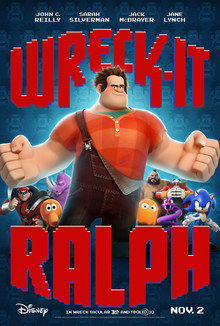
"Wreck-it Ralph" - Film Review

Wreck-It-Ralph has an initial premise that sounds really cool. It’s Who Framed Roger Rabbit meets Toy Story. When the customers are away from the arcade, the video game characters have their own lives. Each game is interconnected so that characters can leave their own game and go to therapy in Pac-Man or get a drink at Tappers. The film gets a lot of mileage out of the many in-film references to various video games, both from the arcade era but also about more modern games such as Call of Duty and Gears of War.

While this intriguing premise is part of the film’s charm, what really sells it are the more original elements thrown in. There’s a surprisingly touching story about misfits and finding your place. I was just pleased to see an animated Disney movie that didn’t have anything to do with a princess. The film’s central relationship is about Ralph and Vanellope von Schweetz. The two of them are both unwanted in their games and attempting to do things to earn their place in their respective games. This relationship ends up becoming the heart of the film. 

This is a case of the animation and the voice acting complimenting one another. There’s some wonderfully luscious, rounded animation that’s warm and inviting. The film really gives each video game world we enter a distinct feel. The animators have fun playing around with the fact that we are inside videogames. In the more retro games, characters move in stilted and clunky movements when they attempt to do different actions. The newer games are more fluid and, as Fix-It-Felix puts it, HD. This animation is brought to life by an impeccable cast. John C. Reilly is perfectly suited for Ralph, providing a real soft spot to the lug. Sarah Silverman is also well-chosen for Vanellope, providing the right amount of lisped, cutesy enthusiasm to all her lines but not so much that it becomes annoying.   

Ralph is tired of being the “bad guy” of the game he’s in, Fix-It Felix. He decides that if he gets a medal, it’ll be proof that he’s just as good as the “good guys”. So he sets out to earn a medal. His first stop is in a big shoot-em’- up.  He eventually gets the medal but in the process releases one of the bug monsters from the game, and outside their own game these creatures start to wreak havoc. 

He then finds himself in a racing game set in a candy-based world. Here he meets, who is a glitch that wasn’t meant to be part of the game. Ralph immediately sympathizes with her outcast status and tries to help her achieve her dream of winning the race.

After Ralph leaves, kids stop playing the game assuming the game is broken. The arcade owner puts an “out of order” sign on the game and plans to have the game removed. Felix (Jack McBrayer) scrambles to find ralph and save the game from going on the trash heap. 

The stakes are raised due to the fact that if a character dies outside their own game, they die for real. A problem exacerbated by the alien bugs and a meddling candy king who’s obsessed with maintaining his power, and also may not be all he seems to be.

The film works as well it does because it isn’t just a handful of amusing, randomly strung together jokes about video games. There’s a really well told, original story. Though the story has lot of familiarity to it, no one ever said a good film had to reinvent the wheel. The film’s ability to build up whole new worlds that feel rich and detailed adds to the viewing experience. Above all else though, this is a really fun movie. It’s funny, heartwarming, and filled with tons of great visuals. 

Grade: A-

Friday, March 22, 2013

Community - "Economics of Marine Biology" - Review

To be quite honest, I’m not really sure what’s going on in Community anymore. There are plenty of series that decline in quality in their fourth season. On tv right now, there’s Cougar Town, Archer, and The Vampire Diaries, all diverse series that haven’t lost their sense of purpose but aren’t operating at the same level of output they were at their peak. And yet I really just don’t know what’s happening on Community anymore.

Part of it is the natural evolution of a television comedy. Shows are often weaker in later season and pushing to squeeze out any jokes they can, and fourth seasons are a common time for this fatigue to start setting in. The show probably wouldn’t be as good as it was in the past even if Dan Harmon was still showrunner. The third season had a lot of problems that were very clear, but even with those problems the series was still producing some of its best episodes. And even in the episodes I had qualms there were plenty of funny moments that made up for their flaws.  And yet, the series isn’t all that funny anymore. Humor is subjective and tastes will vary, and so it’s a little unfair to judge a series on how funny it is, and that’s why when I review I try to get at the other matters at hand that make something work or not. But when something is funny it can raise a series above its shortcomings and when a series is not funny, well it just stinks. 

Part of it is that the episodes are overstuffed, and this is the most overstuffed of them all. Abed is hardly even in the episode, and none of the storylines are given enough room to go anywhere. But the series has been overstuffed before and made it work. And being overstuffed isn’t bad when in the hands of capable talent, but when done wrong very glaring. A lot of these stories could have become bigger premises but they’re never fleshed out enough.

I like the idea of Jeff and Pierce making an unexpected connection, and this is the most engaged Chevy Chase has appeared to be all season, but it’s barely given screentime. The Troy and Shirley storyline is incredibly pointless and never given enough room to make an impact or provide a purpose for itself.

The Annie-Dean storyline is so broad and unfocused that it doesn’t really work. While I like the idea of Magnitude being forced to retract his catchphrase, the sentiment never hits the emotional note it ought to.   
    
These are very good performers but they’re stuck in stories that even they can’t save.

Grade: C+

The Vampire Diaries - "Because the Nights" - Review

Something I’ve noticed lately in The Vampire Diaries is that it’ll have one plot that is great (arguably even one of the best it’s ever done) and then the other one or two storylines will feel slight. It’s usually been the A-plot (which is what you’d likely expect in a tv series) and for the most part these awesome plotlines are so good that they make up for the weaker portions of the episode elsewhere. This was true of last week’s episode where the newly transformed emotionless Elena was the highlight of the episode, and it’s true once again of “Because the Nights”.

It’s not just that Nina Dobrev is great in this new role. It’s the fact that this character is so completely unhinged that I have no idea what she plans to do. Klaus broods and complains, but he doesn’t really stir up unanticipated trouble. Silas is another one-minded villain hell bent on a singular goal. But, much like Katherine, emotionless Elena is a devious, calculating individual who is beholden to no one.

When Elena tells Rebekah how she’s aware of how Damon is playing her, and how she’s simultaneously playing him back, it had me grinning. This is the type of delicious scheming that is the raison d’etre of The Vampire Diaries. 

That this story is paralleled with a story of Damon’s involvement in the 1970’s punk scene is even better (Though I’d have liked to seen them play up the period detail more). Plus we get the return of one of the series best guest stars, Arielle Kebbel as Lexi. Lexi attempts to fix Damon and get him to embrace his emotions again, but Damon plays her, sleeping with her before leaving her stranded on the roof. Present day we find Elena (with the help of Rebekah – an unexpected but great pairing, which is the return of another classic Vampire Diaries element:  ever shifting alliances) doing the same thing to Damon. Karma is the worst sometimes.

While this storyline features some of the best elements to a great Vampire Diaries episode, the Silas storyline feels bland in comparison. Klaus and Caroline’s bickering has gotten repetitive and isn’t being taken in any new directions. The scheme to stop Bonnie from using expression magic to create a witch massacre also should have had more weight to it. Why isn’t’ the cavalry being called in? We get three characters trying to stop what could potentially cause the end of the world. 

The NYC storyline covers for a lot of the problems in the other storyline but I wish the episode was more streamlined. Although that ending paid off both stories nicely dovetailing them when Steffen and Damon talked only to realize they’ve both failed and thus things have gotten much, much worse. It’s the mixed bag that this season has ultimately been, but recent episodes have had enough fun and enough forward momentum to make up for the problems. And, hey, with a story as punchy as this, I can’t complain.  

Stray Observations:
-Great music choice: Talking Heads - “Psycho Killer”
-Back in the 70’s, Damon was killing people so their ID’s could be used for vampires on the run, including, unintentionally, Katherine.
-Man, they’ve done an awful job with using Bonnie’s dad.
-The crosscut of the feedings was weirdly erotic.
-“I hated the moral self-righteous you”
-Though much of the Caroline-Klaus stuff was a re-hash, this last scene between them I found to be really effective. Candice Accola’s acting was excellent.
-Caroline kills the witch to save Bonnie and in the process causes the massacre. How do we feel about this?

Grade: B+ 

Thursday, March 21, 2013

"The Loves of a Blonde" - Film Review

There are some films that feel true to life. They’re filled with so many nicely observed moments that there’s an authenticity to them. They feel real. The Loves of a Blonde is obviously staged because it’s a movie, but, in the hands of director Milos Forman, there are so many of these joyous small scenes that sometimes it’s easy to forget and slip into its world.

Andula (Hana Brejchová) has gotten engaged to a man that she hasn’t seen for a month. She says she loves him but she’s upset that he hasn’t gotten back to her in so long. 

In the meantime, she goes to a party hosted for reserve troop brought in to undo the gender imbalance in the small town (A ratio of 16 women to 1 men - There's some social satire here about communism in Czechoslovakia). She and her friends notice that three soldiers keep looking over at them and they’re certain they want to dance with them. The girls are embarrassed, but also a little flattered. The soldiers, who are much older than these young girls, argue as to whether the girls would be cool with them going over to ask them to dance.

In the film's first incredibly charming and funny moment, the men send over a bottle of Champaign to the girls and the waiter accidentally sends it to the wrong table. Due to the crosscutting, the meaning of the whole situation is made further funny; the girls are relieved while the men are flustered and angry.

Eventually the soldiers do dance with them. It’s a slightly awkward but mostly fun night. After one of the soldiers pressures them to drink wine and then to go somewhere else with them, they head off to the bathroom to discuss what they should do. Andula isn’t interested though. 

She’s about to leave, but then she runs into the piano player from the band at the party. She’s been occasionally eying him all night. He convinces her to come back to his room, but she keeps saying that she’s going to leave soon. He jokes around and teaches her self-defense, and before you know it she’s won over. They sleep together, and she sneaks out in the morning. In another one of those perfect little details, at the same time she’s doing her walk of shame, she runs into one of the women from the table who falsely received the Champaign doing the exact same thing.    

She returns to her normal life. She works in the factory and lives in her dormitory. The piano player, Milda (Vladimír Pucholt), is still on her mind though. When the boy she’s technically engaged to suddenly shows up, he berates her for not wearing the ring he gave her. He makes her go back to her dorm to get the ring. When she won’t come back down, he storms in and yells at her. But her roommates defend her, and she finally tells him off. 

Inspired by this, she decides she’ll hitchhike up to see Milda. However, she never tells him that she’s coming, and it leads to a series of awkward encounters with his parents. She shows up at his apartment, but he’s at a gig. She leaves but asks them to hold onto her suitcase. The parents contemplate and argue why Milda would have a girl come over like this; the mother is particularly frustrated. Andula returns because the frontdoor is locked and she needs help leaving, but the mother has her stay since she wants to get a look at the potential beau of her son. The mother questions the lack of thoughtfulness to her decision making (where was she planning to spend the night in Prague?).   

They tell her that she can spend the night. Everyone goes to sleep, and Milda (who has been out having dinner with another girl) returns home in the middle of the night. His father hears him come in and asks him who the girl is. He claims that he doesn’t recognize her and didn’t invite her. Andula wakes up and he gets a better look at her and makes the connection as to who she is. They talk, the spark between them seems rekindled (or Milda at least feigns that it is). 

But soon after, the mother will not tolerate them sleeping together and drags him into the parents’ bed. This leads to one of the funniest and most realistic scenes, where the three individuals find it near impossible to get comfortable with the lack of space they now have in the bed. It also doesn’t help that they’re bickering the whole time (mainly about Andula’s sudden arrival). She sneaks a listen into this and it makes her cry.  She's been disillusioned by the whole incident and heads home.

Not much happens, but it all has a sincerity to it. We’ve all had those days where these odd but meaningful series of events have occurred. We’ve all juggled romantic commitments. The greatest aspect about it is how it undercuts these moments to make them all the more real. Andula showing up at Milda’s doorstep is that grand romantic gesture everyone has thought of making and seen in the movies, and she shows up and nothing goes as planned. More importantly the guy she thought she was in love with and her romantic longing turn out to both be false. A funny, poignant, breezy film.

Grade: A