Sunday, March 17, 2013

"Heathers" - Film Review

Heathers is the dark cousin of the John Hughes 80’s teen movies. It’s a dark antidote to the sentimentality of The Breakfast Club, Ferris Bueller’s Day Off, and Sixteen Candles. It’s a dark, twisted, cynical satire of high school, cliques, and popularity.  

The moment a guy pulls a gun out in the middle of a cafeteria, shoots people with blanks, and everyone seems to just shrug it off matter of factly is when you should realize Heather doesn’t exactly want you to always take seriously everything that’s taking place.  

Veronica (Winona Ryder) befriends the popular clique of the Heathers (Shannen Doherty, Lisanne Falk, Kim Walker) three attractive mean girls all with the same name who dominate social life. Veronica thought she wanted to gain popularity and power at the school, but she’s two smart and subversive to truly belong to the Heathers. She’s getting fed up with all their bashing and pranking of the geeks and outcasts, which they’re making her an accessory to.

Enter J.D. (Jason Slater) a pretty boy rebel with an odd sense of humor who wants knock the Heathers down a peg as much as she does. 

This is where Heathers increasingly enters into the realm of the absurd and surreal. The satire remains but it becomes broader and darker. When the de facto leader of the Heathers pisses Veronica off, she decides she’ll give her a bad hangover cure that’ll make her throw up. J.D., on the other hand, suggests giving her drainage fluid; she, ouf course, refuses this idea and takes it as a joke. However, when Veronica mistakenly picks up the cup containing the poison, J.D. simply smirks and purposely fails to tell her. Heather drops dead and the two scramble to make her death look like a suicide.   

The fake suicide ends up turning Heather into a fallen martyr; she suddenly has depth no one could have imagined, and she now has a hold over the school that’s even stronger than when she was alive. AKA the exact opposite thing they could have hoped for. Veronica could have swallowed the death if it actually brought greater equality in the school, but everyone acts like vultures, picking off the suicide for their own benefit and gain.  

J.D. has bizarre control over Veronica; she doesn’t want to harm anyone else, but he keeps convincing her to take the lives of other people. But, hey, it’s only popular kids who’d be making life miserable for the majority of people. When Veronica just can’t be part of this anymore with a clean conscience, well, J.D. doesn’t take it too kindly. 

There are films that I claim are fun but that I personally don’t find to be fun; however, these types of films are the ones that I could definitely see other people getting a lot of enjoyment out of and it’s why I frame the reviews in that way. This is not the case with Heathers which is one of those films that I’m not feigning how much I liked it. It’s a film that’s frequently hilarious with its apocalyptic sensibilities and sharp, intelligent satire. It could have stayed the course as a typical teen film about a girl realizing she wants nothing to do with the popular kids anymore and embracing other subcultures and life outside the it crowd, but, by allowing itself to go into murkier, off the beaten path territory, it turns the film into something far more interesting and memorable, even if it’s not always well-executed. There’s a fair amount of caricature here, there’s plenty you have to accept at face value in order to buy into the premise, and that ending feels slightly tacked on, but by refusing to be a traditional teen movie, Heathers become something far more peerless and gratifying than it would have otherwise.    

Grade: B+

Saturday, March 16, 2013

The Vampire Diaries - "Bring It On" - Review

Something The Vampire Diaries has proven itself incredibly adept at is evolution. It’s taken advantages of one of the strongest assets of the television medium, the ability to change characters over time. Go back to the Pilot and you’ll find a much different character in Elena Gilbert.

This is a character that was a shy, nervous teen that was bored and uncertain about her life. Now she’s strong-willed, defiant … and of course most importantly a vampire. While the series has handled the vampire transformation with mixed results (particularly after the sirebond reveal), Elena turning off her humanity plays out wonderfully in “Bring It On”.

The series at its peak was a sight to behold for how purely entertaining it was. Throughout the second season (its best season), there’s practically not an episode that isn’t a rip roaring good time. Part of this came from how anything could happen at any given moment. The wildcard in the form of Katherine shook things up so radically that it caused constant twists and turns, changes in alliances, backstabbings, scheming, and people getting injured and dying left and right. Then the third season came along and the pacing slowed down and things became a bit more predictable and a bit less inspired.  

I bring this up because Elena without her humanity is a great deal of fun. She’s utterly unpredictable and delightfully manipulative and calculating. She throws off pithy one-liners and strings along people, particularly Steffen. Nina Dobrev has proven herself great throughout the run of the series, but she always appears to be enjoying herself so much more when she gets to play Katherine, the more lively of her two reoccurring roles. I got a serious Katherine vibe in humanity-less Elena and that’s all for the better. It sparked new life into a series that’s plot wheels have been getting stuck lately.

The rest of what’s going on in the episode is much less interesting. Damon and Rebekah are a nice pairing and its amusing to watch Damon tell Rebekah’s what’s what, but this storyline ultimately amounts to little. Damon is forced to kill someone he supposedly knows but whom we never met and so the moment has little impact. We also discover someone has been hoarding blood bags from nearby hospitals, and it’s likely Silas feeding after thousands of years of imprisonment.  

Klaus and Hayley on the other hand are a far more interesting pairing, even though they’re much more disconnected from the plot. The writers are doing a great job setting up the spin-off The Originals (which will feature both Joseph Morgan and Phoebe Tonkin). Their dialogue also worked well as both banter and an exploration of who these two characters are. We finally get some background on Hayley who’s apparently an orphan seeking her parents (with the help of Katherine). Klaus is revealed to have an obsession for control, which isn’t revelatory but it’s interesting to hear him admit. Although, the discussion of control leads to a slightly offputting sex scene between the two characters where Klaus dominates the situation (albeit at her request).  

However, I can forgive these subplots or their lapses because that Elena main plot was delightful. “I’m no longer the scared little girl who didn’t want to admit what she wanted to be,” Elena tells Damon.  It’s very, very true, and that means anything could happen. And that’s a good thing.

Stray Observations:
-Elena strips naked in front of everyone. Cuz that’s what people who don’t give a fuck do. Her response to their aghast reactions: “What? It’s nothing you haven’t seen before”
-The important part in all of this that I forgot to mention is that the sirebond no longer works now.
-When Elena attacked Sheriff Forbes I was really upset. Too far!
-“Your world revolves around me” – Seriously though Steffen get a hobby or something.
-Tyler is gone for good, which hopefully means Caroline will stop leaving angsty voicemails. 

Grade: B+

"Network" - Film Review

Network is a broad, unsubtle, and at times wonderfully absurd satire that takes a cynical attack on television.

Howard Beale (Peter Finch) is having an awful time in life. His wife is dead, he has no kids, and he’s about to be fired from his job. Is it all that surprising that he snaps then? A terrible psychosis kicks in and on the nightly news broadcast where he announces his retirement, he also announces he plans to kill himself. The people in the editing room are so used to the typical routine of news broadcasting that they initially don’t even notice that he’s made plans for suicide on the air in two weeks.

The network scrambles to deal with the aftermath and most think Howard is crazy and ought to be fired. But Diane Christensen (Faye Dunaway) sees an opportunity; USB’s ratings went up after Howard’s candid talk to his audience and Diane realizes that they could have a real hit on their hands if they let Howard speak his mind. Diane plays all the angles and convinces network executive Frank Hackett (Robert Duvall) to produce a show hosted by Howard. 

What follows is an incredibly funny, but also slightly terrifying, (and admittedly sort of implausible) look at the power of television and its power to construct the world and our lives. There’s, of course, Howard’s now infamous line: “I’m mad as hell and I’m not going to take this anymore”. Soon after we find his fans all across the country accepting his advice, opening their windows, and yelling at the top of their lungs this refrain. It’s undoubtedly hilarious but it’s also a nice statement on television’s influence. In many ways, Network feels ahead of its time; sure, television was big back in 1976, but now pop culture is even more pervasive. Studios increasingly go out of their way to create the most sensational content to garner audiences in an increasingly fragmented marketplace. 

Bolstered by a great cast, a great script by Paddy Chayefsky, and sure handed direction by Sydney Lumet, Network is prescient, funny, intelligent, dark, and a whole lot of fun.  

Grade: A-

Friday, March 15, 2013

The Office - "The Farm" - Review

“The Farm” is a very odd episode of television. Initially intended as a backdoor pilot for a series of the same name as the episode, NBC scrapped the show after shooting the pilot. The Office in turn had to rework the rest of the season to smooth over the change in direction. And so “The Farm” is a salvage mission; it’s an episode that tries to integrate the footage of “The Farm” and make it work as just another episode of The Office.

It’s not a terrible episode; this season has had far worse ones. However, it’s an episode that feels halfbaked. The material about Dwight on the farm never is given enough footing to truly take off. Thus it’s a lot of ideas that actually aren’t that bad but never amount to much.

When Dwight’s aunt dies, he attends her funeral, where he’s reunited with never before seen siblings. Setting aside how weird it is that we’ve never even heard in passing about his brother or sister, I’d be willing to accept their existence if it weren’t for the fact that I doubt we’ll ever see them again. Much of this episode is very “pilot-y”. It’s setting up ideas that would potentially have paid of down the line in the spin-off. But since there’s no longer a spin-off, the siblings are just types, and they don’t seem to have at least a cursory similarity to Dwight. His brother is a tad off, but he’s a hipster loser. His sister is a single mom who lives in the city and loathes rural life. There’s the suggestion of history between them (the brothers playfully fight the moment they see eachother), but we know nothing of these other characters beyond the fact they’re related to Dwight. But what does this do to service Dwight’s story arc? (wait, for that matter: what is Dwight’s story arc this season?)

There’s a B-plot that’s tacked on about Todd Packer pretending to be a part of AA and trying to apologize for his past mistakes. I’ve never been a fan of Todd Packer. It’s a character that if the series had used him any more than they did, he would have become frustrating and annoying. The storyline is incredibly unnecessary but it was interesting to watch Packer be kind of backhandedly nice for a change. And the reactions were all appropriately in character. However, the storyline is made problematic when it turns out Packer laced the cupcakes he gave to the office with drugs. At which point an unnecessary but not grating storyline took the series back into the realm of surrealness it’s ineffectually been dancing around with in recent seasons. 

The Packer story is treated like an afterthought, and the Dwight storyline is a series of amorphous but never fully formed ideas. Part of the problem is derived from trying to make the best of the fact there’s no longer a spin-of and the show does an amiable effort. I’m a sap and so I probably would have checked out the first few episodes no matter how little I care about The Office at this point.  But even the best salvaging efforts sometimes can’t completely save the wreckage. 

Grade: B- for effort, C+ as an episode of The Office.

"A Fistful of Dollars" - Film Review

A Fistful of Dollars is one of those rare remakes that’s quite possibly as good if not better than the original. When it comes down to it, Sergio Leone’s spaghetti western is a reworking of Akira Kurasawa’s Yojimbo; the setting is now Mexico rather than Japan, and it’s gunslingers rather than samurais, but the simple but great premise about a loner who wanders into a town fought over by rival gangs remains. In many ways, Dollars is the superior of the films. It streamlines the narrative and cuts away some of the fat, which leads to more action and a more crackling, sensational vibe.

Dollars is the first in Leone’s "Man with No Name" trilogy. Most people remember him best for the third of the films, The Good, the Bad, and the Ugly. I’m a contrarian who finds the film to be more problematic than Dollars. It’s too overlong, too digressive, and too unfocused. Here in Dollars is all the best aspects of Leone. It feels a lot less rambly and sprawling than Ugly. It focuses on a small Mexican town in the 19th century just across the border from the U.S. The Man with No Name (Clint Eastwood) comes across the town, learns of the infighting, and decides to clear the town of evil and make a profit in the process. 

There’s Leone’s undeniable style; it’s a film that’s often so cool that it makes you shut off your brain at times and forget to be critical of it. From the opening animated title cards to that wonderfully well-executed final standoff, it’s a film that’s massively energetic and fun, even surprisingly thoughtful, but definitely by no stretch of the imagination boring. This is perhaps best exemplified by Ennio Morricone unforgettable score. And while it’s certainly not a perfect film, it’s an incredibly entertaining movie with some memorable action scenes and characters, particularly Eastwood in the lead role. 

But more than anything is the feel the film gives off. It’s darker and more stylish than just about anything that came before it. There’s a reason Eastwood’s character remains iconic even for those who haven’t seen any of Leone’s films. With his signature poncho, the nameless badass who’s quick on the trigger but even quicker with his wits is an archetypical hero with outrageous amounts of charm and swagger. The film has style to spare, especially from its protagonist, but it also has some incredibly effective plotting and some nice character work even from supporting characters, all the more impressive considering much of the dialogue is dubbed. 

All of the action isn’t just for the hell of it; it all grows organically from the plot necessitating it, and then once Leone has justified the action, he goes out of his way to craft  some of the most electrifying and exciting scenes in film history. It’s not the brainiest of films but it's a damn good time.

Grade: A-    

Thursday, March 14, 2013

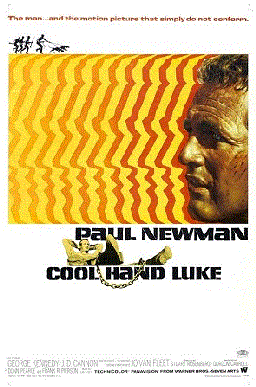
"Cool Hand Luke" - Film Review

“What we have here is a failure to communicate,” the prison warden tells the inmates a little over halfway through Cool Hand Luke. It’s a great line and the scene from the film most people remember when they think of the film. It’s a line that’s become part of colloquial expression and pop culture consciousness. But it also marks a change in the tone of the film.

Up to that point, Cool Hand Luke is about as feel good as a movie about prisoners can be. Luke (played wonderfully by Paul Newman) gets sent in on some petty crime for taking off the heads of parking meter while drunk. His rebellious, jovial, aloof, devil-may-care attitude initially puts him at odds with the inmates, but he slowly wins them over. He’s willing to do anything to stop the boredom and tedium of working a prison chain gang. He makes absurd bets in a poker game; he has them rush the tarring of a road; he eats fifty eggs in an hour.

But soon it’s not enough. He learns his mother Arletta (Jo Van Fleet) has died and he can’t stand the prison any longer. He plans an escape with the help of the other inmates but doesn’t make it very far before he’s sent back. He breaks free again and it seems like it might work, but Luke is apparently shit out of luck. The warden isn’t going to put up with this anymore; he decides he’s going to break Luke and puts him through hell. He’s sent to solitary confinement every night; he’s beaten relentlessly at work; and he’s given needlessly difficult and pointless work assignments. The wily smiles and jokes soon fade to reveal the sadness hiding behind Luke’s carefree persona.

The film is inhabited with a rich world of characters. There are a number of great bit roles. This is especially true of the prisoners particularly George Kennedy who won an Oscar for his role as Dagget, the de facto leader of the prisoners. Strother Martin is also fantastic as the prison warden, the Captain.

Stuart Rosenberg's direction is frequently clumsy and awkward. Cool Hand Luke’s tonal shifts don’t always work and this is largely due to some unfocused plotting and some scenes with great writing but a peculiar presentation. However, overall the film is funny, compassionate and moving.

Grade: B+

Tuesday, March 12, 2013

"Repulsion" - Film Review

Carole Ledoux (Catherine Deneuve) seems like a nice girl. She’s perhaps a bit shy, nervous and quiet but she’s not dangerous.

Something’s not quite right about Carole though. She’s spacey, distant, obsessive. Repulsion takes its time peeling back the layers of her damaged psyche. She’s not well and possibly has some disease like schizophrenia. It’s clearly never been diagnosed though. 

The only people that have any interest in her overlook what’s wrong with her. She lives with her sister Hellen (Yvonne Furneaux) who cares for her but sees her as a burden. The guy, Colin (John Fraser), that’s interested in her just wants to be in a relationship and doesn't stop to think there might be something wrong with her.

Carole mostly keeps to herself. Stuck in her mind where everything is in a constant state of hyper-reality. Every sound stands out stronger and louder; the lighting and the space of the tiny apartment start to make everything feel increasingly claustrophobic and confining.

Eventually she’s left in the apartment for several days and the time alone takes a toll on her. She begins seeing things that aren’t there and disappear at a moment’s notice. She leaves food out to rot and gather flies. She bars the door and cuts the telephone line. When people begin inquiring she freaks out and attacks them.

On display for most of this is Catherine Deneuve who’s incredibly convincing while speaking next to no dialogue, even in her scenes with other actors. Deneuve has this ability to subtly shift her eyes and provide all the necessary information you need to know. It’s not all that surprising that director Roman Polanski uses the eye as a reoccurring motif throughout the film.      
     
The film takes its time desconstructing Carol’s life demonstrating to us the limiting and frustrating nature of her life, and how desperately overlooked and disregarded she is. It has a wonderfully well-executed build up and it leads to some riveting and intense climatic scenes. 

Repulsion is a penetrating character study and a great psychological horror movie with creepy, evocative atmospheric visuals and Deneuve’s great performance. 

Grade: B+