Friday, February 15, 2013

The Vampire Diaries - "Down the Rabbit Hole" - Review

Well, that was more like it!

After last week’s massively disappointing “Into the Wild”, “Down the Rabbit Hole” reminded me about why I watch this series.

I could analyze this episode in great detail, but I have only one thing to say: KATHERINE! 

The show has failed at the one thing it’s become almost infamous for: its plot twists. And there were so many turn of events in this episode that it had me yelling out like I hadn’t in a long time. How lovely were they, let me count the ways:

Well firstly we got the nice bombshell that there’s only one dose for the cure, which shakes up alliances and complicates matters in a way that the universal healthcare package cure just wasn’t pulling off.

Secondly, we got ourselves good ole Katherine. Now I was actually thinking to myself while watching this episode: man, this show is gotten really far away from its origins, and Katherine was at the heart of that. 

The series just kept expanding and expanding to the point where this season took it to a point where it had expanded perhaps a bit too much with the cure plot (which felt “shark jumpy”, but wasn’t nearly as terrible as the sirebond).

The series always was a little more fun with Katherine around and it was only a matter of time before she came back, and boy did she ever come back. As if that awesome twist wasn’t great enough, we got the biggest cliffhanger in a long while: little Jeremy Gilbert has left this earthly plane. 

HOLY SHIT!

I had complained in the past how the series had been too cautious and kind with its characters. It needed to kill someone to raise the stakes again (or least something on par on the devastating scale). 

Not only that but the show needed a new villain and Silas looks to be the answer to shaking up the dynamics of the series and prevent it from going stale.  

This was the show at its finest. Finding ways to be shocking and daring, while still being intelligent, emotional and remembering its characters. 

Stray Observations:

-Man these opening recaps are terrible and cheesy. And seem to be getting worse as we go along.
-After having the Caroline-Tyler-Klaus story feel totally disconnected last episode, the writers find ways to make it dovetail nicely with the main plot.  
-Our new hunter had a nice accent; Damon quaintly describes him as “Shrek”. They utilized him well for the short time he existed. RIP.
-“Need any help my love?” “Nope” – Great line reading by Candice Accola.
-“It’s called a cryptex … what I’ve seen the Da Vinci Code”
-Bonnie was actually pretty great this episode. “I’ll kill him myself,” shes tell Jeremy about if Shane were to cross them. Way to finally wise up.
-Shane breaks his leg, and everyone’s reaction is, “Well, you kind of deserve it”. “Best to stay off it,” Bonnie replies to his pleas for help.
-“You’d still give it to Elena wouldn’t you?” – I want to ship Rebekah and Stefan. Why won’t you let me?!
-“Your attachment to your friends will be the end of you” – that was very Star Wars-y
-That contraption that the hunter used on Rebekah was kind of awesome.
-Silas using Grams to manipulate Bonnie: Not cool man!
-“You prefer who you are to who you were” – Caroline begging for Tyler’s life was a great scene.
-An even better scene: Tyler and Caroline on the porch saying goodbye. “Tell me you’ll forget about me… that you’ll lead a happy life without me,” she pleas. That’s not tears … something just got in my eye.
-“I’m done playing nice” – Nina Dobrev is usually pretty good, but her talent really shines through when she gets to play Katherine. 

Grade: A-

What did everyone else think?

"Morocco" - Film Review


Let’s set aside the fact that Morocco is filled fairly abundantly with Orientalism. Besides that though, what does the film offer us? Well, for starters it’s an entertaining, if a little lightweight and jumbled, story that tells a semi-atypical romance and stars a fantastic performance from Marlene Dietrich. 

Yes, this is some pretty blatant orientalism that constructs at times an exotic or backwards other in the natives of Morocco. Even the music that accompanies the shots of daily life is broaching on the offensive.

I hate to be an apologist for a film that features orientalism, but we have to take films in context and by 1930’s standards Morocco is pretty progressive. 

It’s an example of the themes pre-code Hollywood could get away with. The film at times has a rather sophisticated and nuanced exploration of gender and sexuality. The long sequence where we’re first introduced to Dietrich’s Amy Jolly is surprisingly provocative. She steps out centered staged, cross-dressed in a suit, and she gleefully looks out at the audience as they begin to jeer; but she soon wins over the crowd, singing a flirtatious French tune. By the end of the number, the crowd's taken such a liking to her that she’s able to kiss a female audience member and it causes raucous cheers. The female bears a bemused grin at Jolly, and both men and women whoop and holler. It’s an incredibly sexually charged scene that Dietrich carries with superb confidence and charisma.   

Dietrich is simply awesome. And I don’t mean in the conflated sense that the word has gained in recent years. I mean in the literal sense of the definition: she inspires awe and reverence. This is a strong female character who knows what she wants and who’s in control of her sexuality and her identity. 

Gary Cooper stars as Tom Brown, a legionnaire in the French Foreign Legion who’s a womanizer and who Jolly falls for despite herself. Cooper is probably a bit ill-suited for the part, almost too gruff with his deep mid-western drawl.

Thankfully the film makes this slightly more complicated than the average rom-com. The two are uncertain of their feelings, and Brown’s womanizing and Jolly’s desire for independence aren’t helping matters. 

Though the film's plot is a bit one-note, and it isn’t very well paced and the editing leaves something to be desired, it’s worth it for scenes like Dietrich’s tuxedo-garbed kiss which was scandalous back in 1930 and still as memorable today.

Grade: B-

Thursday, February 14, 2013

Community - "Paranormal Parentage" - Review

I was probably too overtly harsh on Community in my last review.

The series isn’t bad. It can still manage some rather funny and touching moments. But something is very noticeably off. It’s hard to pin down what exactly feels wrong, but it’s enough that it keeps me at arm’s length when watching these new episodes. 

This episode returns some tried and true stories. We get Britta psychoanalyzing Jeff, more explication on Annie and Jeff’s relationship, Pierce attempting to get the study group’s attention, and Jeff exploring his daddy issues.  So it’s nice to see some of the underlying kinetics that made this series so fluid.

But the cast is split up into too many pairings (and for too long), the pacing is still dialed down a few too many notches, and (worst of all) the show feels like it’s just going through the motions.   

The series needs to find its footing or re-brand itself. Either way, as critic Ryan McGee put it, “That… Community wasn't good. But it was hardly horrible. It totally, definitely existed.”

Grade: B-

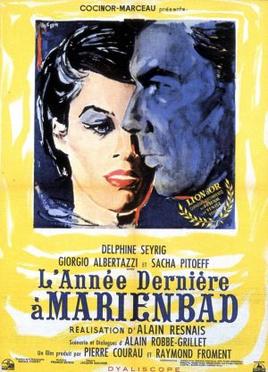
"Last Year at Marienband" - Film Review

Today’s filmgoers are massively literate about film language. They know how stories are told. When someone glances off in the distance and the next shot is some other object, we immediately make the connection that the person is gazing at the object. But people had to establish this language, and breaking the rules took time. The Lumiere brothers produced “actualities”, single frame shots of some real life event. George Melies soon started doing multiple shots to tell a story. In The Great Train Robbery, we got our first use of crosscutting: cutting back and forth between two plots to create tension and new meaning. And so on and so forth.

Last Year at Marienband came out at an interesting time in film history. It was released during a time when filmmakers were hugely interested in testing what was possible within the film medium.  It was made during the early years of the French New Wave, and like many other noted French films of the time, it blows up structure in mesmerizing, offputting, and bold ways. Linear storytelling is thrown out the window entirely. The film plays around with time and reality, posing existential questions and an uneasy sense of ennui. Much of the film feels like we’re walking through a dream, as we dash through space and time with uncertainty. 

The film often chooses to go for style over substance; shots are carefully calculated and framed, but the tidiness of the artistic design is occasionally undercut by how deeply surreal the film is. This is perhaps best exemplified by the now infamous shot of the perfectly positioned people standing amongst the manicured French garden; we see them from a distance with the sun overcast; the people cast long shadows while the trees cast no shadows at all. 

The film leaves itself up to interpretation. The plot is fairly straightforward: a man approaches a woman at a gathering at a hotel and claims that they met last year and insisted upon meeting again a year later. The question is posed for us as to whether this is true or not, and through repetition of events in multiple locations and in different contexts, the breakdown of reality and the truth continues to collapse until it’s nearly impossible to tell. 

To some it might be seen as intellectual masturbation, so overtly attempting to be highminded to the point of being irredeemably pretentious, and far too purposefully convoluted and incomprehensible. And to an extent it’s a smattering of all these qualities; but it’s also aesthetically interesting and vibrant. Plus its utter rejection of structural conventions has been highly influential on films.

Grade: B-

The Office - "Moving On" - Review

Well, that was … I don’t want to say a mess. But it was a lot of ideas that really didn't amount to much.

Shows should have some level of cohesion in each episode, no matter how many plots are thrown at us or how structurally unique it may be. Thus a show like The Walking Dead gets flack all the time for starting out with opening scenes that don’t feel like they logically lead us to the end scene of an episode (no matter how well those individual scenes may be executed). 

These plots don’t feel like they should be in one episode together, or really any episode at all for that matter. The backdoor pilot doesn’t make sense anymore because Dwight’s escapades on The Farm have been canceled and aren’t happening anymore. And so we get a storyline that is just plain weird. Dwight goes to take care of his ailing aunt, who we’ve never heard of before. He brings along Angela, and just flat out strange, unjustifiable things occur. The scene where he plans to hose his aunt feels like it’s coming out of a redneck caricature. If Dwight still had feelings for Angela, it should have been hinted at least a few times before this.

The most pointless plot of all: Toby’s misplaced affections for Nelly cause him to visit the man incarcerated for the Scranton Strangler murders. Toby goes to the prison and lets the man know that he now believes him to be innocent, despite the fact that his juror vote was “guilty.” And in fitting irony he ends up getting strangled by the man. At least, Nelly gives him a ride home (not that I care).

These subplots were each odder than the next, but we weren’t there enough for them to become completely grating. On the other hand, the Andy-Erin-Pete plot that dominated the episode is noticeably all over the place. The real problem is that Andy has become a plot device and not an actual character. Sure, Andy could be weird in the past, but the writers kept him just on the right side of crazy. Now though, he’s descending into a moustache twirling villain intent on nothing but seeing the pain and destruction of Erin and Pete for hurting him. 

The best plot in theory proved to be also very frustrating. Bob Odenkirk is usually comedic gold, and positioning him as an office manager who’s one step removed from Michael Scott sounds like one of the most inspired things the show has done in a long time. But few people apparently can control and capture the manic energy that made Michael Scott so joyous and oddly charming like Steve Carrel (even a seasoned comedian like the brilliant Odenkirk – who isn’t bad, but trapped by predictable and constraining material).

Worse still is that this was an hour long episode that had little right to be an hour long. Least of all not when this felt like four different series having their episode’s haphazardly cut together. Duct taping a number of plots together and hoping the mere charm of a cast will make it work is not a recipe for success, especially with plots as empty as these.

Any of these plots could have become something. May be not something spectacular but something where they felt like there was a point to them and that they mattered. Modern Family has been doing a good job about this lately. I never really laugh anymore at Modern Family, but I also rarely think to myself, "Oh my God what is that thing?" It's not a form of storytelling that will blow my mind or keep me a devout follower, but it puts a show one step above the mediocrity.

Stray Observations:
-Oddly enough the return of one of the series’ worst characters, Gabe, proves to be one of its best moments. “Yes, thank you for remembering,” he cheerfully says when Kevin points out that he and Erin used to “do it”
-Kevin’s miserable failed attempt to introduce himself to Pete’s ex is hilarious.
-Pam admits she wants to stay in Scranton. We’ve known this for a while so it’s really not surprising. 

Grade: C

Wednesday, February 13, 2013

"Eyes Without a Face" - Film Review

Eyes Without a Face is usually labeled as a horror film, and largely to an extent it is. But more often it feels more like an incredibly disturbing melodrama.

The film is more concerned with setting a mood or staging scenes so that you feel the utter isolation, sadness, and desperation of the characters than with trying to scare you. The film is thoroughly frightening but less because of the presentation of the story and more due to how unsettling the film’s premise is.
Doctor Génessier (Pierre Brasseur) is performing experimental surgery in order to restore his daughter Christiane’s (Edith Scob) damaged face; all that remains unscarred are her lovely, sad blue eyes (hence the title). With the help of Louise (Alida Valli), his assistant who he restored the face of, he kidnaps unsuspecting women with similar faces to Christiane’s. 

There’s a somber beauty to the film. The film is filled with a sense of anguish and psychological pain. This is perhaps best exemplified by Maurice Jarre’s haunting score; the leitmotif musical piece that plays when Christiane is on screen is unspeakably chilling. While the visuals formed by Eugen Schüfftan’s vivid black and white cinematography are striking and enchanting with undercurrents of melancholy. 

Though largely overlooked in its own time, through theatrical and home video releases the film began to collect a greater reputation. It’s now widely accepted to be a major influence on both European and American horror movies.

Its fascinating, poetic exploration of identity and beauty, and its considerations of the price being paid to achieve the surgery make it achingly mesmerizing even as it continually unnerves us. 

Grade: A

Tuesday, February 12, 2013

My Thoughts on Season 1 of "Suburgatory"

Suburgatory is exhaustively filled with tropes. Its stories take place in and around the candy-coated, bubblegum pop vision of a New York suburban town that is Chatswin. A town populated with meangirls like Dalia (and still yet mean girls with outlandish names such as Kamantha); happy-go-lucky neighbors like Noah; overbearing soccer moms like Sheila; a southern belle like Dallas; and then our two protagonists Tessa and George (both a tad clichéd in their own way). Tropes are almost to be expected in the story of urbanites getting stuck in the suburbs. Early on in the show’s run, however, this played against the series. A lack of continuity and a lack of through line for characters hindered the series from rising above these tropes.

Now tropes aren’t a bad thing. When used effectively, they remind us why they exist in the first place. Suburgatory slowly began to peel back the layers on its archetypes, and in the hands of some great performers, particularly Alan Tudyk’s Noah and Cheryl Hine’s Dallas, the show became more consistent and more endearing. Consistent both in its characters and its jokes, the series became at times incredibly funny and oddly, even surprisingly touching. 

“Cartoonish” is a word tossed around by television critics often when they want to make an underhanded jab at a show they consider to have failed to be good. It’s a word that should be taken back, and re-appropriated. Being cartoonish isn’t bad, but it’s an easy insult to poke at shows that over time fail to maintain the logics and mechanics of their universe. However, some of television’s best series were very cartoonish. The Simpsons’ first nine seasons are masterful at being both hilarious and heartwarming, while also being everything one would expect (and often wonderfully not expect) from a cartoon. 

Suburgatory because of its tropes and because of how bizarre many of its characters, scenarios, dialogue, and jokes could be felt like a live-action cartoon. This was something, especially very early on, the show didn’t always handled well. Early episodes such as “The Chatterer”, “Charity Case”, and “Don’t Call Me Shirley” are rather cartoonish, but they don’t really work because we know next to nothing about the characters at this point to justify much of what takes place or for a number of jokes to land. The characters failing to be well-defined played into this problem. Typically the best comedies are those that create jokes out of character observations rather than contrived scenarios, and here the characters changed frequently from episode to episode in these early days. 

There was still much that didn’t quite click later on this season. However, the writers began to make better use of the cast and learned to balance the many, many talented performers. “Thanksgiving”, for example, is a very overstuffed episode, but the series efficiently tells the many plots without short shrifting any of them. It’s an early example of what the show would become confident and good at, incorporating many, many characters while never losing thematic cohesion or failing to be funny. There are a number of characters I never anticipated ever liking such as Rex Lee’s overly optimistic, clueless guidance counselor Mr. Wolfe and Parker Young’s hopelessly dumb jock Ryan Shay. But by the Eden story arc of the last four episodes, Chatswin had exposed the heart and sincerity underlying its façade, and the show had paid off on many of its early glimpses of promise apparent in the “Pilot” and “Barbeque” that may have gotten lost for a little while along the way. 

While if it doesn’t continue to expand itself and take risks, the praise I’m heaping on it now will have been premature. But this series charms me and I have hopes, and that’s enough for now.