Monday, February 11, 2013

"Freaks" - Film Review

“Gooble-gobble! We accept her! One of us!” and so with that haunting chant, the good-natured, mocked circus performers of Freaks strike an odd chord with us. It’s one of those lines that has since blown up far bigger than the cult morality tale itself.

Though overlooked in its own time due to the "sensitive virtues" of theater goers, Freaks is a film whose success has grown with time. Much of what makes the film so great: it's shock value, it's many scares, and how genuinely touching it can be were discovered much later in midnight movie screenings in the 70's and 80's.

At the same time, Freaks is one of those Pre-Code Hollywood films that would never have gotten made after 1934. Once the Hays Code kicked in, some of the more objectionable material of the film would never have passed the standards test. As it stands much of the brilliant final sequence where the titular “freaks” take their revenge on the “normal” people, who turn out to be the real freaks, has been significantly cut for how graphic it apparently was. But it didn’t need to be any more explicit than it already was. We’re given an incredibly good sense of how far the justifiable vengeance sought upon Olga Baclanova’s Cleopatra and Henry Victor’s Hercules goes. 

Neither do I believe Freaks would get made nowadays; though it has some modern sensibilities to its narrative (it’s realistic, loving depiction of the circus performers feels like something films would shy away from until the breakdown of studio control in the 70’s), there’s still a fair level of quaintness to the film. A number of the film’s plots are just everyday occurrences, “slice of life” pieces about the performers that never go anywhere. Plus much of the film is blatantly black and white in its moral relativity. But that’s totally cool; we want to see the circus performers get back after all the jokes, criticisms, and eventually attempted extortion.  

Director Tod Browning (who directed the original Dracula) actually spent time as part of a traveling circus and drew upon his experiences for making the film. Browning went out of his way to hire real carnival performers and its part of the film’s charm. If the characters had just been actors in prosthetics it wouldn’t have the same impact. 

Though some of its execution isn’t particularly graceful, it’s still one of those oft-forgotten gems of the early years of Hollywood. Oh, and that final sequence where the “freaks” get their revenge still holds water; it’s one of the scariest and most memorable sequences in all of cinema. 

Grade: A-

Girls - “One Man’s Trash” - Review

Television series have to balance story-arc heavy episodes and standalone episodes. The standalone episodes may be informed by larger narrative, serialized elements, but anyone can come in and watch that episode without being unreasonably confused. Television viewers have become so literate with the medium and so used to serialized narratives that it’s easy to mistake a standalone episode as a bad thing. But on the contrary some of television’s best episodes are standalones. The episode that crystalized The Sopranos as the show we know it today was the standalone episode “College”.

Standalone episodes are frequently used to do structurally or stylistically ambitious or interesting things not normally done on a show. Many of Buffy the Vampire Slayer’s best episodes including “The Zeppo”, “Hush”, and “The Body” work perfectly as standalone episodes while also breaking formatting and structural rules to great effect. 

“One Man’s Trash” is a standalone episode. Much like season one’s “The Return” (another, very good standalone), it cuts out almost every other major character besides Hannah. There’s no Marnie; there’s no Jessa; there’s no Shoshanna. Ray appears only briefly and only then to get the plot in motion. Otherwise this is a half-hour dedicated to the puzzling and often frustrating psyche of Hannah Horvath. 

When Ray’s neighbor Joshua complains about finding trash from Ray’s coffee shop in his garbage can he asks him to stop. Ray knows that this couldn’t possibly be true and so he begins to berate Joshua. Well, the garbage was from Ray’s coffee shop and Hannah is responsible. She goes to apologize to Joshua and somehow ends up spending the rest of the day and the following day talking, fucking, and hanging out with the forty something guy separated from his wife whose out in San Diego.
  
Here the meandering aimlessness of Girls (with massive hints of Louie) comes out in full force. It’s hard to read where this episode is going to go from one moment to the next. Hannah starts out the episode believing she invented the word “sexit” and ends up hooking up with a total stranger.

The total irony of the episode is that Hannah’s big revelation she has, breaking down in tears and confessing to Joshua, is that she’s tired of “having experiences”. And yet the whole episode is one of those bizarre series of events she’s been seeking to write about since the start of the series. 

Hannah’s adventure seeking has driven her to a point of desperation. She’s on the rocks with both Marnie and Elijah; she broke up with Sandy and she lost Adam who’s continually gotten crazier. It’s no wonder she declares “I’m so lonely”. Hannah is her own worst enemy and early on in the episode it almost feels impressive that Joshua isn’t felled over by Hannah’s narcissism. 

Lena Dunham’s storytelling suits itself well to this kind of wandering storytelling. Standalone episodes almost provide the perfect framework in which to tell such sorts of stories. It would be impractical for the series to do this in every single episode (at least as extensively as it’s done here), but it highlights many of the series best aspects: its wonderful character work (even from guest stars), its wry sense of humor, and its ability to set a tonality. 

Stray Observations:

-The weirdest part of the episode: The "beg me to stay" scene which is a line of pleasure seeking, self-satisfaction Hannah would totally go for.
-Urban Dictionary of course has tons of definitions for "sexit", none of which are Hannah's. 
-What are we to make of Hannah's bizarre garbage drop off fetish? Or better yet how the episode ends with her taking out the trash?

Grade: A

The Walking Dead - "The Suicide King" - Review

After an almost neckbreakingly fast first eight episodes, the mid-season return “The Suicide King” is decidedly slower than the previous episodes of season three. It’s not entirely unexpected, after tossing kerosene wildly on everything in its path, the show invariably needed to take stock of everything that had happened up to this point. Whether that calm before the storm ought to have been the mid-season return is a completely different story.

Walking Dead fans know from experience that slowing down can be almost unbearable. Season two was practically a case study in what slow pacing can do to this series, and that can be incredibly painful.

But the series makes the more cautious outing work (mostly) by filling it with character scenes that feel meaningful and often work either to advance current plots, or develop new or underdeveloped characters. Season two failed because it never used its quieter moments to either move the plot forward or tell us something interesting we didn’t know about a character. And with no real purpose, it became grating and frustrating. 

Now not every scene in “Suicide King” works. Beth has had so little in the way of development that when she starts espousing her opinions on what the group should do I had no clue how to feel. There had been almost no earlier scenes where we got a moment in which Beth went: “Hey, this is who I am and why you should care about me”. Similarly, Carole is practically a nonentity; so much so that it’s hard to feel bad for her when Darryl chooses not to come back (Better still: putting Carl and Carole together. It’s like the writers wanted to find the ultimate unengaging pairing). 

However, despite these few scenes that don’t quite work, generally speaking the stakes feel much, much higher. The mere fact that major characters (albeit ones I didn’t really care about) died earlier in the season has me nervous about nearly everyone. When Darryl was forced to fight his brother to the death by the Governor, I was at times both nerve racked and thrilled. Darryl is the character who’s arguably been the best utilized by the series. Enough groundwork has been laid down for him to be more than just a caricature redneck, and in the hands of Norman Reedus the character has become not just a total badass but the heart and soul of the series. The group’s rescue of Darryl comes off as a bit too easy considering how hard it was to get in and out in the first place, but it's hard to imagine a much nicer fix to that scenario.  

The show never would have been able to manage something that truly left me wanting more (i.e. the mid-season cliffhanger that left Darryl’s life in the balance) pre-third season. Sure, if the writers had done better character work and created more interesting conflicts perhaps season two could have, but besides Darryl, Rick, Maggie, and Glen, almost every character felt like simply zombie chow in the making. Now even Chad Coleman’s newly introduced Tyrese receives a couple scenes that endear us to him already. That’s a major step up from what the series has attempted in the past. While some of this still doesn’t work, it’s a vast improvement that continues this season’s great streak … just at a more deliberate pace. 

Stray Observations:

-The whole argument between the group in the woods outside of Woodbury was some great writing and acting. The cherry on top: Rick knocks out Merle.
-I’m interested to see the dynamic of Darryl and Merle; it seems good for now. I just hope they don’t contrive some terrible reason to bring Darryl back into the fold.
-Glen smashing the zombie head in was another great scene: It tells us everything going on inside his head, and Steven Yeun plays it great.
-The Governor meanwhile is losing his shit. He kills a dying man in front of everyone.
-The Governor admits everything he's been withholding from Andrea. Did not expect that but it makes sense considering how crazy the Governor has apparently become. Andrea seems to be stepping up into a leadership position. A.K.A. Andrea does something that makes her character less unlikable for once (too bad it’s undercut by the fact I know about only three other people in Woodbury).  
-The cut to commercial where it gets all wonky while Rick watches the baby cry was a weird editing choice.
-Written on the box the baby is in in: “Lil’ Asskicker”. D’Awww.
-Who wants to play: spot how they hide the fact that Hershel is missing a leg. It's getting pretty obvious.
-Admittedly, that ending was totally bizarre and I’m not sure I entirely like it. We’ll see how it plays out. 

Grade: B+

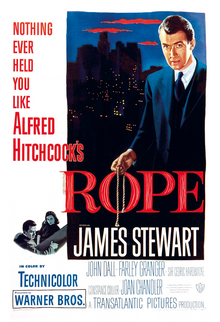
"Rope" - Film Review

Alfred Hitchcock always seemed to use every one of his movies to explore something different with the film medium. Nowhere was this ever more apparent than in Rope.

Rope is shot entirely long takes; it’s intended to make us believe the film is shot in one continuous shot, but there are some fairly obvious (occasionally awkward) cuts where the camera bumps into an object or the back of a person. None the less, these shots go until the camera reel runs out of film and thus many of these shots must have required impressive and lengthy staging.   

There’s a high level of theatricality; large portions of the film feel like an experimental play. Hitchcock finds interesting ways to make use of the limited space which only takes place in a compact apartment.

Based on the play of the same name by Patrick Hamilton, Rope tells the story of Brandon Shaw and Phillip Morgan (John Dall and Farley Granger) who kill their former classmate David Kently as a form of intellectual exercise. They then hold a party using the chest David resides in as a serving table, inviting guests close to David (including his father (Sir Cedric Hardwicke) and his fiancĂ© (Joan Chandler)). They (particularly Brandon) find a weird, sick pleasure out of the excitement of trying to get away with being caught. Phillip, however, often seems to have been unwittingly drawn into the scheme and grows increasingly nervous as the night wears on. 

Though Jimmy Stewart is top billed as their prep school housemaster Rupert Cadell, the film is really a showcase for the talents of Dall and Granger. Dall is unimaginably slimy as he plays up the virtues of killing someone, and Granger plays off Dall’s beguiling straight charm quite well with his sweaty flustered anxiety. Stewart plays against typecast of the goodnatured everyman; it’s slightly bizarre to see him praise the notion of killing someone with his usual amiable drawl. However, Stewart does a fine job even if he doesn’t seem the best suited person for the role at times. 

Though perhaps unnecessarily experimental, especially for this subject matter, it’s still a fascinating story with strong performances.

Grade: A-

Saturday, February 9, 2013

"Dead Snow" - Film Review

Nazis Zombies? NAZI ZOMBIES?! Yes, Nazi freakin’ zombies…

Now that we have that out of the way, Dead Snow is a horror comedy about a group of friends who travel up to an isolated, snowbound cabin. This cabin just happens to be located near the site of a gruesome Nazi burial site. And hence the film’s central gimmick: Nazi Zombies. 

Dead Snow is a concept movie. Concept movies live or die by their big central idea, which may be cool on paper but can fail disastrously when put to screen. 

Dead Snow avoids the pratfalls of the hokieness of its overlying premise, by doubling down. Yes, Nazi zombies are an almost stupidly ridiculous concept. It combines two of film's most notorious villains. But once you get past the initial intriguing-ness of this pitch, what else is there to tell?

Well, it’s to the credit of writer and director Tommy Wirkola that the film moves past its initial premise and succeeds by playing up its excesses to the extreme. 

Dead Snow is frequently scary. But it’s even more frequently hilarious. There’s a massive shock value inherent in the film going over the top at every turn. There are some wondrously disgusting scenes that have a feeling of gleeful reckless abandon. The special effects and the use of gore are used to drench the pure white snow with buckets upon buckets of blood. 

This isn’t the best film, or even the best horror movie. But it’s incredibly entertaining. 

Grade: B-

Friday, February 8, 2013

The Vampire Diaries - "Into the Wild" - Review

Ultimately one of the reasons that we lose interest in a show is because we can predict what’s going to happen. We’re taught the structures and patterns by which it’s going tell us its stories. And by the third or fourth season if a show isn’t continuing to be ambitious and bold, it’s probably going to peak and will either coast or decline.

There’s an added layer to this with The Vampire Diaries. Part of its fundamental nature is the fact that it thrives on constant cliffhangers and twists. It tries to shock us regularly. And when it does, it achieves it almost unlike any other series out there. But when it fails, it just feels like good old Vampire Diaries trying to scare and surprise us. How quaint!

The show would be finding itself saddled with this problem even if it weren’t having significant plotting problems this season.  But it’s an added element playing against the show. There remains to be scenes and moments that are great. But holistically episodes have been leaving a lot to be desired.  Part of that problem has to be chalked up to ineffective cliff hangers, i.e. cliff hangers that are easily overturned or don’t advance the plot.  

Very few scenes or sequences of late have truly made me go OH MY GOD! The stakes just don’t feel nearly as high. There’s not a single character who feels like they’re fair game to die anymore. I still remember when Jenna died at the end of the second season that that was a death I never expected and it was shocking, emotional, and a great plot decision. With vampires, werewolves, hybrids, and witches running amuck, people should at least feel like they could die at any moment. But this sense of hanging dread that anyone could die at any moment doesn’t exist. When Bonnie and Jeremy get taken as hostages by Shane at episodes end, it just feels like the series saying “Okay, what big cliffhanger can we leave it on this time?”

The only scene that completely took me unexpectedly was Klaus attacking Caroline. Klaus is so deeply in love with her that it’s not something I didn’t anticipate. It makes sense that he would do it out of frustration and anger, and it’s pretty inspired that he creates a situation in which he’s the only one that can save her. But Caroline has been around for so long that she’s become a mainstay of the series (and one of its best characters). 

Not only did it take me by surprise, but it leads to the great scene between Klaus and Caroline, and it’s played so well by both Joseph Morgan and Candice Accola. When Caroline starts talking about the good she sees in Klaus, it doesn’t strike me as being entirely a lie to save herself; she seems to, on some level, truly feel sympathy for him, but, the other hand, she still can’t overlook all the awful things Klaus done. Caroline is such a sincere and good natured person that the gesture is just her being her typically honest self.

Now why Caroline and Tyler weren’t included on the excursion to find the cure, I’m not entirely sure other than for the desire to create a subplot. Though the storyline feels really disconnected from the A-plot, it’s still interesting enough that it’s not a distraction. The scenes between Tyler and Klaus are also great. Watch as they have an angry stare off that ends with the great Klaus line, “Let me tell you, your mother was a fighter”.  Equally well done is the scene where Tyler begs for Caroline’s life, offering up himself in order to save her. 

Elsewhere, we finally got some necessary backstory on Shane and his whole deal. Shane’s addition to the story, much like April’s, has never felt well-integrated. He’s been more of a plot device than a real person. Sure, he’s mentioned that wife and son of his before, but we never really got a good sense of what made him so obsessive about finding Silas and the cure. Here we’re given some flashbacks that don’t necessarily provide as much information as they probably ought to but fill in some gaps of information.

And, lastly in Love Triangle News: I’m not sure what’s going on with Elena and Damon anymore at this point. It could have been potentially very interesting to confront whether Damon wants to take the cure or not and what that means for the relationship, but it gets annoyingly, overly melodramatic and lacks nuance. The show should settle on this love triangle thing for at least a little while; it was intriguing earlier in the series and the writers have handled it well in the past but ever since the sire bond twist, the show has consistently been murky on the matter. 

Murky is an apt word for this episode in general. This is an episode too hesitant to know what it wants to be, and filled with too much stalling that is so very clearly stalling. 

Stray Observations:
-The whole deal with the Native Americans on the island was a little strange.
-May be it was just the setting, but much of the scenes in “Novia Scotia” felt very awkwardly shot.
-“It’s all an act. Being a vampire is miserable” - The Rebekkah-Steffan's scenes are great though. Rebekkah becomes a better and better character with each episodes. Her explanations for her unhappiness and desire for the cure are very revealing.
-“If I took the cure it wouldn’t be for her, it would be for me”
-Damon hasn’t gotten to torture anyone in a while. Not sure what it says about me that I find these scenes to usually be pretty entertaining.
-“I’ve caught myself wishing I could forget all the terrible things you’ve done”

Grade: C+

Thursday, February 7, 2013

The Office - "Couples Discount" - Review


I had pretty much forgotten Andy existed until he returned in tonight’s episode. I’m also entirely indifferent to his return. Andy has become such a broad character that I don’t really care about him anymore. It was sweet when he was courting Erin. But now I’m far more interested in Erin and Pete as a pairing. 

Andy’s return is just strange. He looks like a Rastafarian and apparently smells like he’s homeless. Not to mention the fact he’s been gone for 3 months. The whole thing feels like an afterthought. He doesn’t return until the episode does a whole brief plot about the office workers getting their nails done (a storyline that could have been a full episode's plot if the writers wanted it to be but is probably better off not going any longer). By which point there’s not much to really to do with him. He loses a major account and pisses everyone off, which leads to him getting duped by his co-workers into believing they’ve started doing some crazy things while he’s been away, my favorite being Phyllis’s suggestion that they’ve been selling balloons.  

However, this does lead to the episode’s best scene where Erin breaks up with him while he’s on a conference call with David Wallace. Having been talked out of breaking up earlier, seeing her run up and tell him off was nice to see (and also  hilarious).

Though I’m baffled by the point of Brian being introduced (this doesn’t seem to be going anywhere to justify his introduction), it does lead to a surprisingly sweet moment where Pam tells Jim not to go to Philly, “I want us to have a fight” (a line that sounds very weird out of context, and doesn’t stick as well as I feel the writers intended it to, but it’s still touching).

Grade: B-