Saturday, January 19, 2013

"Dial M for Murder" - Film Review

In the pre-Easy Rider days of Hollywood, there was a rather simple formula for making a film. You wrote a script, you got some actors, and you had those actors read the dialogue on a pre-built sound stage. The strength of a movie for the most part was determined by the strength of a film’s script and the strength of the acting abilities of those people reciting the dialogue. In those early days, movies had much in common with theater; certain movies added spectacle and grandeur (i.e. Thief of Bagdad or Ben-Hur), but besides these (which were impressive: 1960’s Spartacus had battle scenes with hundreds even thousands of people who were actually real people filmed; there was no CGI, no digital trickery. If you wanted to do something massive and sprawling, it took a lot more serious consideration of how you would pull it off), there was mainly more grounded and practical films. The leading men were in a well-tailored suit; the leading ladies in a dashing dress; the dialogue was whip-smart and sharp (at its best) and the actors acted like their lives depended on it. This is on one level me being sarcastic, but if you actually look at a lot of the films from the 1930’s through the 1960’s (and the successful, well-lauded ones at that), so much of what makes them work is the ability of the scripts and the actors (and the staging by the director) to draw you in. There’s no special effects trying to blow your mind, and there didn’t need to be.

This brings us to one of the earliest of auteurs Alfred Hitchcock, the infamous director of Dial M for Murder. Hitchcock has been dubbed time and again the “master of suspense”. He made movies that were intense, and thrilling that took hold of you and drew you in as if mesmerized by a hypnotist. There were more high concept conceits in his canon: The Birds is thrilling, but at times a bizarrely handled horror flick; North by Northwest is an odd case of mistaken identity meets spy thriller. But a lot of his films were fairly straightforward once you got past the thriller or mystery elements of them. For example, when you get down to it, Rebecca is primarily a movie about a newly married woman dealing with living in the shadow of her husband’s former deceased wife. 

Not a great deal happens in Dial M for Murder when it comes down to it. Tony Wendice (Ray Milland) discovers his wife (the always charming and stunning Grace Kelly doing a surprisingly convincing British lilt) has been cheating on him and so he decides to have her murdered. He blackmails C.A. Swann, a man he went to college with, in order to kill her. The film spends a good deal of time building towards the climactic “murder” of the title and then a fair amount more portraying the consequences. In the expertly capable hands of Hitchcock the twists and turns are drawn out to great effect. The murder scene itself has wonderful editing and cinematography; the use of shadows and light to heighten the intensity is brilliant. But Hitchcock’s expertise can also be seen in less prominent scenes such as when Wendice blackmails Swann or when he tampers with the scene of the crime; these scenes are shot with the intention of maximum engagingness and intensity. We are left to wonder how Wendice is going to get away with his crimes at every turn and it’s to the credit of Hitchcock that we’re so invested to begin with. 

Fine acting from a tremendous cast (Robert Cummings and John Williams are also rather good as Mark Halliday and Chief Inspector Hubbard, respectively), a great script by Frederick Knotts (who adapted it from his own play of the same name – there’s plenty of really superb classic films that are adaptations from theatrical productions), and typically brilliant direction by the inimitable Alfred Hitchcock make Dial M for Murder an unequivocal example of classic Hollywood thriller at its best.

Grade: A-

Friday, January 18, 2013

30 Rock - "Florida" - Review

30 Rock is going out on top form. Jack is on his way to being CEO of Kabletown and confronting the death of his mother (which turns out to be more complicated than he anticipated). Liz is now married and looking to adopt kids (a brother and sister as the end of the episode would have us believe). And the show in the form of its B-plot appears to have established the end game for how the show plans to go out: a law suit brought upon the show by batshit crazy Hazel has TGS canceled with only one more episode left to air. It’s all very satisfying, funny narratives that deal with major aspects of the lives of our two main characters across the 7 seasons.

Jack goes to Florida with Liz (who joins him fearing she’s not spontaneous enough) to see the in-home nurse Martha who took care of his mother. Turns out she had a secret lesbian relationship with his mother. Liz keeps pushing him to accept it, and Jack finally breaks. He’s discovered that his mother was in fact very happy (a shocking revelation for him), and that her last words to him telling him to be happy weren’t spoken out of mockery but rather out of concern. (Is Jack Donaghy actually happy with all the success, power, and prestige he’s accumulated? Are we to see him make a change in his life in these last few episodes?)  

The best part of this story is a scene where Liz and Jack are forced to share a bed, and Liz broaches the subject that’s crossed most our minds: why haven’t the two ever dated or at least hooked up? Martha even points out how they bicker and argue like a married couple. Liz acknowledges that obviously it’d be weird and tawdry if they ever did but that it’s peculiar how it’s never crossed her mind. The relationship is at the heart of the show, and the series’ willingness to examine it and many of the core foundations of the show up to this point have been great. We know there’s no sexual tension there; it’s a mentor-mentee relation, but if this sort of thing were to happen in real, you’d have to imagine it would be hard for there to be no sexual tension or awkwardness on some level. There was in fact an episode (Season 5’s “Gentleman's Intermission”) where Jack’s former wife Avery Jessup is fearful of their closeness. 

(In a story who's only real purpose is to set up the final story arc of the series) Back at TGS, Tracy and Jenna are oddly enough left in charge of overseeing everything. They make Kenneth sign an affidavit swearing against Hazel’s claims, but he doesn’t feel comfortable and it leads to him descending into a bizarre Fonzie caricature. The two of them feel bad and have Kenneth admit the truth to legal, which imperils TGS just in time for the last three episodes. 

Stray Observations:

-“The last time I said ‘good news’ was when I taught my pets ‘News’ the meaning of Christmas”
-Florida Emergency Services include aid for: anacondas in pipes, Indian bones in the sink, and being unable to find JAG on tv.
-Hazel’s real name is “Richard Drench”
-“Let me show you some hospitality. This is Florida. Let me boil you a bottle of Gatorade. Is blue good for you?”
-“You’re kind of a slut” “I did sleep a lot with Jenna during season 3”
-“You’re allowing Tracey Jordan to criticize your life choices?” – Cut to Tracey and Jenna holding a door to stop an avalanche of oranges.
-I've never been a fan of Hazel which is a shame because I like Kristen Schaal in everything else she does.

Grade: B

What did everyone else think?

Parks and Recreation - "Two Parties" - Review

Most series are burnt out by their 5th season. Not Parks and Rec though. The series is on the top of its creative game. It’s such a treat to stop in on Pawnee, Indiana and the great characters that inhabit it. They’re such deeply likable, fully realized individuals who you never doubt for a second care for one another.

Last night’s episode had the series at its best with Leslie and Ben’s bachelor parties. 

Leslie is as always obsessed with work though, and can’t focus on her Abraham Lincoln stripper, specially gotten for her. Paunch Burger intends to steal the plot of land Leslie and April had hoped to build a new park on. Leslie buries Native American artifacts there, but then retracts on the idea, and becomes desperate to dig them back up to make up for the mistake. Her bachelorette party finds her, Anne, and April failing to dig them back out (with Donna sitting watching). However, once the artifacts are discovered, Ken Hotate, leader of the local Wamapoke tribe, sides with Leslie, seeing how good of a person she is. 

Ben’s bachelor party starts out as a board game night, but soon turns into all the guys making up for all their lack of bachelor parties for their own marriages (Andy’s marriage was spontaneous, Tom’s was a greencard marriage, Garry was getting an appendectomy, and Tammy 2 called in a bomb threat). Each one of them is given an event to celebrate: they go get ice cream for Gary, Tom takes them to a strange, fancy bar, Andy is taken to the Colts’ football stadium to see players, and Ron takes them to a steakhouse. All the guys afterwards assure Chris, the only one never to be married, that someday he’ll find someone, and in the end Ben sets him up with news reporter Shauna Malwae-Tweep, who appears to be looking for happiness and friendship as much as he is (if her enthusiasm about writing about the bachelor party is any sign). 

These characters really do feel like they care about one another, and despite how very different they are and how unlikely it seems that this oddball group would ever come together, they continue to come together time and again for one another. If they didn’t, the show wouldn’t work. The series is about the underdog winning and people getting what they want; it’s built into the DNA of the show. The series is as enthusiastic, heartfelt, and happy-go-lucky as Leslie is, and it would feel wrong to have it any other way. It knows its characters like the back of its hands, and this episode gives every single one of them a moment to shine. It’s funny and sincere and nicely observed.

I’m smiling just thinking about it. The series is so utterly charming and pleasing, and it doesn’t even have to try hard to achieve that. 

Stray Observations:

-The episode gets a lot out of the Native American jokes: “Water… like firewater … not but seriously can I get some whiskey?”; Leslie points to a censored image of atrocities: “Our relationship with the Wamapoke in the past has been … murdery”
-“Our slots are downright filthy”
-“That’s why I’m stress eating gummy penises”
-Ben’s idea of a perfect night: beer and boardgames. Game of choice: Settlers of Catan.
-Paunch Burger’s slogan on its billboard: “Start drooling, fatties”
-“Things magazine says it’s gonna be the next big thing”
-“Son, there’s no wrong way to consume alcohol” Next scene: “This is the wrong way to consume alcohol”
-The girls use cowboy hats with penises on top to dig up the artifacts.
-“Babe Lincoln”: “Come emancipate this lap!”, “The Gettysburg Undress”
-“I didn’t have time to shower before or after … for like a week and a half” – Adam Scott’s expression after is priceless
-The ice cream place has a backup cone prepared for Gary because he tends to drop his ice cream about half the time.
-The image of the ice cream on Ron’s moustache is perhaps the greatest thing I’ve ever seen.
-Newt Gingrich cameo! - Man they've had some awesome cameos this season.
-“I’m going to be candid with all of you: I like her” – Woe! That’s the most open I think we’ve ever seen Swanson.
-“No Muslim stuff. No Jewish stuff. None of that stuff from those weird countries”
-“Don’t try to bond with me”
-“I believe we left Gary back at the gas station in Martinsville”
-“Was that a threat” “Why yes, I thought that was obvious”

Grade: A

What did everyone else think?

The Office - "Suit Warehouse" - Review


If The Office were a series in its first season right now, people might be commenting how this was a decent show that was on its way to finding its footing. Nothing about this season has been completely terrible. There have been definite lows, questionable plot decisions, and stretches that aren’t terribly funny. But there are absolutely worse things out there on tv. However, there’s something about a show that was formerly great that no longer is that’s far more frustrating and bothersome than a show that’s always been bad or has always simply coasted. So why do we stick with shows until the bitter end despite having lost a significant interest in it?

I personally dropped out early on last season, which had the series at a new low, but returned upon the advice of fans of the series who said it picked up a bit in the second half. And there are some decent outings in the 8th season such as “Trivia” which was far funnier than anything up to that point that season, and there’s the great Jim and Dwight moment in “Last Day in Florida” where Jim stops Dwight from taking credit for the Sabre store plans, and thus saves his job. But these episodes don’t compare to all time classic Office episodes such as season 1’s “Diversity Day” (which elevated the creative level of the series and solidified the premise of the show) or Season 2’s “Office Olympics” (which demonstrates what the show was at its best: people finding ways to avoid boredom at their job).

So when I lay it on hard on this series, it’s because I know and you do too that this show is capable of so, so much more. 

Now, “Suit Warehouse” is definitely a step up from last week’s “Lice”. Jim is better integrated into the narrative, and despite how broad, cartoonish, and even slightly outlandish the effects of the espresso are on the characters, it’s still very funny and far more grounded than the lice or the work bus or Andy sailing off into the sunset.  

Clark returns from being Jan’s sexual assistant (something I’d totally forgotten about), and is enlisted by Dwight to help land a father-son company. They pose as father and son and prove weirdly well-suited as a duo. To me though, this was the least interesting and funny of the stories. We know next to nothing about Clark, and Dwight is too weird of a character to carry the story.

It’s not the worst work the series has done, but neither is it its best.

Stray Observations:

-“Jim was the closeted brother with a foot fetish … well, they never knew that. But I did” –The cold open where Dwight recounts his sales trips with Jim is oddly  touching.
-Meredith and her ill-fitting wig is a great sight gag.
-“If it leads to me being a salesman, I’ll even be your friend”
-Oscar enthusiastically yells “YOLO” and everyone disapproves.
-Angela puts a napkin on top of all the hands before putting her hand on top of all them. Nice character beat.
-Kevin had a great episode: Lifting up Angela while on espresso was hilarious. As was him telling a scatterbrained Erin that she’s gunning for Pam’s job.
-Pam and Darryl returning to find the office’s carpet all torn up was great.

Grade: B-

What did everyone else think?

Archer - "Fugues and Riffs" - Review


Archer could have chugged along as a better than average spy spoof, but as the series went on it became something more. The dialogue became sharper, the cast deepened and expanded, and the scenarios became increasingly more outlandish and absurd. Carried by some of the best voice acting on television, Archer became one of tv’s best animated series, and arguably one of its best comedies.

Few series could get away with the totally bizarre premise of “Fugues and Riffs”. H. Jon Benjamin who voices Archer, also voices Bob Belcher from another very different animated series Bob’s Burgers. Benjamin’s inimitable voice work doesn’t change too much from one show to the next and fans have commented on just how similar, when you get down to it, all his performances are. So Archer goes undercover as Bob and loses his memory of ever being Archer. When KGB spies track him down and try to kill him, he flees the restaurant to protect what he believes to be his family (the way they translate the Belchers to the very different animated style of Archer is a thing of beauty).

Meanwhile back at ISIS, the rest of the spy organization is scrambling to find and deal with the consequences of Archer forgetting who he is. The series gets away with how totally implausible and weird the plot is by just running with it, accepting that it doesn’t make sense but acting as if the audience honestly won’t care. One explanation after another is quickly given to us until mad scientist Krieger describes to us how Archer must be in a fugue state that needs to be delicately handled. 

Everyone follows Archer to the hotel he’s shacked up in, in order to jog his memory. Lana befriends him, and Cyril and Krieger pretend to be KGB chasing him. But then real KGB pop up and complicate the whole matter. And it quickly devolves into a ridiculous fight sequence by the pool with everyone yelling at one another. 

This may just be the show’s most awesomely crazy scenario yet (and that’s saying something for a show that sent its cast into space). While there’s probably a tad too much set up to get to the meat of the story and that leads to less jokes than usual, it’s uniquely, strangely, darkly comical.

Stray Observations:

-John Roberts’ Linda Belcher gets in some good lines for her brief appearance: “Were you speaking Russian?”, “When you gamble?”
-“Ostrich. They’re good. Shut up!” – Somehow I always buy into Cheryl’s quirks no matter how flat out odd they are.
-“Said the fake doctor” “What are your parents’ names?” –Krieger and Cyril’s fighting prove to be some of the episodes funniest lines.
-Also: “His mind-brain is rejecting his real identity” “Mind-brain? That’s a real thing?”
-“Have you ever met anyone less damsely?” “Pam”
-“Sour mix in a margarita? What is this Auschwitz?”
-“Oh, why don’t you just join a support group?” “What for crippled gay hillbilly spies?”
-“You hate everyone at work” “That’s what gets me up in the morning”

Grade: B+

What did everyone else think?

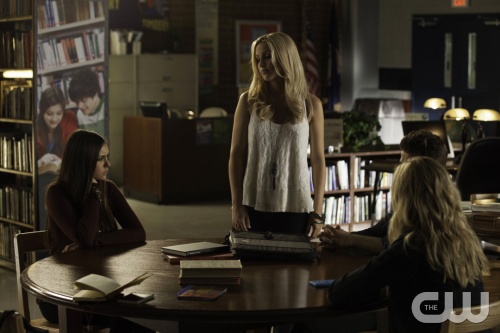
The Vampire Diaries - "After School Special" - Review


The Vampire Diaries is the type of series that’s twist and turns if done improperly could take it off the rails. This season has been heading back into guilty pleasure territory with the sire bond and vampire cure stuff. Having Elena sired to Damon is frustrating and infuriating and feels like bad writing; it seems to completely take the decision out of Elena’s hands. The vampire cure on the other hand comes off as an all too convenient way to retcon things back to status quo, which is a shame because the show has been great at demonstrating good, believable character evolution (Look at how much characters like Tyler, Caroline, and Damon have changed over the course of the series).

As bad of a plot decisions as I initially found them to be though, the writers have dealt with them incredibly well. The sire-bonding has thrown into examination the love triangle in a surprising way. “O Come All Ye Faithful” brought out an interesting side of Damon, who finally having what he wanted still struggled to do the right thing because Elena’s love still may not be real. Here the Stefan-Elena side of the question is put into focus thanks to a conniving Rebekah. Brought back to life by the most useless character April, who now finds herself relevant to the plot finally, Rebekah feeds on April’s desire for the truth to get what she wants. She brings Caroline, Elena, and Stefan to the school and compels them to ask her questions. She mainly wants to know the deets on the vampire cure, but she’s not beneath fucking with them while she’s at it. We finally get the answers we want about what’s what here, and though it’s based on prior information about what we knew about Elena’s feelings towards each side of the triangle, the shift towards Damon does feel SUDDEN (Is this meant as an excuse to get Stefan and Elena back together when the cure is found?). Totally helpless, Elena reveals that she feels like she’s merely Stefan’s “project” and that to him she needs to be “fixed” like a “broken toy”. She may still “love” Stefan, but she’s not “in love” with him anymore.

The vampire cure has suddenly given everyone purpose. Everyone and their mother wants it. Klaus wants it to keep making his hybrid army. Stefan, Damon, and Jeremy want it so, for various reasons, they can cure Elena. Rebekah wants it to cure herself. Shane wants it so he can unearth that crazy beast Silas (Next season’s villain?).

Bonnie has never really worked as a character. Too many times she’s been at odds with our protagonists, and for questionable reasons. Now here she is being manipulated by Shane to use “expression” (I don’t care how desperate you are for magic. How do you not get suspicious when you’re sessions entail you falling asleep for multiple hours while the guy roots around in your mind?! You barely know him!). She goes out of her way to use a protection spell on him, but the “expression” magic leads to April being linked to Shane, and her nearly dying. Bonnie ends up swearing off this “expression” stuff, but since a Bennett witch is required to use this kind of magic to get the cure, I doubt that’s going to last long.

Jeremy’s training to control himself while hunting vampires is a slow moving process. Too slow for Klaus anyway, who by episode’s end has created a new batch of vampires to speed up the process of revealing the tattoo map. And Damon is cool with it now because Elena has admitted that she’s in love with him. This story didn’t work for me. It was too disconnected from all the rest of the action, and not much happened other than a pizza delivery girl turned vamp attacking Jeremy and Matt, which felt clumsy and pointless. The plot was too shoehorned into the narrative (they probably could have just set it aside for the episode, but that would mean Damon wouldn’t be in the picture and that would be impossible with the love triangle stuff at the forefront).

The episode was mainly an excuse for the writers to deal with the love triangle head on. “What does this have to do with the cure?” an ever defiant Caroline asks after a heated, personal line of questioning from Rebekah. Rebekah would be angered enough to just twist the emotional knots in Stefan (who daggered her last episode) and Elena, and so it lends the right amount of justification to have a character ask what’s all been on our minds. That’s good, smart writing that puts everything into sharper focus. Otherwise this is typical, boilerplate Vampire Diaries tightly written and edited, intense, and fun.

Stray Observations:
-April has been tacked on in a really awkward way. Connecting her to the pastor was a good idea, but the writers never followed through with it. And so she’ just sort of been there with no real purpose or point.
-Oh, and we finally meet Bonnie’s dad Rudy Owens who is Interim Mayor in the wake of the death of Mayor Lockwood.
-Speaking of the Lockwoods: Tyler is compelled to turn by Rebekah to imperil everyone else. And he never thought he’d have to again! At least, he has Caroline to comfort him afterwards.
-“Both of which require you to be alive. That’s why I’m updating our relationship status to ‘It’s complicated’”
-Damon shoots Klaus for killing Carole Lockwood. *slow claps*For all you Damon haters out there: HE’S TOTALLY NOBLE!
-Kol returns as well, and he kidnaps Shane, but otherwise he’s mostly perfunctory.
-“Being with Damon makes me happy” “Oh come on! Clowns make you happy!”
-As poorly done as the pizza girl sequence was, her initial failure to gain entry until Jeremy (the owner of the home) asked her in was a nice piece of writing and a good callback.

Grade: B+

What did everyone else think?

"Battle Royale" - Film Review


Consider for a moment how many movies and tv shows feature a gun. Now consider how often when a gun (in the Chekhov-ian fashion) is then used to kill someone or least harms them. It’s substantial, but critics of pop culture’s effects on gun violence in the country miss the point. Gun violence’s excessive depiction isn’t the cause of all that gun violence in real life, but that doesn’t mean it’s not troubling. The more rape, murder, violence, etc. we show on tv, the darker and bleaker the world seems. Studies have shown that people who watch more hours of tv tend to find the world a scarier and more harmful place.

It becomes harder to justify violence when there’s simply no point to having it. Violence and gunplay in pop culture shouldn’t be there simply because c’est la vie. But rather, they should be there to make a statement about the nature of violence or some other worthy subject matter. 

All this is a longwinded way of saying: Battle Royale is pretty fucking violent. The film takes a gleefully sardonic, darkly humorous approach to watching 40 kids murder eachother Hunger Games style.

The film is highly self-aware of the absurdity of its premise of a dystopic death match staged by the Japanese government, and it spends very little time establishing its premise and more time throwing the kids right into this mess most of them never wished to be part of. Drugged on a field trip, the middle schoolers are shipped off to a deserted island, attached with tracking collars (that explode when taken off), and are informed they’re to fight to the death. 

The goofy, tongue-in-cheek, graphics-filled training video explains the nature of the games; they’ll be assigned a backpack with food, water, a map of the island, and a randomized weapon (ranging from guns and knives to stranger things such as crossbows, tasers, and a GPS tracking device). Within the next 3 days, if someone hasn’t killed everyone else off, they all die. Two “transfer students” have also been brought in to make things more interesting, including level-headed loner Shogo Kawada (Taro Yamamoto) who’s been forced to return to the game and the villainous, sadistic Kuzuo Kiriyama (Masanobu Ando) who’s joined for the fun of it.  Their former teacher turned douchey rogue villain Kitano (Takeshi Kitano) lords over the game, announcing when different regions of the island have been made off limits.

Our ostensible protagonists are Shuya Nanahara (Tatsuya Fujiwara) and Noriko Nakagawa (Aki Maeda), who, after watching their best friends die early in the game, team up to try and survive. And, by all logic, it’s impressive that they do. Early in the film, the story feels like a string of vignettes of people fighting and killing eachother in inventive and bloody ways. If it weren’t so stylishly shot and the premise weren’t stretching plausibility to begin with, the film might have become plain disturbing or silly or bizarre. However, it stays just on the right side of crazy. Unlike films such as much of the Saw franchise or Hostel which feature a torturous, almost obscene level of violence and blood at the expense of their characters, the film’s violence never feels pointless and is never used merely to provoke.

This is a bloody, bizarre, stylish rumpus that’s massively entertaining but not lacking in smarts. 

Grade: B+